bayeslaw
Re:The bridge to wealth is being pulled up with AI
on Tuesday March 24, 2026 @02:58PM (#47507494)
Thanks for the detailed reply, really appreciate it!
Re post agi world and coefficients: yupp totally agree. This isn't proper modelling. I just wanted something I can play around with to test my intuitions.
Re Jevons: ok let's say that latent demand is freed up. It's bounded by human purchasing power and the rate at which humans can actually consume the output.
Re programmer jobs, point taken, thanks for the clarification, I'll actually look this up properly. However there is other evidence suggesting that not all is well either https://digitaleconomy.stanford.edu/app/uploads/2025/11/Cana...
Thanks again for reading!
Re:The bridge to wealth is being pulled up with AI
on Tuesday March 24, 2026 @02:36PM (#47507176)
Hey thanks for reading and for leaving a considered comment. You might be right, we'll see. In my mind, GDP growing isn't really that reassuring:
1/ GDP has been growing steadily while people's happiness and overall satisfaction is flat lined or finishing (so even if this was true it won't lead to better lives lived at scale)
2/ it's more interesting to look at the ratio of labour wages / GDP. I actually make a prediction about this and that has been shrinking already. If it continues (which I think it will) even if everything grows ppl will be unhappy and unsatisfied bc a large part of our self worth is coming from comparing ourselves w the ppl around us in the wider society. This is why more equal societies tend to be happier as well.
Re:The bridge to wealth is being pulled up with AI
on Tuesday March 24, 2026 @02:28PM (#47507059)
Finally a useful comment. Thank you :D
Re:The bridge to wealth is being pulled up with AI
on Tuesday March 24, 2026 @02:27PM (#47507042)
Fair point on the rhetoric: "no regression, no noise, just compounding" overstates it a bit. Individual family wealth does dissipate across generations. The model actually reflects this: η=0.85 inheritance fraction, threshold gating that blocks compounding below ~$20k, and a residual term that captures the noise and bad luck - which your sources are measuring.
The stronger claim of the essa is different from "any given dynasty compounds forever." It's Piketty's r > g: capital returns have systematically outpaced economic growth, so the wealth class maintains and grows its share even as specific families within it churn.
Re:The bridge to wealth is being pulled up with AI
on Tuesday March 24, 2026 @02:20PM (#47506935)
Cool, I'm a scientist too w a PhD and everything, I just don't make a big deal out of it - unlike you it seems. Granted, distributions don't get multiplied, random variables do. Funnily enough the essay's actual model (log(Y) = 0.35·zIQ + 0.45·zW + ...) is additive in log space, which is multiplicative in outcome space. The preface language is loose I grant you that but the formal model that appears later is well defined. Not sure what you want to say with a 2d histogram. We are modelling, not visualizing.
Re:The bridge to wealth is being pulled up with AI
on Tuesday March 24, 2026 @01:09PM (#47505907)
Hey HN, author here.
Thanks a ton for the comments, really appreciate it.
It seems like a few of you haven't really read the piece before forming your opinion on it, which is understandable, it's super long. So here's a short version:
https://danielhomola.com/m%20&%20e/ai/your-bridge-to-wealth-...
Re the LLM accusations: it's true that I let Claude and Gemini suggest and streamline passages. It's a long piece of text and I was struggling with the tone of it (it touches on biology, stats, history sociology and ends w a letter to my kids) - it was hard to keep it coherent and stylistically cohesive. However saying this is AI slop is absurd. I'll just leave it at that.
I'll try to reply to some of the criticism individually.
Thanks again!
Re:
on Tuesday March 24, 2026 @09:23AM (#47502229)
or two centuries, the credential system gave intelligence a route to heritable capital. Artificial intelligence is closing that route. This essay builds the argument from first principles - with probability theory, interactive simulations, and a prediction specific enough to be falsifiable - and puts a number on the window that remains.
Re:GenAI turned producing $1M videos into $100 and dead easy
on Tuesday January 13, 2026 @03:51PM (#46607762)
Ok maybe I'm off by an order of magnitude. That's still 3 orders of magnitude of cheaper.
Re:GenAI turned producing $1M videos into $100 and dead easy
on Tuesday January 13, 2026 @01:53PM (#46605829)
I'm an ML engineer/founder and I'm frankly amazed what has happened to the promo/intro video industry.. A few years ago this video that I just made in about 2 days would have required serious funding and whole group of 3D artists, cinama crew, voice actors..
Forget what the video is about. Focus on the fact that I - a non-pro - made this in 2 days for $100.
What will this do to dozens and dozens of jobs?
On the one hand I never felt more empowered as a bootstrapper, on the otherhand it doesn't taka a lot of thinking and foresight to start to fear my demise as a builder, coder, ML engineer.
How are you doing in 2026? Do you have friends who already lost their jobs?
Re:Ask HN: Would you pay for a privacy-first social platform?
on Saturday January 10, 2026 @02:57PM (#46569335)
Asked this here 2 years ago. Answer is: no
Ask HN: How do you pick side projects?
Now that Claude et al practically made building anything and greenfield projects in particular 100x faster start l, how do you pick side projects?Do you pick more ambitious ones? Do you try crazy things that you wouldn't have dared before? Do you try all sorts of different ones in parallel? Do you pursue projects that can make you money? If so, do you ever validate or jump straight in?
The equation of making money changed forever in 2026
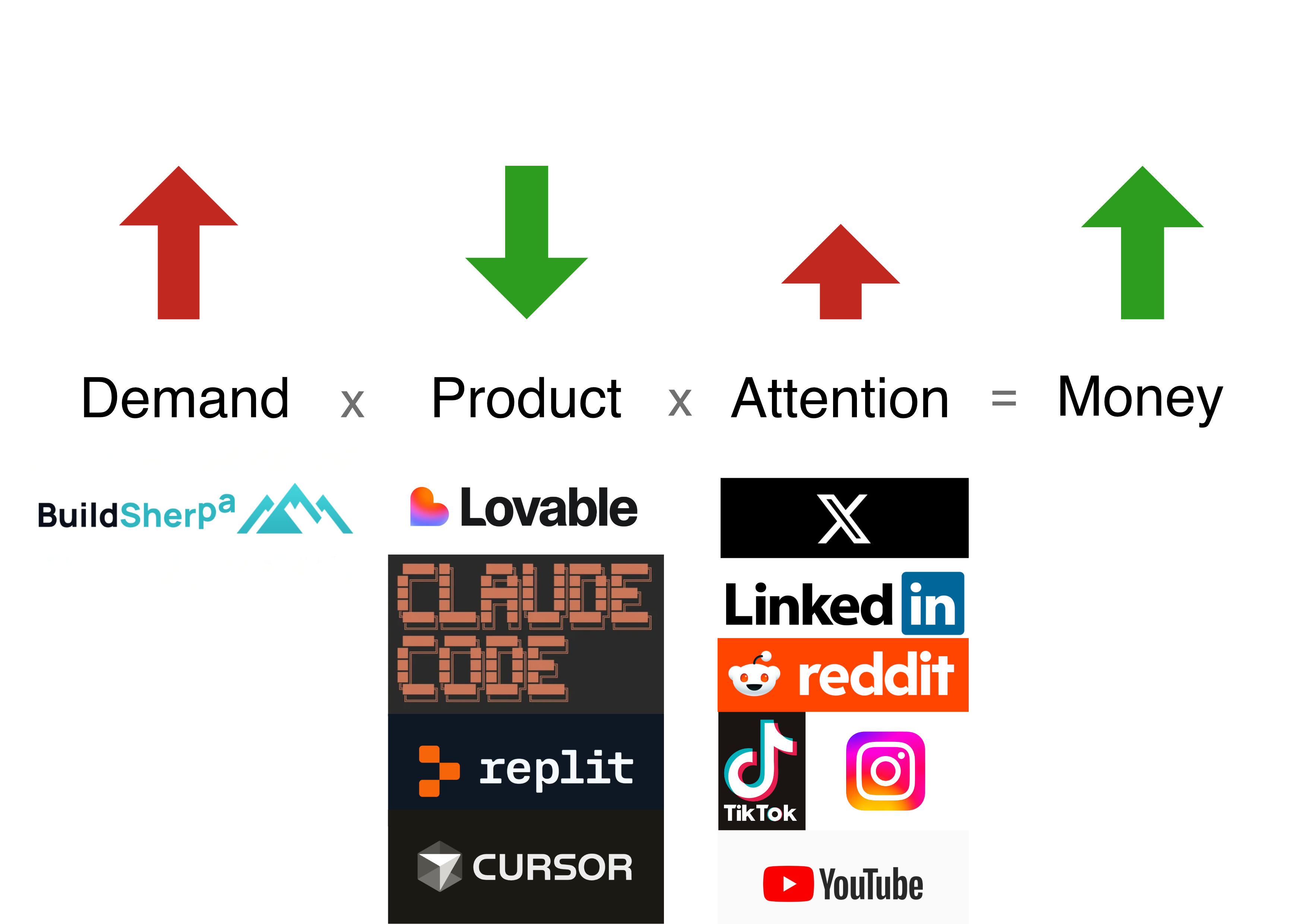
Re:The equation of making money changed forever in 2026
on Thursday January 08, 2026 @09:24AM (#46541317)
The equation for making money with software changed forever in 2026.
But not the way you think. And not the way everyone says.
Everyone's celebrating that AI made building cheap. They're missing what it made expensive.
The equation was always: Demand × Product × Attention = Money
Here's what actually changed: Product collapsed to near-zero. Lovable ships MVPs in 2 hours. Cursor writes your backend in 30 minutes. Claude Code generates entire stacks. Building went from $50K and 6 months to $500 and 6 hours.
Incredible. Genuinely world-changing. So naturaly, billions are pouring into the AI application layer. The opportunity is massive and real.
But here's the part nobody's talking about: Demand got a lot harder. Not easier. HARDER.
Why? Because anyone can build an MVP now and everybody does. But the pool of good ideas didn't grow. The number of people chasing them grew 100x overnight.
Attention became nearly impossible. Thousands of new apps launch daily. Your customers are buried in options. Standing out went from hard to borderline impossible.
And here's the brutal part: 42% of startups still fail because they built something nobody wanted. Not slowly. Not badly. Just the wrong thing. That number isn't improving. It's getting worse.
Because everyone's optimizing the wrong variable. They're focused on: Shipping faster Building cheaper Iterating quicker
Almost nobody is focused on: Validating systematically Testing demand first Talking to customers before touching code
AI didn't solve the hard problem. It made the easy problem trivial and exposed what the hard problem always was: figuring out what people actually want.
Yet nobody is tackling demand testing and validation systematically. Well, almost nobody. We do at buildsherpa.ai.
Everyone's racing to build. Nobody's stopping to ask "should I?" So the discipline to validate first is the only edge left. Because in a world where everyone can ship an MVP in a weekend, knowing WHAT to build is the only remaining moat.
The beginning of the equation is now THE MOST IMPORTANT part.
Demand. Not Product. Not Attention.
Demand.
Because if Demand = 0, the rest doesn't matter: 0 × Easy × Hard = $0
You can build anything now. Which means you better know WHAT to build.
Validate first. Ship second. The speed at which you fail is not a metric.
Re:Ask HN: What are you building as a side-project or side-hustle in 2...
on Tuesday December 30, 2025 @10:42AM (#46434420)
Hope you succeed!
Re:Ask HN: What are you building as a side-project or side-hustle in 2...
on Tuesday December 30, 2025 @10:42AM (#46434417)
Sounds really valuable and relevant! Best of luck!
Re:Ask HN: What are you building as a side-project or side-hustle in 2...
on Tuesday December 30, 2025 @10:41AM (#46434402)
Cool, what country are you focusing on?
Re:Ask HN: What are you building as a side-project or side-hustle in 2...
on Tuesday December 30, 2025 @10:17AM (#46434119)
How did you get to this many subscribers? Where and how do you promote? Or is it all organic?
Re:Ask HN: What are you building as a side-project or side-hustle in 2...
on Tuesday December 30, 2025 @10:16AM (#46434116)
Wow! Vertical Saas for poultry producers is not something I was expecting to see :) awesome, best of luck!
Re:Ask HN: What are you building as a side-project or side-hustle in 2...
on Tuesday December 30, 2025 @10:15AM (#46434104)
Love how niche this is!
Re:Ask HN: What are you building as a side-project or side-hustle in 2...
on Tuesday December 30, 2025 @10:15AM (#46434096)
Who's the target audience? How would you market it, or get it in front of ppl? Sounds like a really solid product ..
Re:Ask HN: What are you building as a side-project or side-hustle in 2...
on Tuesday December 30, 2025 @10:14AM (#46434077)
This is awesome!
Re:
on Tuesday December 30, 2025 @09:27AM (#46433624)
Most things worth doing are simple and hard.
- Raising good kids: be present, be patient, love them unconditionally, let them be. - Staying married 40 years: communicate daily, accept them instead of trying to change them, do joyful things together, preserve your intimacy. - Getting in shape: eat less and real food, move daily, lift heavy things, sleep enough.
The entire instruction set fits on a napkin. That's why they're hard. There's no hack. No shortcut. No "one amazing trick." Just the same simple things, done repeatedly, even when you don't feel like it.
But simple doesn't sell.
So there's a $50 billion industry dedicated to convincing you these are actually complex problems requiring complex solutions.
The fitness industry doesn't make money from "eat less, move more." They make money from 200-page protocols, gut microbiome analyses, and metabolic typing assessments.
Productivity gurus turn "just do the work" into 12-week courses on neural optimization.
Management consultancies rake in billions writing unintelligible strategy docs and transformation frameworks.
They take something simple/hard and dress it up as complex/hard. Because complexity sells. Complexity looks like expertise. Complexity justifies the $1,997 price tag.
Now, some things ARE genuinely complex/hard.
Curing cancer. Building rockets. Proving mathematical theorems. You can't napkin those. They're irreducibly complex.
Most good companies push things from complex/hard to complex/easy (Mailchimp, Salesforce). Once-in-a-generation companies push to simple/easy (iPhone, Google, Stripe).
But some things will never be easy.
Starting a profitable business will never be easy. Talking to strangers about their problems will never be easy. Making the call to pivot or push will never be easy.
These require courage, judgment, persistence. You can't automate those.
So we're pushing business validation to simple/hard. Automate the dozens of variables that don't require human work & judgment. Leave founders with only three: - talk to customers, - listen to what they actually say, - make decisions based on real signal.
Simple and hard. That's where everything good in life actually lives. The instruction set fits on a napkin. The execution takes everything you have. No framework to hide behind. No dashboard to blame. Just you and the work.
Ask HN: What are you building as a side-project or side-hustle in 2026?
Is it an idea you had for a long time? Is it something totally random and weird?
BuildSherpa – end to end validation platform for your ideas
Re:BuildSherpa – end to end validation platform for your ideas
on Wednesday December 24, 2025 @12:19PM (#46377355)
We are launching soon and would love some grilling, feedback, or whatever.
Context: We failed more times with our ideas than we would dare to admit and we wanted to build a platform that ensures that others don't have to and can find solid (profitable) ideas with less suffering and time wasted.
40 Year Heist
Re:
on Monday April 28, 2025 @02:25PM (#43824433)
We have validated thousands of ideas from this and other bootstrapper / indie hacker communities over the last month. While we cannot share stats on the private ideas (i.e. ideas that our users wanted to keep to themselves), there's ample evidence in our public library that most ideas are terrible, i.e. end up in the swamp category.
These ideas are called swamp in our framework because they will drain your energy, time and motivation and get you no where.. Here are a few real examples, submitted by fellow bootsrappers. They seem totally legit or even great on the surface:
Simple and intuitive inventory managment software for small ecommerce sites owners with integration to major platforms such as woocommerce and shopify
A music/sound platform that host AI generated music to keep people focused in productivity work.
A habit tracker, but concentrated on fighting unhealthy habits instead of building positive ones.
Restaurant discovery app as a marketing platform for businesses and 2for1 coupons for customers
a historical forex data api for developers, that returns clean data from central banks
But these are all ideas where we have many similar products with zero or very low engagement, meaning people have tried and tried but no one really cares.
Without validating your idea it's extremely easy to end up chasing one of these swamp ideas and wasting months or even a year of your life in the process.
Remember, everything has an opportunity cost and shitty ideas have a huge one
The same energy that got you to build an MVP nobody cares about, might have given you an MVP that is generating revenue already.
Re:
on Friday April 25, 2025 @09:22AM (#43793317)
We made this business idea validator app and almost every day someone tries to jailbreak the app with some LLM-bending jedi-trick. Or so they think :D
Show HN: Shouldibuild.it – Validate your startup/product ideas with real data
We are a pair of bootstrapped founders with several failed products behind us (ouch!)While looking for our next thing, we came across a few idea validator sites but all were paywalled and basically wrappers around GPT without much added value, giving us generic LLM fluff.So, we built ShouldIBuild.it, a tool that lets you validate your ideas based on a database of nearly 100k (and growing)...