The point of RISC is that each instruction does one thing and only one thing. There's no addressing modes where a single instruction can access memory, perform some operation on the contents, and write it back into memory. This is why RISC is sometimes described as a strict load/store architecture.
Small simple instruction set, to minimise the size of the decoder
Single cycle execution
Aggressive pipelining
Replacement of decoder space with a much larger on-chip register space
The theory was everything would work faster. And this was true for a while.
But eventually CISC cache killed the register speed advantage, CISC pipelining became astonishingly clever and killed the pipelining advantage, and the actual difference in efficiency between a CISC instruction decoded to u-ops and compiler translation of complex statements to RISC instructions turned out to be somewhere between not much, nothing, and negative.
So RISC basically wins for relatively low performance low power computing. It's not such a win for anything that requires SIMD, MMX, or any kind of DSP extension - which today means most desktop computing.
The basic problem with the premise is that it's more efficient to cache memory reads and decoded instructions and data than to keep data in registers and assume a pipeline is going to give you cache-like performance for instructions.
In fact, modern CISC chips include the equivalent of a hardware compiler that tries to run an optimised internal RISC machine while also providing the benefits of fast data and u-op caching.
The simple many register model is really a bit old fashioned now.
So yes, there are more registers than you'd think by looking at the ISA, but they aren't available to the compiler, which can limit the kinds of optimizations it can make. I think when AMD introduced x86-64, they only increased ISA registers from 8 to 16. RISC ISAs at the time were offering 32-64 (and some also had larger physical register files to support OoO). Granted these days there's also all of the vector registers for SSE/AVX, but you'll need to have vectorizable code to leverage those.
All that being said, I don't think cache is a replacement for the register file.
In a pure register-register design, all opcodes which use the ALU only operate on data stored in registers, and only store data to registers. Due to this, the only opcodes which touch RAM in such a design are load and store opcodes, and they only use the simplest addressing modes.
In a register-memory design, ALU-using opcodes can touch RAM as well. This is taken to an extreme in accumulator-based designs, which aren't used much now but were previously very popular: One "main" register which is involved in all (or nearly all) opcodes, maybe a couple index registers to make memory addressing easier, and everything else is in RAM. The 6502 is the prototypical accumulator-based design, with the interesting twist that its zero page (all memory addresses with a high byte of 0x00) is almost as fast as registers, making it practically a machine with 256 one-byte registers.
(Stack machines are fairly self-explanatory. I think they're mostly VMs now, because it's easy to take stack machine code, turn it back into a parse tree, and then compile that to optimized machine code.)
Register-register designs are typically RISC, which implies constant-size opcodes (one machine word per) to save on decoding hardware, pipelining built in from the start (so no or few complicated opcodes which can take an unpredictable number of cycles to complete), and a very Spartan design philosophy, even to the extent of making the pipelining architecturally visible by specifying things like branch delay slots (where the opcode immediately after a taken branch opcode is still executed, because it's already in the pipeline). The idea was that the compiler would make it all invisible to the average programmer.
The "no complex opcodes" thing was sometimes taken to extremes: There's no single-cycle algorithm for integer multiplication or division. MIPS therefore had integer multiplication and division opcodes which executed while the rest of the chip was still executing other opcodes: The code would issue a multiplication, say, and then the next n opcodes would be run while the multiplication hardware was cranking through the math; when it was done, the result would be placed in a pair of special registers, called hi and lo. How many opcodes was n? Dunno, it depended on the inputs to the multiplication opcode. Division worked the same way. I don't remember if reading hi and lo early would stall the pipeline or generate garbage...
However, when you remember that the VAX had an opcode which would evaluate a polynomial of arbitrary degree when given an X value and a variable-length list of coefficients, you can kind of see where the RISC folk were coming from.
http://regmedia.co.uk/2011/10/20/arm_a15_pipeline_large.jpg
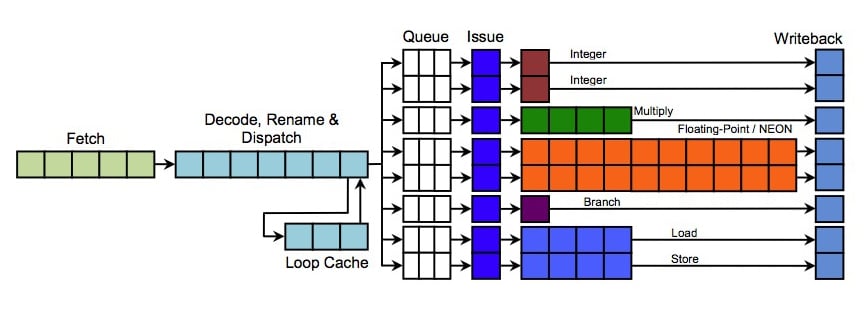
On ARM most of your splitting is going to be breaking out the predication so that the scheduler only has to work with 2 input uops. The thing about x86 is that the instruction stream isn't self-synchronizing, it's hard and occasionally impossible to figure out where the instruction boundaries are if you don't decode progressively from the front. This means that to decode mulitple instructions per clock cycle x86 has to use complicated voodoo.
Of course, it is unlikely that you can make 256 instructions use the exact same format (some operations will not have any use for 3 registers, for instance) but if you can keep things as consistent as possible, decoding becomes easier. Price paid is that you sacrifice instruction space, for example because the instruction format allows you to write the result of an operation to a register hard-wired to contain a zero.
And x86 isn't that CISC-y. There were processors that basically could do a simple number to string conversion in one instruction, and there _are_ processors with an instruction that does Unicode conversions (http://publibz.boulder.ibm.com/cgi-bin/bookmgr_OS390/BOOKS/d...)
The big difference is really that x86 has an ISA->uop decoder, which basically is another decoder in front of the decoder in a RISC.