http://en.wikipedia.org/wiki/Zen_(microarchitecture)
http://www.pcgamer.com/amds-next-gen-zen-cpu-due-in-2016/
Seems like the next chip after Carrizo is targeted at 14nm fin-something.
Which, if it pans out, would put Intel & AMD on the same node for the first time in a while. Supposedly Intel's first 10nm part isn't due until 2017:
http://en.wikipedia.org/wiki/Skylake_%28microarchitecture%29
Not everything gets shrunk in modern die shrinks.
What my limited understanding is that transistors might be getting shrunk but wiring connecting transistors is not getting shrunk it is still at some larger number (65nm?)
And it seems very unlikely for AMD to ever be competitive on that front.
Intel seem to be struggling though, with shrinking not working out as they planned. They've missed one upgrade-round with the delay to Broadwell, and if the rumours are correct and they're releasing a couple of CPUs and then jumping to Skylake - that's quite a hit to ROI given the investment they've put in to an 'unused' chip family IMO.
Lenovo released Broadwell laptops in Q1, it is hard to believe they will release Skylake before 2016.
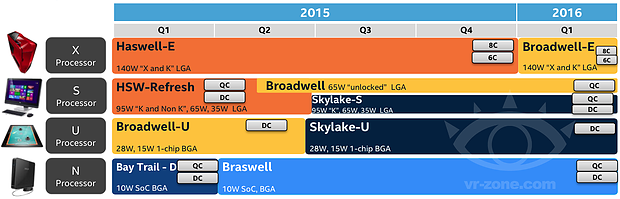
Why not?
Not sure what happens after that though.
I have a 4 year old i5 laptop that can handle 100% of general office/home use. Battery life and gaming are the only two weak points. AMD aren't going to compete with Intel on battery life but with overall cpu/gpu power consumption falling it's not as big of a problem as it used to be.
Wish they weren't stuck on 28nm still. It seems like Intel will be pushing 10 before they get down to 20/22... Maybe I'm just nostalgic of my overclocked Athlon 64 but I'd love to see AMD make a comeback and the nm gap between AMD and Intel just seems like kneecapping the underdog.
Realistically they are going to be launching this against Skylake and I can't help but think all the advantages they are promoting are going to get nullified by that. (HEVC and gaming performance)