Given what the global scientific consensus is (AGW is real, ice is melting, humans are to blame), it is my first impression that your graph and stance is probably crap, but I don't know enough about climate science to make a reasonable argument one way or another (or even interpret the data for that matter).
What's a layperson to do? You can learn basic Python in an afternoon, but basic climatology?
----
Quoting the now-deleted comment for context:
Yep. It's already been debunked multiple times, but they just keep rehashing it to sell newspapers. Here's a trend for those interested in the actual numbers: http://www.climate4you.com/images/NSIDC%20GlobalArcticAntarc...
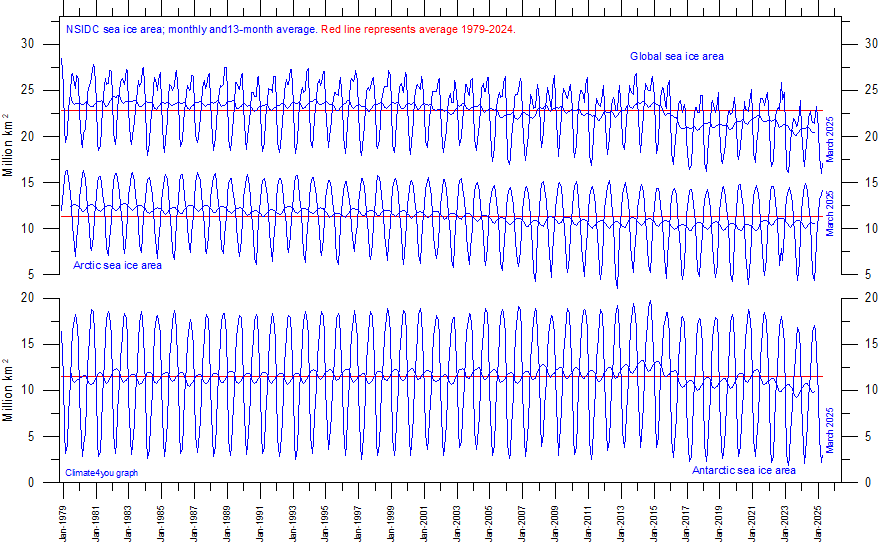
Source (for those that REALLY still want to believe in climate change): http://www.climate4you.com/SeaIce.htm
Source's source (for those that are just being silly at this point): ftp://sidads.colorado.edu/DATASETS/NOAA/G02135/
But sea ice does not really matter if you care about sea level. Ice cubes melting in a glass does not really impact the level of drink in your glass. What does matter is the thick glaciers over landmass, which, when they melt, add water into the ocean.
You can also learn the germ theory of disease in an afternoon. The fiddly biological bits of how antibiotics actually interact with germs? Probably not.
For the companies that rake in tons of cash selling fossil fuels, it's been an incredible bit of propaganda to lie about the details and get people to doubt scientists.
I guess if there were enough money to be made keeping people sick with bacterial infections (heh, Big Disease), we'd probably see the same thing, but with germ-theory deniers.
It only take one counter argument to debunk a theory. The defenders of the AGW cannot prove their argument (burden of the proof) and so use of fallacies (ad hominem arguments and others) to keep their farce. I don't know their reasons; but their "scientific" arguments has no ground!
Still other things like e.g anesthesia is also magic to me, but I know for a fact that it works.
What bugs me about GW research is lack of focus on mitigating GW, other than by cutting greenhouse gasses (ain't gonna happen) and especially things like this:
http://www.forbes.com/sites/jamestaylor/2011/11/23/climatega...
Lots of non-sceptics would tell me that some scientists would break ranks if they found an issue, but those emails suggests that such attempts would be prevented. Considering how much money is given to these scientists by the government and how much their funding would be cut if it was found out to be a none issue, I can't consider them impartial.
So it boils down to a lack of trusts in scientists and an inability to interprent the data.
If that seems magical to you, then most of the world should seem like magic rather than science. We can predict all sorts of things over long time scales that we can't predict over short time scales, and we do it all the time. We can't predict turbulence or the exact way that steam will rise from a hot cup of tea, but we can predict the amount of steam and the average speed of its rising.
And if you think that you have any sorts of technical chops, familiarize yourself with things like the Lorentz attractor, for which we can not predict exact trajectories, but we can predict where the two attractors are.
https://en.wikipedia.org/wiki/Wishful_thinking
https://en.wikipedia.org/wiki/Appeal_to_consequences
Life (including human life ant its apurtenances) is transformative. It maximizes entropy generation and energy throughput. It's dramatically affected Earth's climate several times in the past, and many of the life-forms responsible for those dramatic effects didn't survive them.