In many jurisdiction initiating sex with an unconscious person is consider the same as non-consensual sex (one can't consent if one is unconscious). Some jurisdictions, like England and Wales, explicitly include sleep in the legislation around consent (i.e. a sleeping person cannot consent to sex, a reasonable person could not believe sex was consensual when the other party is asleep).
This is much more serious than "half-asleep" makes it appear.
The confusion seems to stem from a text message she wrote afterward, in which she called it half-asleep. The police document however wrote that she was asleep. Which should be seen as more accurate depend I guess.
Did you just guess at this? Or do you have something to contradict the police interview (http://www.nnn.se/nordic/assange/docs/protocol.pdf, top of page 6)?
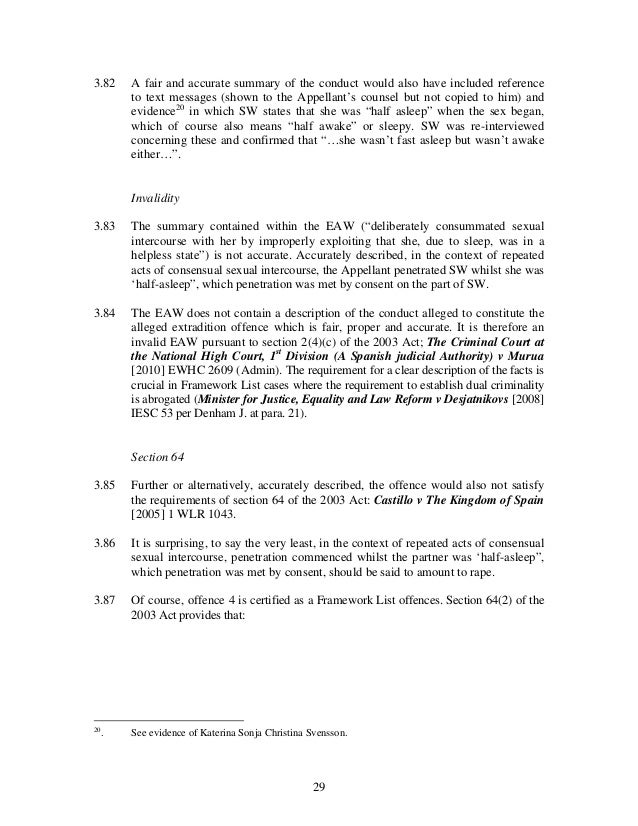
Allegedly SW was re-interviewed and confirmed that she was half-asleep.
Page 54 of the document you cite also says that she was "half-asleep".
However the full quote is:
> Sofia also said that, when she was half asleep on her side, she had been aroused from slumber to feel that Assange was inside her.
Which is quite different from a plain "half asleep", especially with the rest of the sentence: "aroused from slumber to feel that Assange was inside her".
Even in its best light, assuming "half asleep", this begs the question of whether someone in that state can consent to sex (under the Swedish legislation), and/or whether a reasonable person could believe that there was consent.
I'd say no... but I will grant that this sort of question is why judges and juries are necessary.
He is accused of initiating sex with a woman later an evening after consensual sex had finished and she became "half-asleep". The legal questions to be answered is: was she half-asleep, ie, does he contest that statement and if so, what conclusion can be reached by a court.
Furthermore, there is an accusations that consensual sex was agreed under a condition, and that Assange broke that verbal agreement by ejaculating inside her. Its a rather odd situation for a sexual molestation case, but I guess that the court would first have to establish if both parties had reached the same understanding, and if the above mentioned act then broke it.
On either of the two cases, my best guess is that we will never know.