If it's as they say, then it seems to me like the next oscillation should be much more dramatic (for some measurable definition of dramatic) than the historic ones because most of that "stored warming" will come up in a rush. On the other hand, if we get to the time when the cycle reverses and it's no big deal (after giving it time to get into full swing), perhaps we should reconsider our premises.
Besides, other than saying that the climate is just too complex to make these predictions, I haven't ever heard a plausible argument against extending the simple observation that a volume of air enclosing an absorbing and emitting solid when exposed to a wideband source of light (the sun being a good example) will trap heat in different amounts dependent on the concentration of the gases in the volume and that CO2 is one of the gases that increases this effect if you start with a mix the same as our atmosphere.
Besides, the people who are saying that the system is too complex to make a prediction are not saying that there will be no effect. There is an increase in the energy going into this system and saying that things are so complex that we should bet on there being no effect is not saying that there is no global effect, but that there is a global effect that more or less exactly counterbalances the initial effect and that to me sounds like wishful thinking from the viewpoint that nature is somehow magically in balance.
Things that come to mind immediately:
1. The solid can change colors (amount of vegetation, amount of snow/ice cover).
2. Cloud cover at various altitudes. (I think I heard this one tends to annoy the model-makers, since they don't have a good way to predict it yet.)
3. How much of the wavelengths that CO2 absorbs, is already at 100%? https://en.wikipedia.org/wiki/Absorption_band has a picture that seems to imply "most of it".
Item #1 I've heard should make the effect stronger than your simple model, #3 would probably make it weaker, and #2 I doubt anyone knows.
I think it is unlikely, but definitely not that unlikely that reality will nicely balance for a wide range of values of CO2. I would like us to plan against that but it would be nice if it were so.
We are probably somewhere near a local minima, in terms of temperature stability, however we have no fucking idea really where the edges are or how deep the next valley may be.
The future doesn't have to be like the past, especially if we kick it.
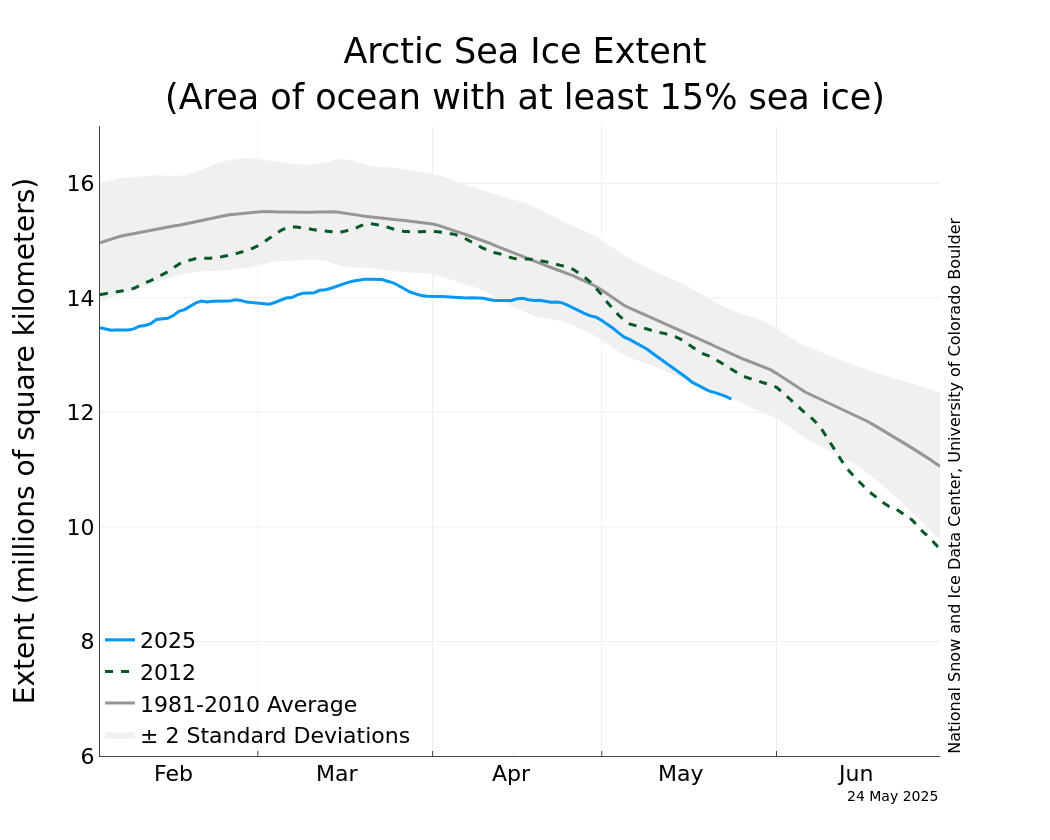
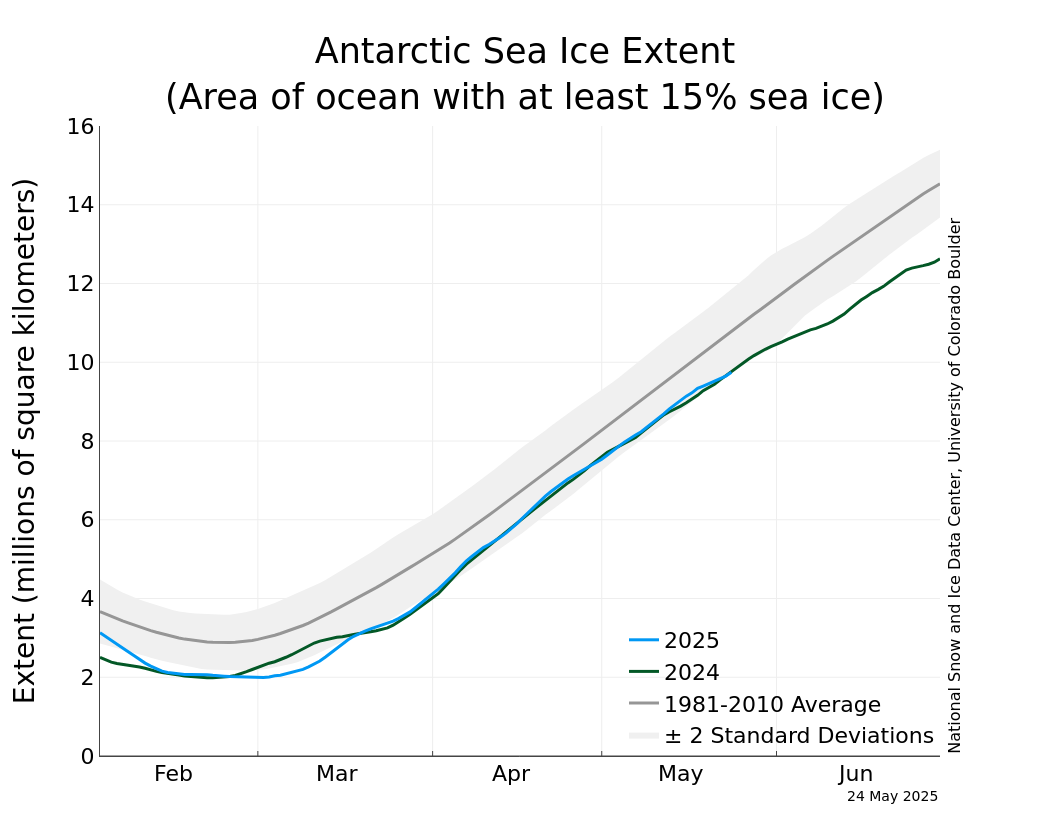
How do you explain folks who pick at the science but ignore the melting of every ice pack on the planet in a few dozen years? What principle are they exhibiting, to ignore overwhelming data for the sake of scoring some points on a web blog?
I feel the science is complex and not yet understood and we shouldn't treat questions about climate science as having nefarious motives.
Ironically, my comment here is the kind of science nit-picking that think JoeAltmaier is commenting on and I think he makes a good point. Something is bound to be happening to our climate and it would be remarkable if it wasn't at least affected to some degree by human activity.
[1] http://nsidc.org/data/seaice_index/images/daily_images/N_std...
[2] http://nsidc.org/data/seaice_index/images/daily_images/S_std...
I don't think that makes it strictly non-falsifiable, it just makes it a little fuzzier where you have to accept that there are too many variables to isolate, and you need to take clues and relative changes to be worth something even if there isn't a controlled scenario that science would prefer.
The worst part of climate change science isn't the uncertainty, it's the fact that any uncertainty will be grasped upon by the oligarchy to create FUD in favor of the status quo that generated their fortunes. That systemic bias could well be the end of the species as we are collectively unable to pull our heads out of our asses.
Ah, but it will also be grasped by researchers to create FUD in favor of sensationalism so they can get more grants and maybe become famous for Saving The World.
That systemic bias could well be the end of the species as we are collectively unable to pull our heads out of our asses.
Sure. Or equally unlikely, the opposite systemic bias causes the end of the species as a result of banning all effective telephone cleaning chemicals since they react with water to produce greenhouse gasses.
Or terror.
Can't be terror though.
You can't have a war against terror.
That's obvious.
Must be Terra then.
We surely aren't led by idiots.
After all.
I too am generally in favour of the world.
---
satellitecat:
Release the kittens.
I repeat:
Release all the kittens.
I think that given the physics, global warming is probably true. That said, one of the things I find annoying about it is that there are many good reasons not to burn stuff and global warming has all the focus.
How about building stuff like solar based electric transportation, just because our city atmospheres are killing people right now, never mind in several decades.
And this is the problem with those "a posteriori" explanations of the hiatus. They are saying that the models that predict a global warming catastrophe can't be wrong, instead of recognizing that the models lack predictive power and they must be adjusted. But if the models can't be wrong they are not science.
Who said that?
The incompleteness of climate models isn't something that has just come up recently - they have always been incomplete (they can't be anything but - 'all models are wrong') and that is well understood by anybody who develops or uses them. There are large sub-systems that global circulation models don't even really attempt to model at this stage. Others where they are widely recognised to do a very bad job (e.g. ice sheets). Others that are just modelled stochastically because we don't know how to predict those processes on a year to year basis (e.g. ENSO).
Finding inconsistencies between the models and reality is one of the ways that they are improved.
I don't know where you are getting these ideas about how climate modellers think, but they don't bare any relation to how climate models are actually developed.
If you are asking, why have they not thrown out our entire understanding of the climate system and started over, then I would argue that isn't a way to actually improve our understanding of the climate. We would be starting over every day. Out understanding clearly isn't all wrong. There are all sorts of other lines of evidence used to develop our understanding of the climate system. From things that are reproducible with simple experiments (or just application of basic physical laws), to things that have taken large investments and long term study to work out.
There can be all sorts of reasons that the model got it wrong (assuming it did, I don't think we really have enough evidence one way or the other yet for the idea proposed in the OP - it seems like a bit of a curve fitting exercise at the moment). Not only is our understanding of the systems incomplete, our measurements are incomplete as well (and that gets much worse even just a few years ago - we've only had the Argo network of floats taking ocean temperature for a bit over a decade for example). Often there is just as much reason to suspect that it's our measurements that are wrong than that it's our understanding of the system. It's just the nature of working on a system the size of the entire planet. It's not easy to measure everything, and ever harder to measure what was happening in the past. There have been real issues where it was the data that was wrong and not the models.
See the UAH troposphere temperature record for example: https://en.wikipedia.org/wiki/UAH_satellite_temperature_data... It contradicted other data sets and the models, and it turns out there were errors in the way the temperatures were calculated. That is a record run by scientists very much on the skeptic end of the spectrum by the way, if you were getting worried about any kind of conspiracy.
I mean, get off it. "Theory" means something in "critical theory", something else in formal logic, etc. etc. There's nothing to say that applied scientist's uneasiness with tentative conclusions should dictate natural language. You don't want to be misinterpreted, you don't leak to the press before it's been in a few peer-reviewed journals.
>> More than a dozen theories have now been proposed for the so-called global warming hiatus, ranging from air pollution to volcanoes to sunspots.
>> “Every week there’s a new explanation of the hiatus,” said corresponding author Ka-Kit Tung
First of all, a hypothesis is NOT a theory. Secondly, they have a goal indicative of an agenda - they're looking for a plausible explanation and publishing speculation as "theory". If you don't have data you're just speculating, and by data I don't mean "yeah, volcanoes erupt and emit stuff". You need data that supports your hypothesis, and if you really want to claim a theory, IMHO you need some kind of mathematical model. If all these weekly explanations had data and models to back them, I don't think there would be nearly so many.
To me this resembles the folks who blame every weather event on climate change. Even if I accept the premise, they look like fools trying to tie warm, cold, erratic, extreme, and calm, all to the the same cause with nothing but simple high level hand waving.
Never mind my views on certain topics, doesn't all that speculation out in the public view damage the perception of science as a whole? That bothers me.