The phrase "Peak Oil" has become much more than a statement that at some point in time the human production of oil will. For example, one of the primary boosters of the phrase was the website "Dieoff.org" which anticipates the death of most people on the planet. And you've demonstrated this yourself by jumping to the Hubbert curve...
The thing about a Hubbert curve is that it is base on regional data. Production in various regions has, rather roughly, indeed expand exponentially and then gone down exponentially. But where this behavior has been roughly seen, the exponential decline has happened because the particular sources have been replaced by cheaper sources elsewhere. Since this cannot happen on a world scale, there is every reason to expect world-scale production on existing fields to go down gradually rather than exponentially. Further, as the GP notes, more oil is being discovered even into the declining range.
This relatively slow decline will provide some impetus for alternative energy sources - it already has to an extent.
The world has quite a few problems but approach that our "Peak Oil" friends use for framing these problems is not useful.
The cheapest and most efficient sources have already been found. They're in the middle east, and many of them have recently reached the point where production is declining despite all technical efforts. And those efforts to sustain a very high production rate from a diminishing source mean that the decline could indeed become quite steep.
As for new discoveries, the problem is that they, too, are declining (and have done so for over 2 decades).
The reason that is bad is the same reason that demand for oil is inelastic. The cost of not consuming oil is very high.
If you don't care about the environment, there are even easier solutions; processes for making gas out of coal have been around since before world war 2.
The real point here is not when we run out of oil, but rather when it becomes too inconvenient -- too costly in other words. Even with new finds, oil is becoming a more and more inconvenient source of energy. The reason it remains attractive is because of the infrastructure surrounding it's production, transport and use.
Why can't oil be made synthetically? Say by genetically engineering bacteria etc. That being the case I don't see any limit to oil production
Basically, synthetically-made oil only makes sense only if the process involves an efficient way to turn a widely-available but inferior form of energy into oil. Basically, that's bio-ethanol: already being done, but not feasible at the scale it would take to satisfy all current demand for oil-
The two problems I see are scale and unwillingness.
On the one hand, the conventional wisdom say that the natural oil was made over millions and millions of years. Even if we manage to find a way to speed up nature 1000x we are in the thousands and thousands of years to regenerate the whole global reserve. At present consumption rates, know reserves will last less than 50 years. This means we would be better off developing alternate energies, reducing consumption, and reserving oil exclusively for strategic uses only (you cannot fly a plane without fossil fuels, but you can make your chairs of wood instead of plastic).
The other issue I see, and I belive there is no solution at all, is unwillingness from the politicians and the society in general to acknowledge the problem and do what needs to be done. Every child learns in the school that oil is a non renewable resource... and what we do? We consume more and more of the stuff every year. It is depressing to see the huge amount of utter garbage that gets made and sold out of oil, frivolous stuff, junk that nobody really loves or cares about...
Markets are slow to transfer information to economic actors when conditions change drastically. Lack of political organized response, we are in for very interesting times in the decades to come.
But those reserves are growing not shrinking over time. In the 1950s there was only 10 years of known reserves. We need to start worrying when the known reserves start getting smaller, rather than growing over time.
http://www.scdigest.com/images/misc/World-Oil-Reserves_web_0...

http://www.cheaperpetrolparty.com/Images/World%20Crude%20Oil...

http://www.theoildrum.com/uploads/12/opec_reserve_growth.gif
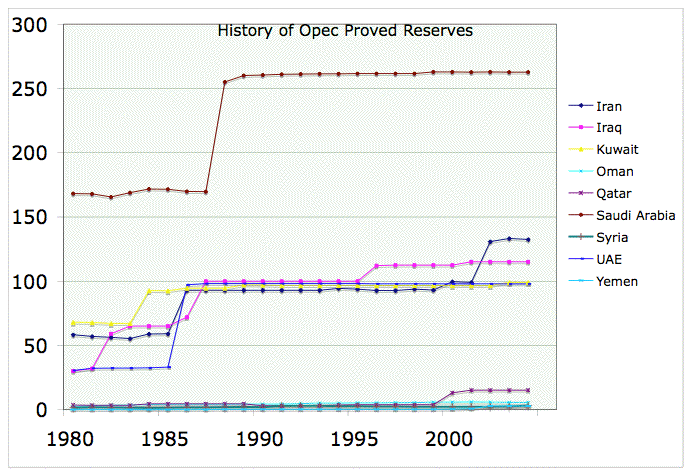
> Markets are slow to transfer information to economic actors when conditions change drastically
Hardly. Prices rise and fall in minutes when there's new information.
Also if the 20th century has taught us anything it's that we need to keep politicans as far away from resource development as possible,
Rebuild an artificial oil reserve of the size of our original natural oil reserve (at the late 19th century levels... regardless of the reserve was known or not), is not an achievable goal for the 21st century. We dont have the time to do the R&D and we dont have the resources to implement the project in the scale needed. Can we do the stuff, I think yes; but un a much lower scale and only for strategic applications that cannot use any other form of less concentrated energy. The rest of society will have to due without or find an alternative solution.
Now... >Hardly. Prices rise and fall in minutes when there's new information.
That is precisely the problem! Variation within minutes does not produce a consistent strategy, it produces noise. We are guiding the future of ourselves and our children on sheer noise. Not an improvement over the shaman who reads the burned scraps of the dinner.
In peak oil circles, it is a widely held belief that 2005 is the year of Peak Oil (since global oil production has plateaued over the last 5 years or so). I do not believe it is the Peak Oil. I believe we are observing a peak oil, resulting from underinvestment from the Big Oil industry in the 90's, when it was so cheap to bother and they decided to "focus on developing existing reserves". Fortunately, you cannot just declare that you are now exploiting new reserves. It takes both material and human infrastructure that takes time to implement. Thus, demand exceeds supply and you see a barrel rise up to almost $150 USD. This triggers a catalyst to structural problems in finance sector and you end up in recession... unable to command the resources needed to upgrade your infrastructure.
So here's the interesting thing, our known reserves today are bigger than they were in the 19th century and paradoxically are getting bigger every year even though we are using more and more oil. Until this situation ends there's no need to waste resources developing an alternative energy source (assuming the sole reason for doing so is to mitigate running out of oil). We are essentially running into oil rather than out of it.
Higher oil prices automatically command resources and people to direct their attention to oil production. This is why we never run out of any resource, as soon as the price rises people move into the field (in order to get higher wages/returns) to solve the problem.
Yes, oil production will peak at some point is the too terribly distant future, but no, the pattern of decreased oil consumption won't be the same as the patter of increased oil consumption because the factors generating the decline won't be the same as the factors that generated rise.
New discoveries don't change that - you'd need more new discoveries each year than the year before (which is the opposite of what is actually happening). Oil sands don't change that - they don't just require more capital, but also more energy to use - and energy is exactly what you're trying to produce after all. Eventually we'll have to expend the equivalent 1 barrel of oil to mine and refine 2 barrels worth of oil sands.
Peak oil doesn't mean no more oil tomorrow. Oil production may well continue for a century or more - it will just keep decreasing, not increasing. When this starts happening is a matter of debates, research and numbers. There are strong indications that we are seeing it happen right now: http://en.wikipedia.org/wiki/File:Hubbert_world_2004.png (look at the source - these are not made-up numbers)