The only solution to competition is centrally enforced precommitment. First, the government should actually enforce the eight-hour workday. Then it should reduce the workday, for all employers at once, so no one can get ahead by cheating. I don't see any other solution.
This would not really be a solution. All it would result in is more people taking work home, because job evaluations would still be based on how much progress one made on the primary project. To get ahead and get that next promotion, many people would still feel compelled to work extra (unreported) hours. I suspect a madate such as what you propose would simply push the long work-days into being unreported.
This is basically what happens in graduate school (in the US, at least). I just finished a PhD program; as part of our contrats students agreed to only work 20 hours per week. There is no way one could finish a dissertation working on 20 hours per week, so everyone worked longer hours. Sure, you could complain about how many hours you worked (and some people did), but that did not change the fact that only 10–20% of Astronomy PhDs get faculty jobs, so if you want that faculty job, you need to put in the hours to do great research, regardless of the mandated 20 hour limit.
I'm not trolling here...just curious. My own mind tends to go in the direction of the parent, but, I also see how enforcement would be next to impossible.
If there are any problems about work, they are about making it more enjoyable, making good work more widely accessible and distributing the proceeds fairly.
Until that changes, I would not expect part-time work to happen for anyone but really high up managers where such a trade may actually make sense.
Also see the book "Two-Income Trap", it basically describes how households didn't become better off from making both partners work, because that just bid down the price of labor relative to housing and education. Everyone ended up in the same position as before, but now they work 2x more and cannot opt out. Also the non-working partner in the family provided a safety net because they could start working if things got rough, and now that safety net is gone.
Surely the extra people working produced more output (e.g. ~twice as many bugs fixed/year or ~twice as many new anti-cancer drugs/year). Supply of some things would remain constraint and their prices would be bidden up, but many others would have their supply increased and prices could even fall (e.g. due to capital costs spread over a larger number of units). We definitely have not ended up in the same position as before.
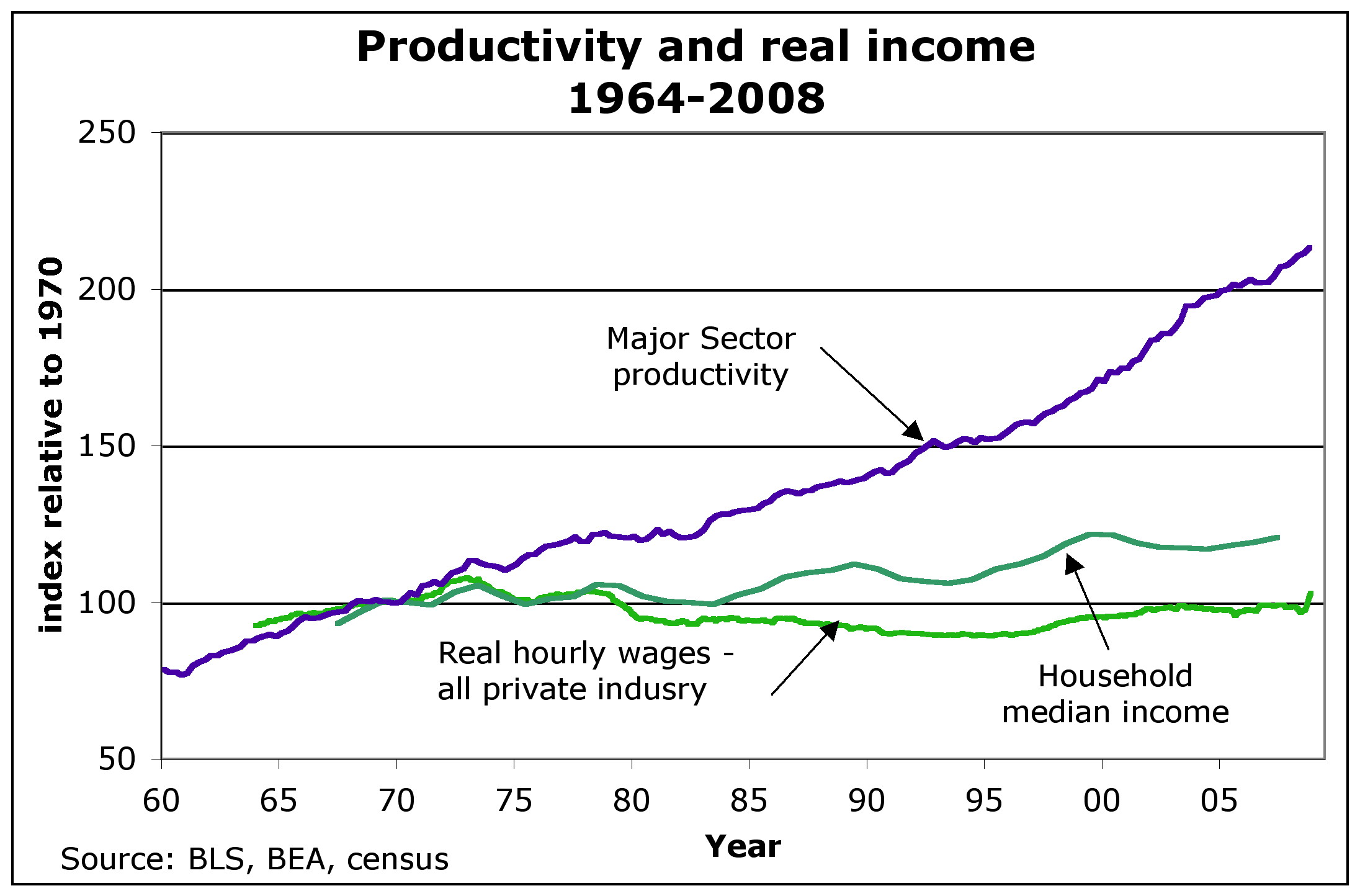
This is where the 4 hour work week went.
Disclaimer: I am an ardent supporter of work hours being reduced as productivity rises.
Total employee compensation as a share of national income was 66 percent of national income in 1970 and 64 percent in 2006. This measure of the labor compensation share has been remarkably stable since the 1970s. It rose from an average of 62 percent in the decade of the 1960s to 66 percent in the decades of the 1970s and 1980s and then declined to 65 percent in the decade of the 1990s where it has again been from 2000 until the most recent quarter.
Makes sense.
The real problem here is productivity increases have been almost entirely soaked up by the increase in the cost of health care.
Source?
Beyond positional goods, the other money-suckers are higher education and healthcare, which are both on the one hand arguably an extremely good thing for increasingly large amounts of economic surplus to be thrown at despite inevitably diminishing returns, and on the other hand utterly ridiculous in the US.
Wow! Sorry, but did you actually read and critically analyze the links you provided?
The first link for example is utterly ridiculous. First, it defines "rich" people as those who have a Bachelor's degree. In which bizarro world is this actually true? Second, the author argues that these so-called rich people work more because of factors like "winner takes all" and "earning more money makes leisure more expensive." Whereas he completely ignores the elephant in the room, which is that poor people are almost always hourly and are discouraged (if not forbidden) from working overtime. In contrast, higher-paid workers are salaried, so of course their companies do their best to suck as much work out of them as possible. This fact alone can single-handedly explain the discrepancy in work hours.
Of course, what the submitted article is talking about when it says "rich" is actual rich people. You know, those who have "fuck-you money," either because they come from wealthy families or because they made a lucky exit. Those people don't have to work at all, and in fact most of them don't.
[1] http://www.bls.gov/mlr/1992/07/art3full.pdf [2] http://crr.bc.edu/wp-content/uploads/2011/08/IB_11-11-508.pd...
Do either of these explore why? My initial uninformed guess is that knowledge based fields many college grads go into are much less tied to physical fitness and thus workers are able to continue their jobs later into life when physical labor wouldn't be possible.
In many ways this is a superior alternative. Children don't work. They used to. People spend a lot more time in school at the beginning of their life when it has the potential to have the biggest impact. It's not all bad. Although not quite living up to the dreams from 20th century either.
There's also something to be said about positional goods. A lot of people are driven by status and they work to be ahead of others. Elizabeth Warren believes that this explains why, despite technological progress, regular middle class family needs two incomes where one was enough a couple decades ago[3], they're competing for the same house, or school district. It doesn't explain everything but it's a factor.
[1] http://www.economist.com/news/finance-and-economics/21600989...
[2] http://equitablegrowth.org/2014/08/18/equitable-growth-make-...
[3] http://www.amazon.com/The-Two-Income-Trap-Middle-Class-Paren...