yy kah kol nel vii kuu sei kasi ysi kymppi
(or a similar variation)
with multiples of ten shorted to -kyt. So twenty-one is 'kahkytyy', the same number of syllables as in English.
Ref: http://en.wikipedia.org/wiki/Colloquial_Finnish#Numerals
Learning Finnish involves learning two dialects, spoken and written, and the spoken dialect can vary considerably even between cities 200km apart. But it's an incredibly fun language to learn. Very logically constructed, few(er) exceptions to the rules, and if you can say it, you can spell it!
My dialect is from the Turku region, for what it's worth.
  yy kaa koo nee vii kuu see kasi ysi
  kymppi yytoo kaatoo ... kaksyy kakskaa kakskoo...
  yksi kaksi kolme neljä viisi kuusi seittämän
  kaheksan yheksän kymmenen ykstoista
kakstoista ... kakskytyks kakskytkaks kakskytkolme(though in practice the polite forms are rarely used in Finnish. You'd probably go for hei, sun koiras palaa)
I knew lots of old words they'd never heard, though, since I was practiced at speaking with 70-year-olds who'd learned from their immigrant parents. A little linguistic time warp...
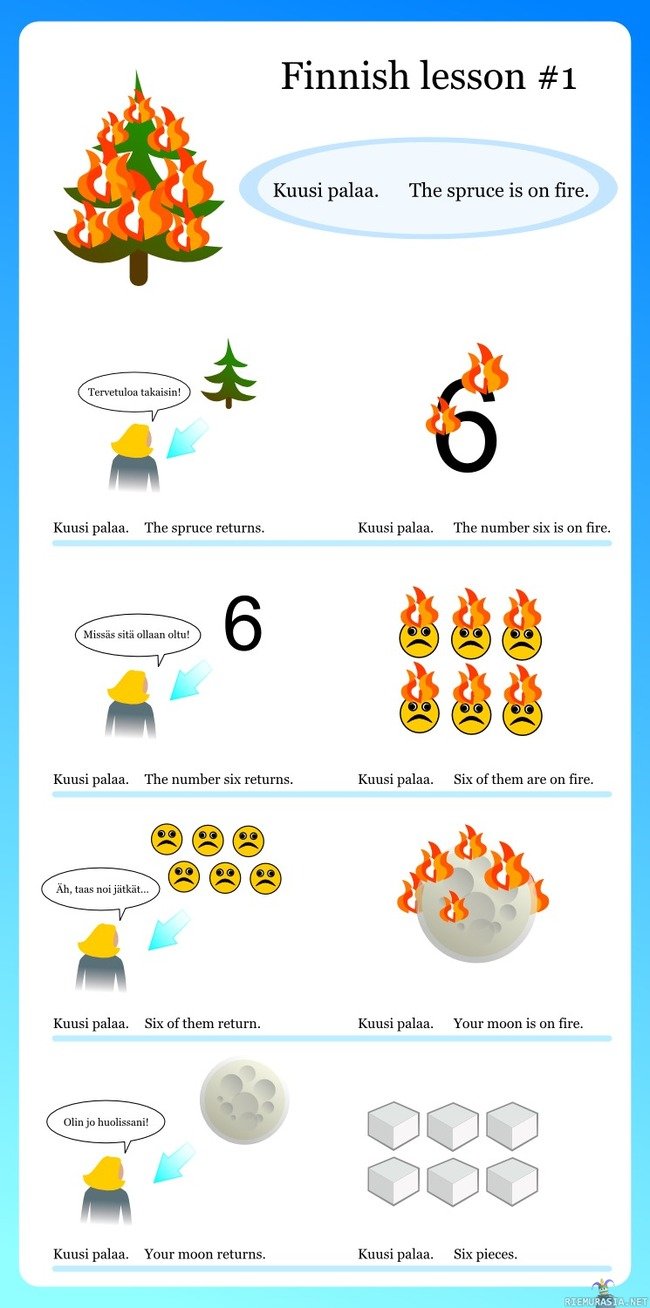
The spruce is on fire. = Kuusi palaa.
The spruce returns. = Kuusi palaa.
The number six is on fire. = Kuusi palaa.
The number six returns. = Kuusi palaa.
Six of them are on fire. = Kuusi palaa.
Six of them return. = Kuusi palaa.
Your moon is on fire. = Kuusi palaa.
Your moon returns. = Kuusi palaa.
Six pieces. = Kuusi palaa
Interestingly, the Estonian numbers are basically the Finnish ones with the last syllable chopped off: üks, kaks, kolm, neli, viis, kuus, seitse, kaheksa, üheksa, kümme.
"kahdeksan" and "yhdeksän" are three syllables, not four.
If I were good I'd be able to identify the region of Finland your teacher came from. Someone from Finland, help me out! Is that a Savolainen murre?
What popped out immediately when learning the Finnish numbers was how long the words are. All of the other languages count with one or two syllable words. When pronounced, the Finnish is, minimum, two syllables. Three, seven and ten are three syllables. Eight and nine are four:
yksi
kaksi
kolme
neljä
viisi
kuusi
seitsemän
kahdeksan
yhdeksän
kymmenen
Twenty-First is: kahdeskymmenesensimmäinen
I've always wondered what it was about the history of the language and culture that led to this. Finnish does quite a bit of concatenating words to create other words. It was originally the same for numbers. For example, the longest, eight: kahdeksan was originally, literally, 'with two ten'. You can see hints of this in that kaksi (two) contains 'ka' and 'dek' references a borrowed word 'deca', ten.
Ref. http://goo.gl/Zt2WBb