Street View is hopelessly out of date in many places (4 years in some parts of Sydney for example) and it has to be super expensive to keep thousands of people continuously driving around the world. And Street View will likely be a vital and profitable data source if VR/AR (in all its forms) is ever used en masse.
Sounds like too much expense for just that. If the problem of street view was it's cost you could just pay people to add a StreetView system to the roof of their cars and get the data much cheaper than having your own car. They may very well want to start by using Street View to validate the technology but the end-game must be larger.
I think you're underestimating the number of people you'd have to pay to get full coverage of cities. Most people do not drive around on every street in a systematic way; they have a small number of destinations and they usually take the same routes between them every time.
That doesn't mean that once you do have self-driving cars you wouldn't use them for that. Or even that StreetView wouldn't be the first thing you'd use them for, since that's a good way to get more training data for your algorithms. But to suggest they'd go to all the expense of creating self-driving cars to then use them just as a cost saving measure for StreetView sounds strange.
Not unlike the experience for drivers on Lyft and UberX it would be trivial for Google to create a rig and an app. You set the magnetic camera rig on your roof and sign in. It shows you available routes and how much they'll pay for them. The offer increases every so often if nobody selects the route. Done.
> Vissa korsningar har en stoppskylt vid varje väg, ett så kallat flervägsstopp. Det innebär att alla som kommer till korsningen måste stanna, oavsett vilken väg man kommer på. Tanken är att man vid flervägsstopp ska ta ögonkontakt med medtrafikanter för att på så sätt komma överens om vem som ska köra först.
Or my translation "Certain intersections have a stop sign at every way, a so-called multi-way stop. This means that everyone who comes to the intersection must stop, despite which way they come from. The thought is that people at the multi-way stop will make eye contact with their fellow drivers in order to come to an agreement on who shall drive first.
(Apparently the actual law says "ömsesidig hänsyn" - "mutual consideration.")
That said, they aren't anywhere near as common as the US.
If you're more curious, see http://www.trafikverket.se/PageFiles/3038/komplett_slutrappo... , among others. That one talks about how they were tested out during the 1980s, and by 2007 there were a few hundred in the country.
Unless I misunderstood the problem.
I've driven a bit around Europe, but I have never seen a single such intersection in my life - if they exist, they must be rare.
Of course, "if you have an intersection of non-priority roads and a car from each direction" then it's the same, but in practice it seems that 'they' make sure that such intersections are only in extremely low-traffic places where you'll very rarely see another car at the same time.
In the countryside you'll often see this warning sign to remind you that "just because your road is bigger and faster than the one you're about to cross doesn't mean you have priority" http://www.transportstyrelsen.se/Vagmarken/Varningsmarken/A2...
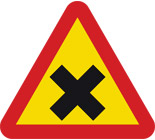
In Europe you can have ambiguous situations with the priority to the right, where you are supposed to be courteous and wave the driver if both (or more) have the right of way.
Google appears to be making an advanced and expensive solution to "full" autonomous driving. The limitation will not be in where it can go, but it is initially limited in weather/environmental conditions. The target audience is likely not production cars in the short term, but a system like theirs can for example make their street view photography cars autonomous: they can work in summer, stop if it rains, and it doesn't matter too much if they cost twice as much as a regular car. It will of course be a regulation nightmare to allow the driverless cars out in the street though.
Volvo on the other hand will probably try to make a simpler and much less expensive solution that will have to work in rain/darkness/snow, and not add a significant amount to the cost of the car. Clearly that means having other restrictions, presumably in the overall intelligence or in which roads it works on. Volvo's system is likely intended for making day-to-day travel more secure at the lowest cost possible, not for creating completely autonomous navigation and problem solving (e.g. 4 way stop turn-taking). It must work in almost any environmental conditions, but it will probably require a driver at all times, and will almost certainly not work everywhere.