Sadly being widespread is no guarantee of clean design ;)
WebKit, like other browser engines, was originally designed in the 90's, and evolved over a long period of time. Again like the others, it's a large and complex C++ codebase, with all the good and bad that comes with that.
WebKit does have some advantages over other browser engines though, specifically it is the most embeddable, and I would say that is the main reason for its being widespread today.
I still harbour feelings that something in the discipline of webkit offers lessons. I just don't know if I can see it myself. Outside of the lessons of brute force being a good tool. (Where I'm assuming there is a lot of force behind webkit.) (I do understand that they have a lot of tests that are fairly complex. Mayhap that is the true lesson. Get a good handle on how to run complicated test cases.)
The problem occurs because this process continues until the equilibrium point is reached, where it is no longer economical to add features to the software. Given the high usage and low marginal cost of software, this is usually when the software has become so inscrutable that nobody knows how to modify it anymore, at which point it is replaced by something else.
It isn't even that I disagree. Just that "everything is terrible" is not a recipe for a happy day for me. For the most part, everything is bloody awesome. The details just aren't as clean as some would have hoped.
http://dot.kde.org/sites/dot.kde.org/files/kf5_big_0.png
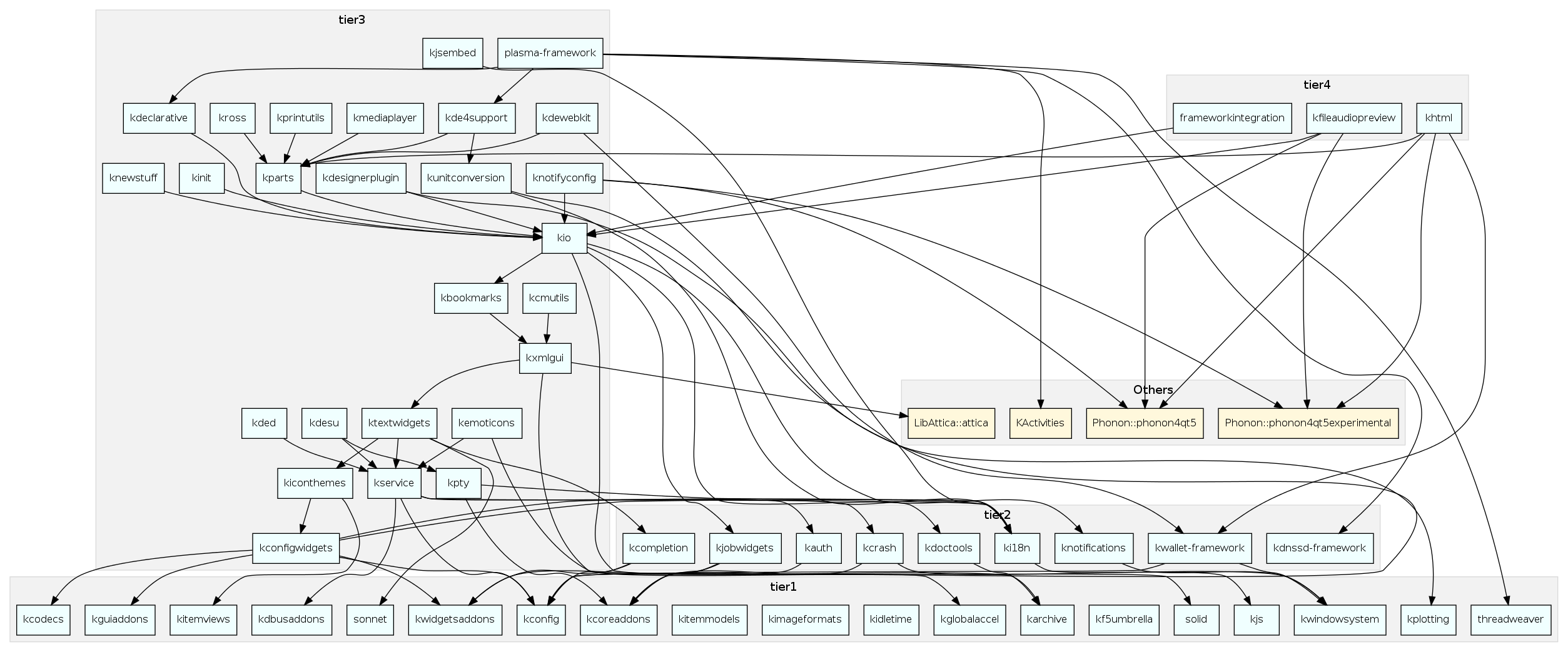
Qt is also used by a few "big" software and as the default toolkit for BB10, Jolla and Mer (totaling a nice 1% market share ;) ). It is also seen as the successor to Motif for large scientific applications.
The Linux kernel comes to mind.
That is to say, in my mind it was one of the counter examples to the idealistic "cleanly designed" solutions.
A good build system/toolchain with GYP that generates Xcode, VS C++, and ninja project files. That would be mega awesome. QtWebkit already has some gyp files, probably could repurpose those.
Also, you can read up on embind on emscripten's website, you can use c++filterjs and the derived object WebCore.exp on the build to create javascript API's from the C++ export symbol table.
I just need to actually have a few days free to finish that and hopefully can have SOME functional demos from the API (that and hopefully I can throw away 90% of the symbols being exposed in the current version and cut the code size down :/)
Anyone have any good pointers on an analysis of the code base? Any easy way to just "dive in" to the code other than the obvious checkout and look around?