For example, you have given links to a couple of github repos. Now if I'm trying to create an overview of how say emacs works, I would try to identify the main sub-parts and break the system down into more manageable chunks of study. This is all what 'viewpoints' are trying to structure. None of this is evident from just the codebase unless it has been captured in some documentation, or you take the trouble to understand it yourself.
You seem to have a very low opinion of software architects, but believe me, you wouldn't want to work on a 5-year old system where huge teams of developers have let loose and no one/team was responsible to ensure a cohesive, maintainable system.
Viewpoints are fantastic for communication purposes, and if you feel that the particular viewpoints shown don't make much of a difference, I agree :). A student project is also not the ideal environment, but it is really valuable to know how to create them, considering the information needs of the audience (biz vs tech vs in-depth tech). And that is what this course is all about.
There have to be persons that guide the overall development, sure, but this does not mean that those have to be "architects" living in a castle somewhere drawing those diagrams. The best "architects" are people with long experience in the trenches that know all the ins and outs, all the relevant theory, know the domain, and supervise it down to the nitty-gritty details. Linus Torvalds is a software architect for Linux, he doesn't do much coding anymore, but he isn't busy drawing diagrams without understanding the code really well either, he just is the person with the widest understanding of the whole project:
Also, ignoring how a system is modularized is typically how you get tangled codebases by introducing unexpected dependencies. Just because it is 'less interesting' doesn't make it 'unimportant'.
Sorry I have to counter-react strongly. Your post is negative without a valid point and the irony is that you agree with the post.
> One can learn much more from walking through the actual source code of some classic projects and from trying to understand what makes them tick
That is the fun part about this post! You propose to mandidate a list of classical code bases. This course lets students freely pick any Github project with activity and complexity. They get graded based on pull requests.. Contributing code and interacting with an Open Source project you picked a week ago is not "drawing pictures" and "connecting them with arrows".
Picking arbitrary programs won't do. The point is to pick the really good designs and illustrate why they are good, and I think it boils down much more to knowing mathematics, algorithms, programming languages and having studied a lot of existing software, than to usage of any modelling techniques so far invented in formal software engineering circles.
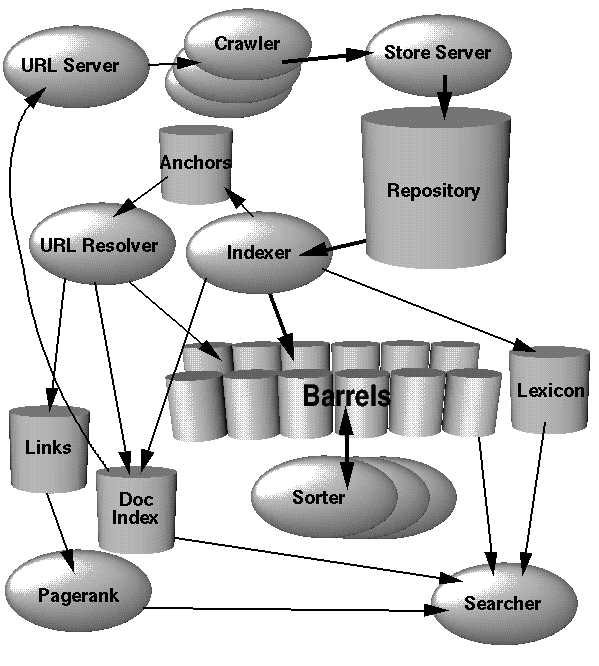
They first explained PageRank (without a diagram), then explained the flow of the data from the crawler (with a diagram). You seem to be arguing that diagrams are never useful, and that just isn't true.
[0] http://infolab.stanford.edu/~backrub/google.html [1] http://infolab.stanford.edu/~backrub/over.gif
Thanks for your feedback.
Perhaps we did not sufficiently emphasize it in the blog post, but we do tell the students about strong existing architectures, open source as well as from industry. The books listed in further reading in the post actually contain chapters about git and emacs, and I share your enthusiasm for Bentley's little language approach.
The philosophy of the course is based on trying to apply published approaches to software architecture (such as those in Rozanski & Woods' book, but it could be others) to real systems actually maintained and used. We encourage to get in touch with the creators of those systems.
The students actually take a deep dive into a foreign code base -- I included pictures because that is easy to share in a post, but the students analyze code, report about that, execute test cases, deploy systems, etc. The pictures are indeed, as suggested by some of the others, means for communication.
I tend to think that a good SArchitect knows that the patterns they might be using are good or well suited for the current problem, a better SArchitect knows that he's perhaps using a less well suited pattern for the problem, but can layout a plan to migrate to a new and better situation without breaking continuity of the project.
Furthermore, it can't be stated clearer that in the course there are a lot of guest lecturers who _do_ show different idea's.
https://github.com/onetrueawk/awk - UNIX philosophy of small tools, DSLs, CS theory: state machines / regular expressions, Thompson algorithm ...
https://github.com/mirrors/emacs - Both a program and a VM for a programming language, hooks, before/after/around advices, modes, asynchronous processing with callbacks, ... Worth to think of challenges of designing interactive programs for extensibility.
https://github.com/rails/rails - Metaprogramming DSLs for creating powerful libraries, again a lesson in hooks (before_save etc.), advices (around_filter etc.), ...
https://github.com/git/git - The distributed paradigm, lots of CS theory again: hashing for ensuring consistency, DAGs everywhere, ... By the way, the sentence "yet the underlying git magic sometimes resulted in frustration with the students" is hilarious in the context of a "software architecture" course.
One of computer algebra systems - the idea of a http://en.wikipedia.org/wiki/Canonical_form
One of computer graphics engines - Linear algebra
...
There are loads of things one can learn from those projects by studying the source in some depth, but I can't think of any valuable things one could learn by just drawing pictures of the modules and connecting them with arrows. There are also several great books that explore real software design issues and not that kind of pretentious BS, they all come from acknowledged all-time master software "architects", yet all of them almost never find diagrams or "viewpoints" useful for saying the things they want to say, and they all walk you through real issues in real programs:
http://www.amazon.com/Programming-Addison-Wesley-Professiona...
http://www.amazon.com/Paradigms-Artificial-Intelligence-Prog...
http://www.amazon.com/Structure-Interpretation-Computer-Prog...
http://www.amazon.com/Unix-Programming-Environment-Prentice-...
http://www.amazon.com/Programming-Environment-Addison-Wesley...
To me, the kind of approach pictured in the post, seems like copying methods from electrical or civil engineering to appear more "serious", without giving due consideration to whether they really are helpful for anything for real-world software engineering or not. The "software engineering" class which taught those kind of diagram-drawing was about the only university class I did not ever get any use from, in fact I had enough industry experience by the point I took it that it just looked silly.