Also, given that the Bureau of Labour is the source, do they include non-labour income sources? It seems pretty important, at least in my mind, to include all income sources. The average high school-only graduate will have $100K of potential to invest by the time someone in college graduates. Even with a low 3% interest rate, that is $3,000 in additional income for high school grads each year.
Educational Attainment by Annual Household Income:
http://content.gallup.com/origin/gallupinc/GallupSpaces/Prod...
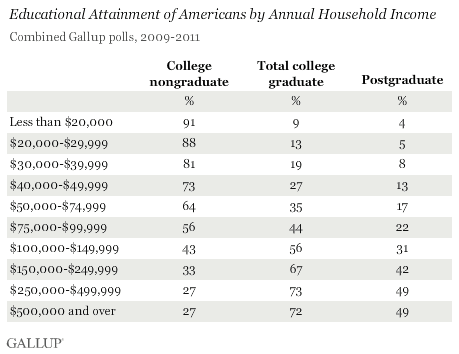
The Gallup link you provide doesn't tell you anything about causality because the relationship is backwards ("educational attainment by income"), while still providing data to refute your original argument (there's a clear positive correlation between education and wealth).
I'm not seeing it. There is very little variance except on the lowest rungs:
  <20K      5%
  20-29K    8%
  30-39K    11%
  40-49K    14%
  50-74K    18%
  75-99K    22%
  100-149K  25%
  150-249K  25%
  250-499K  24%
  500K+     23%
If bachelor's degrees and incomes had a significant correlation, you would expect a considerable increase in each income bracket like you see for the postgraduates, not just a few percentage points between them.
The only interesting correlation is with those who have post-graduate educations, but that was never disputed. It was the argument all along.
If you use the original data, instead of subtracting the columns (arbitrarily), the correlation is stronger. For both columns.
But hey, you keep arguing with facts. I have better things to do.
Incorrect:
http://www.bls.gov/emp/ep_chart_001.gif