> Battery recharge time - out for 15 mins flight? Recharge for 2 hours.
So? Swap out batteries. The whole drone doesn't have to be grounded for 2 hours.
> Flight time / payload - pick one. (20 mins with no payload is a stretch. Add bigger batteries? Too much weight. Add bigger motors and props for more lift? now you need bigger batteries...
That's wrong. There are many off the shelf platforms which can easily handle 5+ lb payloads for 20+ minute flights. Here's one: http://www.freeflysystems.com/products/cinestarHL.php
> No good in 'weather' of pretty much any kind.
That's wrong, too. Multirotor flight speeds are 30+ knots. Modest wind is not a big deal.
> Unstable with a failed motor / prop. Will fall out of the sky under numerous failure scenarios.
Most robust multirotor platforms have 8 or more motors/props, and can trivially handle the failure of one or two. It's true that there are "numerous failure scenarios" which will result in a UAV falling out of the sky, but the same is true of passenger airliners: this will happen if the wings fall off. To suggest that a UAV can't be made as reliable as a typical manned helicopter is short-sighted.
> The blades are lethal - can be shielded, but will add weight and reduce efficiency.
This is only true in the absence of failsafe mechanisms: e.g. a device that brakes the motor when below a certain altitude. Also, as you mentioned, they can be shielded.
> GPS is unreliable at best, and is easily interfered with.
No, GPS is perfectly reliable "at best", and utterly nonfunctional at worst. Fortunately, there are lots of alternatives for GPS.
> Current regulations in countries that have them typically require line-of-sight operation; away from people and property (which rules out landing outside someone's front door); no over-flight of persons; restrictions around distances from the operator when taking off and landing. (And remember the battery / weight issue? Go over a certain weight [~8KG], and the regulations get even more onerous.)
This is 100% valid. Regulations are a concern.
I didn't say wind, I said weather. That said, forward flight in even moderate wind draws considerably more current.
The motors are open for cooling and weight efficiency. They aren't waterproof. Try flying in snow, or dusty / sandy environments and see what happens!
If GPS accuracy randomly ranges between perfect and nonfunctional, then you have described unreliable. Please cite all these alternatives.
What do you imagine might happen if one were to 'brake the motors below a certain altitude'?
And I didn't say 'can't be made', I said the technology isn't there yet, nor by 2015 as Amazon suggest. I also said it will be eventually.
[1] http://spectrum.ieee.org/automaton/robotics/aerial-robots/ir...
Could you squeeze in any more minutes with solar panelling? I mean if they have to fly in decent weather anyway they may as well try to get a bit more charge in them while flying
That's 10 minutes each way. Assuming they fly at 30 mph, you get a range of 5 miles. That might work for big cities, assuming they can fly for 5 miles in a straight line, which they can't.
> No, GPS is perfectly reliable "at best", and utterly nonfunctional at worst. Fortunately, there are lots of alternatives for GPS.
GPS got hacked a long time ago, and even military drones got stolen using a fake GPS transmission.
There are not that many GPS alternatives. GLONASS. Maybe if you have some local towers, but that's a huge project in itself.
2. Octocopters, unless loaded to the hilt, can more or less fly uninterrupted even when missing a propeller.
3. Multirotors fly well even in strong winds (20mph winds and more).
I don't see any technical difficulty preventing a company with the resources of Amazon to introduce this service in a year. The major problems are legislative.
The bigger impact would be on smaller retailers, that don't have this service. This service is an absolute killer, making it faster to order a toothpaste from Amazon compared to picking it up at a shop outside your house.
This would be an incredible benefit to human economy. Imagine the millions of retail jobs completely obsoleted by drones. Consider the price difference between wholesale and the corner retail shop -- a cost this could largely eliminate. Consider all the hours wasted in retail-facing interactions.
If my local mom-n-pop store has an app and a drone, I would shop there.
1) Scale: a small store might not have enough sales to justify buying a single drone and training the staff to use it.
2) Regulation: licensing and certifications to be allowed to use these - particularly in a completely hands-off way - may have high fixed costs that a small store can't afford.
3) Lack of knowledge: most small store managers probably don't have any idea of how to set this up, or that it is even possible.
And in the end, why would you buy from the local mom-n-pop store? Nostalgia? Helping the people you know? I think that'd wear out pretty soon or just not work for many people.
Or maybe someday we'll look back at these comments like we do at http://slashdot.org/story/01/10/23/1816257/
Quoted from the thread you linked.
"Raise your hand if you have iTunes ...
Raise your hand if you have a FireWire port ...
Raise your hand if you have both ...
Raise your hand if you have $400 to spend on a cute Apple device ...
There is Apple's market. Pretty slim, eh? I don't see many sales in the future of iPod.
~LoudMusic -- No sig for you. YOU GET NO SIG!"
Apple is being distroyed by the rumors that are being created. When they announce that they are going to have a new product, everyone thinks it's going to blow their worlds. Rumors start flooding in about even the most outragous products ( I even heard a few "sources" mention teleportion) This is getting plain stupid.
Apple is a normal company. Why does the public constantly expect them do the impossible?
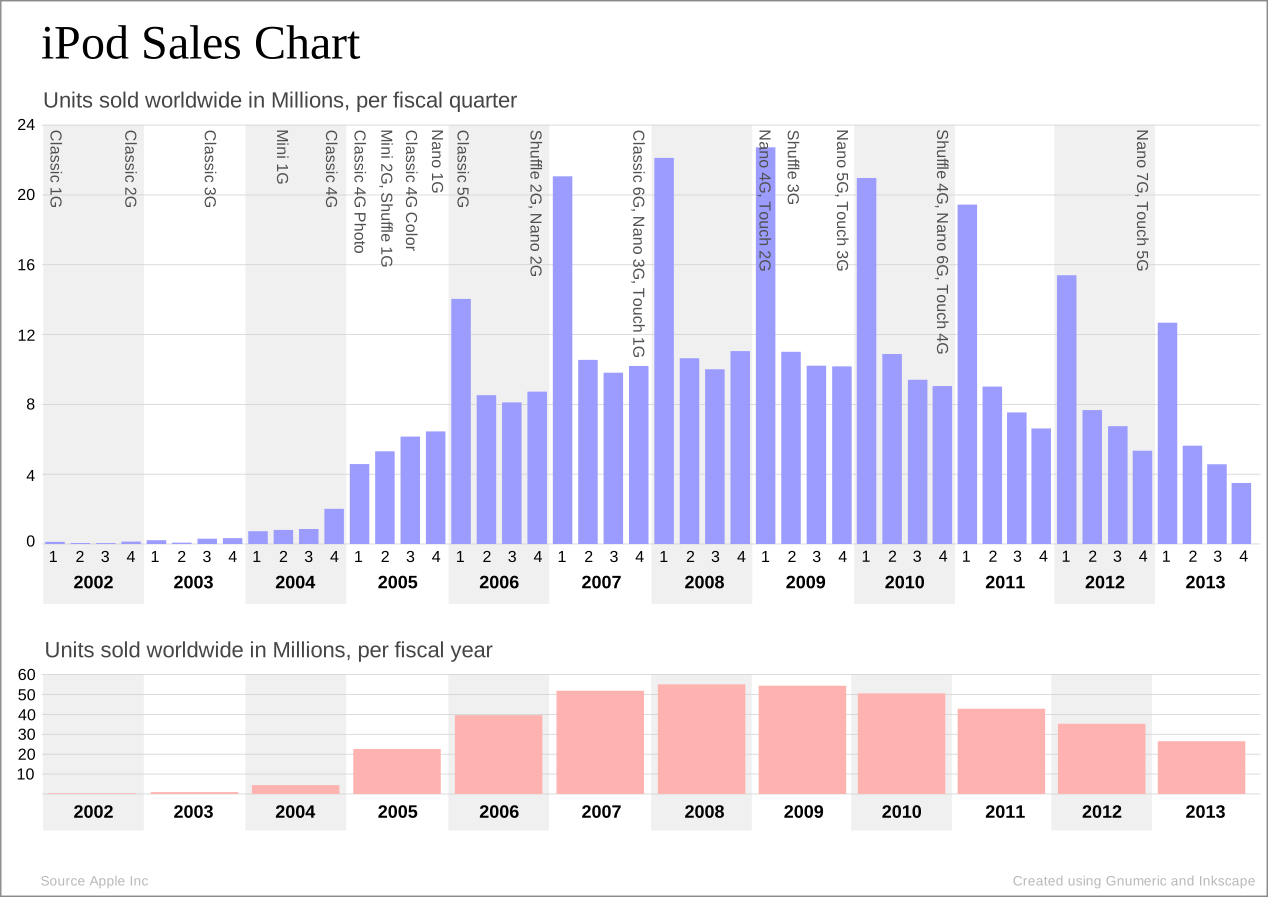
I think it's valuable to point out the problems with the current technology and regulations like scoot did, even though we all realize that in a few years things could change.

Or really any 'disruptive' product.
Battery recharge time - out for 15 mins flight? Recharge for 2 hours.
So they have to be charged in a fire safe manner, and (in a commercial setting such as a distribution centre) away from the main facility. Not beyond possibility, and again with changes in battery technology this will improve (LiFo is looking hopeful relative to LiPoon the safety front), but another logistical hurdle, so still worth mentioning.
Maybe he has an upper hand over the current state-of-the-art.
I don't want to knock hobbyists, because they often do great work. But if Amazon thinks this is the future of package delivery, they could bring an awful lot of resources to bear on the problem.
Now, those resources can be leveraged to generate even more value for consumers.
Don't dismiss the value of insider information re: government policy.
Well, it is carefully crafted to say the rules will be in place, not the technology. The FAA could say Amazon needs to do X first where X is any one of the challenges you mentioned.
I'm glad they put that in, though, because otherwise the threads are always full of "The FAA will never allow this" comments. The wording gives me a reassuring feeling that Amazon knows how much hard work it will take to accomplish.
Except for, you know, that bit (the bit you cut out)
When will I be able to choose Prime Air as a delivery option?
A: We hope the FAA's rules will be in place as early as sometime in 2015. We will be ready at that time.
Sorry, but not a chance. I'm intimately familiar with the flight controller, motor and batter technology behind multi-rotors, and I can state unequivocally that this is just not ready for 'prime'-time (so-to-speak :)
There are multiple issues still to be addressed, not least of which is battery energy density & power-to-weight ratio.
Battery recharge time - out for 15 mins flight? Recharge for 2 hours.
Flight time / payload - pick one. (20 mins with no payload is a stretch. Add bigger batteries? Too much weight. Add bigger motors and props for more lift? now you need bigger batteries...
No good in 'weather' of pretty much any kind.
Unstable with a failed motor / prop. Will fall out of the sky under numerous failure scenarios.
The blades are lethal - can be shielded, but will add weight and reduce efficiency.
GPS is unreliable at best, and is easily interfered with.
Current regulations in countries that have them typically require line-of-sight operation; away from people and property (which rules out landing outside someone's front door); no over-flight of persons; restrictions around distances from the operator when taking off and landing. (And remember the battery / weight issue? Go over a certain weight [~8KG], and the regulations get even more onerous.)
Battery technology will improve, safety issues will be addressed, regulations will change. But 2015? Jeff, I admire your optimism!