a) Humanity has plateaued in its energy usage; or
b) Some other energy source is increasing.
Any of these means oil has hit a peak (there'll be no cliff, though, as you explained). The alternatives are not acceptable (evolution stopped or, for the first time in five thousand years, stopped requiring more energy use).
This is typical of the hand-wavy peak oil arguments.
An increased richness of culture or an increased scientific knowledge clearly don't require ever-increasing energy consumption.
Oppositely, the reason previous evolutionary jumps involved more energy per capita has been that ... cheaper energy has always previously available (ie, this a correlation, not a causation).
Edit: A modern laptop uses less energy than a desktop machine of twenty years ago, yet the laptop's user certainly experiences a somewhat higher level of "civilization" or whatever one would call it. Just a simple counter-example to "evolution always requires more energy per capita" claim.
http://gailtheactuary.files.wordpress.com/2012/03/world-ener...
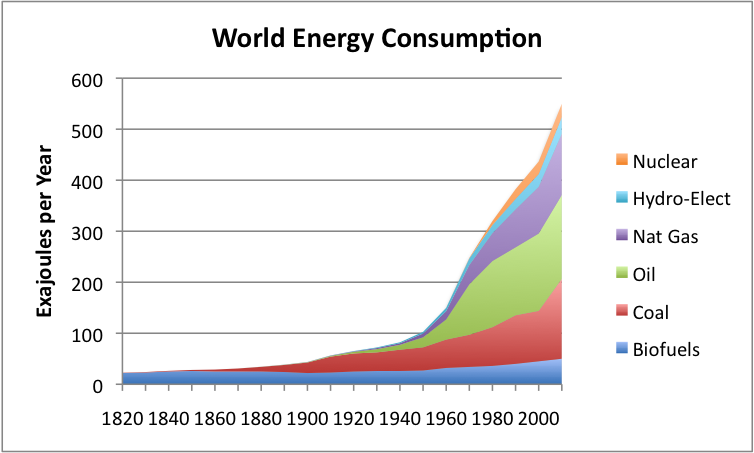
It rather looks quite the opposite...
The problem is a portion of that consumption is agricultural vehicles, employees getting to work and vans of food getting to wal-mart; and real-terms food price rises can lead to political instability, especially in poor countries.
So, one reason to put effort into alternatives to oil is to maintain food price stability and political stability.
The traditional "Hubbert curve" shows exponential growth and decline in a any particular region of oil production. Peak oil theorists generally extend this to a world exponential peak/decline (the article doesn't directly say but it take the "we have to plan for the peak" position).
The exponential growth part makes sense because traditional oil of the ground is a really, "high quality", high efficient energy source (whatever the externalities).
The exponential decline at a given location make sense because the supply winds quickly replaced by some other even cheaper source.
But the thing is that since these aspect explain the shape of the Hubbert curve locally, these is no reason to expect the global decline shape to have any resemblance to the rise shape. Oil today is a efficient meaning you get a lot more energy out than you put in. We're already moving to less efficient, more costly forms of extract and the price has marginally increase.
There's no reason a-priori to think that any cliff would be involved with oil production peaking. Production gets harder, prices go up, consumption declines, technology produces relatively more at the higher rate, iterate a number of times and there you are. It's worth saying that shale oil is arguably much less energy efficient than traditional production but it is still efficient to get a profitable product to market (and does involve the, uh, transformation of a large land area).
The main reason to put effort into alternatives to oil is the externalities - especially since pricier oil is going to involve more energy and environmental impact in its extraction. THAT is quite arguably a crisis but unfortunately for people worried about these problem, there's no going to be a "peak point" where oil isn't practical from a purely economic standpoint.