http://en.wikipedia.org/wiki/1967_Detroit_riot
Things got bad. The insurrection act was invoked. The US military was sent in. Black-white relations have been awful since.
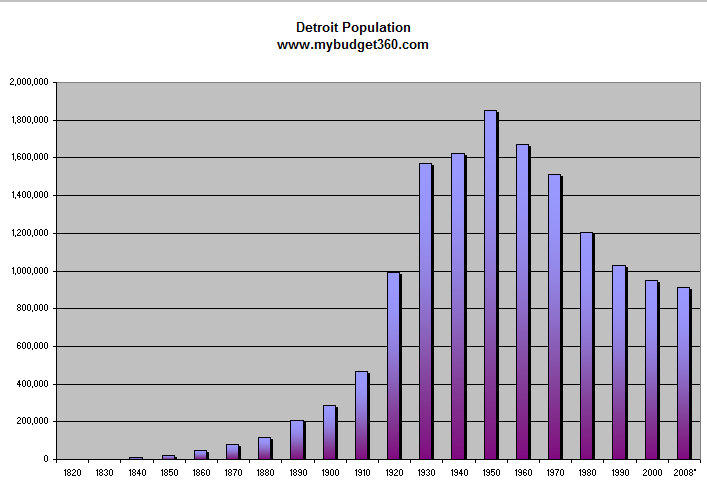
Detroit has faced white flight like no other city. From 1.5 million in 1950 to 75 thousand in 2010.
A good source on this topic is Thomas Sugrue's "The Origins of the Urban Crisis".
Detroit was a symbol of what was great about America in the 1950's and 1960's. In 1960, it had the highest per-capita income in the U.S. It was built on American technology and American manufacturing prowess and an industry that brought wealth and good jobs to ordinary Americans, not just the top 1% (either financially or intellectually).
It was built on the auto cartel, which robbed consumers all across the country to keep the Grosse Point estates of the automobile executives well appointed and manicured.
A quick glance over the list of GM factories[1] shows just one assembly plant in the city. Chrysler has a bit more going on[2] in Detroit. Of course, this doesn't take into account all of the suppliers, which is a huge omission. In my experience growing up in the area, it wasn't so uncommon for someone to be working for a company whose sole customer was one of the Big Three.
[1]: http://en.wikipedia.org/wiki/List_of_General_Motors_factorie...
[2]: http://en.wikipedia.org/wiki/List_of_Chrysler_factories
Michigan has a very strong "home rule" law which concerns the annexing of these suburbs which prevents Detroit from amalgamating these suburbs, which has led to decline in tax revenue for the city proper. As people move out to the suburbs, the city can't sustain itself due to declining tax revenue.
Many other cities have amalgamated recently. Toronto, for example.
Here's an interesting read: http://www.theatlantic.com/business/archive/2011/03/dont-shr...
In the decades following the riots, the middle class black population followed the white population into the suburbs.
At the same time, the industrial economy of the rust belt collapsed.
Then the auto industry collapsed.
Any one of these things could set in motion a vicious circle (people leave, local services become underfunded, crime increases, property values decline, more people leave) but Detroit got hit continuously for ~4 decades.
The 67 riots were a big part of what provoked 'white flight' from detroit to the burbs. Of course, detroit was already losing population before that and the trend didn't speed up overall until much later, when the car companies started struggling. As always, it's more about economics than it is about race.
Housing and education are the two remaining bastions of socially acceptable racism and classism in American society. Middle class white families don't want to move into a city that's 80% black and 30% below the poverty line. There is a lot of talk about the revitalization of downtown Detroit. Take a look at this demographic map (blue = blacks, red = whites) and see if you can guess what neighborhoods those yuppies are moving into: http://media.mlive.com/news/detroit_impact/photo/detroit-rac....

You see the same thing in Oak Park, on the outskirts of the West Side of Chicago, where I live. If you can get out of Humboldt Park and North Lawndale, you do: the schools are better and the neighborhood is safer. And the move from Lawndale to Oak Park doesn't even change your employability, unlike a move out of Detroit.
My hunch would be being less invested in the auto industry and more in general trade and banking.
Of course, the appeal of those neighborhoods to middle-class black people would also drop, because as the whites left, the neighborhood lost its luster as a symbol of achieving the middle-class for black people. Prices start to drop to the level where less than middle class people can move in (to what would still be an aspirational neighborhood to black people who weren't in the middle class.)
Then the city starts to withdraw services (the 1950s, 1960s, 1970s city), and, as in Chicago for example, builds highways and other developments as firebreaks to stop the expansion of these new black neighborhoods. Eventually many sections start to go into serious decline, and middle-class black people either leave, or manage to form exclusive enclaves within them.
tl;dr Humboldt Park and North Lawndale didn't originally have high crime and bad schools, that was a process that was begun by white flight.
I always like to cite the example of the neighborhood I grew up in in Chicago: Avalon Park, where "the average educational level increased, while the poverty rate decreased from 6.1% to 5.1% between 1960 and 1970."[1] The fact that black people were an improvement to the neighborhood didn't slow white flight down a whit - we moved there in 1978, when I was 2, and when I entered school at 5 there was a single white person that attended Avalon Park Elementary School. His name was Patrick, and his stepfather was black. I only ever saw one white person in that neighborhood who wasn't a teacher at that school. It was a windy day, and she was walking in front of Sears on 79th, trying to keep her scarf from blowing away. It was 1989.
If you care, I'll find the reference at some point - but I couldn't find it online, and most of my books are packed away in a fashion where it would take me at least an hour to find anything specific. If this year is like last year, I'll find cause to wade into the stacks two or three times and I'll keep an eye out for it.
Here are some more maps for other cities. Detroit is kind of expected but I am surprised that many of those cities are as segregated as they are. There is a legend in there too.
hah
Looking past the collapse of the auto industry (which coincided with the greatest population decline in 2000-2010), to riots 50 (!) years ago as the sole reason for decline strikes me as having the answer in mind before hearing the question. YMMV.
Not a lot of cities have had black mayors continuously since 1974.
Coleman Young did his best to keep it going a decade later.
As throngs left Detroit in the 60s through 80s, they started families, but not in Detroit. As people died off in Detroit, there was no younger population to keep the numbers up.
It's not all that, but some people moving out in the 2000s (me, for one) made the % drop larger. Had there still been 2 million in Detroit like years past, a 10% drop would have hurt but not that much (and just given the economies around a population that large, it probably wouldn't have even dropped that much).
http://www.mybudget360.com/wp-content/uploads/2009/09/detroi...