The lede on Greenwald's story:
The National Security Agency has obtained direct access to the systems of Google, Facebook, Apple and other US internet giants, according to a top secret document obtained by the Guardian.
Then, just 1 graf later:
The Guardian has verified the authenticity of the document [...]
Later:
The NSA access was enabled by changes to US surveillance law introduced under President Bush and renewed under Obama in December 2012.
The access. Was enabled. No qualifications given.
Next graf:
The program facilitates extensive, in-depth surveillance on live communications and stored information.
The program now exists. The article no longer reports on the contents of a document, but rather on "the program" itself. Is he talking about PRISM, or about the change to FISA law? It's not clear. But it's clear here:
The participation of the internet companies in Prism will add to the debate, ignited by the Verizon revelation, about the scale of surveillance by the intelligence services.
Greenwald has now reified the program and the participation of the listed service providers.
He seems to go back to reporting on the document here:
Some of the world's largest internet brands are claimed to be part of the information-sharing program since its introduction in 2007.
But in fact, the "claim" he's referring to is the calendar date of the start of participation. Next graf:
It was followed by Yahoo in 2008; Google, Facebook and PalTalk in 2009; YouTube in 2010; Skype and AOL in 2011; and finally Apple, which joined the program in 2012. The program is continuing to expand, with other providers due to come online.
It is followed. It is continuing to expand. Not, "the document claims". Words mean things, as Greenwald knows very well.
The extent and nature of the data collected from each company varies.
Again: by this point in the article, the collection is happening, the way his interpretation of the leaked slide deck says it is.
A chart prepared by the NSA, contained within the top-secret document obtained by the Guardian, underscores the breadth of the data it is able to obtain: email, video and voice chat, videos, photos, voice-over-IP (Skype, for example) chats, file transfers, social networking details, and more.
It is able to obtain. Not "claims" to be able to obtain.
Greenwald can't now hide from what he actually wrote, and his attempt to do so is telling.
There's no substantive difference between "It was followed by Yahoo in 2008" and "The document claims it was followed by Yahoo in 2008." The furor of the past 72 hours has given no reason to question the document's authenticity nor the existence of the program the document entails. The president himself has alluded to the existence of the PRISM program and attempted to assure us all that it was only to keep an eye on foreigners and not citizens.
http://theweek.com/article/index/245360/solving-the-mystery-...
NSA says that they can use PRISM to get information directly from a company's servers. That's true, but it happens through an intermediary (the company itself). But even with the intermediary the data being sent did come directly from the company.
In other words intelligence agencies like NSA are concerned with the source of intel and in this case there's no middle man. Access to intel is also important to NSA and in this case there is a middle man. "Access to" and "provenance of" intel are separate concepts though and it does Greenwald little credit to allow himself to be confused by it.
Edit: If I was Greenwald I would clarify quickly as well as otherwise he's going to allow the National Intelligence community to turn the debate into technical sticking points that Greenwald is going to lose on, while at the same time turning the debate away from the transparency of these types of intelligence gathering schemes and whether they're necessary at all.
If true, that means there's no direct panopticon access, only an expedited, direct, digital means of getting the data, once retrieved, into the government's hands.
Ignoring whether I think a government should be able to ask for this information at all, I think the existence of such direct means is probably on the whole a good thing, because if the british government's repeated losses of laptops and DVDs full on private information are anything to go on, governments really suck at secure data transfer and I'd rather only a government had it than a government -and- whoever managed to steal the thing en route.
I still hope google will continue to challenge the NSL process etc. in court, but I can't say I mind them arranging things in the meantime so as to minimise the odds of the government screwing up the execution of said process.
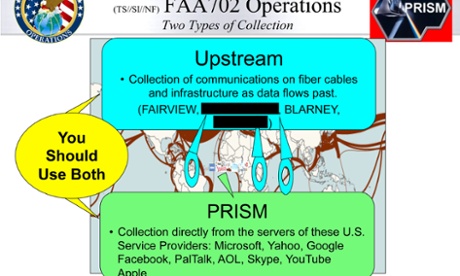
edit: It's just one new slide (http://static.guim.co.uk/sys-images/Guardian/Pix/pictures/20...) which says "directly from the servers"...but since Google is ostensibly arguing that the slides are poorly worded, hopefully the Guardian believes the other unreleased slides elaborate? The blog post ends with "A far fuller picture of the exact operation of Prism, and the other surveillance operations brought to light, is expected to emerge in the coming weeks and months...", which means that they will be releasing bombshell by bombshell, or that they think other revelations will be independently reported?
(original comment below:)
I immensely respect Greenwald, but he's setting up presumptions for his reporting that make it unassailable, no matter what the facts are.
1. Our reporting is accurate.
2. The fact that the companies involved deny it is proof that our reporting is accurate, because our reporting said that they would deny the report.
3. Therefore, our reporting is accurate.
It's possible that the reporting is accurate on its face, but the most relevant details (i.e. the ones that would separate this from, egregiously and surprisingly evil to, well, just more of the same) were not reported correctly. Has either the Guardian or the WaPo released the entire slide set?
Presumably, the Guardian is in possession of the full 41 page powerpoint. They'll likely release pieces of it at a time. Nice to see they're waiting for everyone to trip all over themselves first. I can't wait to see how this plays out in the coming weeks.
Funny. When Wikileaks did the same thing people said it was inappropriate and editorializing and dishonest. It seems that the Guardian and Wikileaks strategies for maximizing impact are on the same frequency.
My guess was that the source feared that one or all of the slides have some kind of identifying tag, if not as a meta-watermark but as something tell-tale in the content...and so had requested the Guardian and the Post to release as little as possible.
He explicitly states in those tweets that he reported the claims of both sides, which he was fully aware were in conflict, in the hopes that the truth of the reality would come out.
> The slide, below, details different methods of data collection under the FISA Amendment Act of 2008 (which was renewed in December 2012). It clearly distinguishes Prism, which involves data collection from servers, as distinct from four different programs involving data collection from "fiber cables and infrastructure as data flows past"...Essentially, the slide suggests that the NSA also collects some information under FAA702 from cable intercepts, but that process is distinct from Prism.
This specific paragraph seems like a non-sequitur...did the counter-argument that Google made rely on claim that the news reports conflated fiber optic tapping and PRISM? I thought the argument was:
1. The Guardian has slides claiming that the NSA has direct access to our servers
2. Those slides, according to Google, are wrong.
On another topic, oh to be a fly in the wall when Mr US Citizen Greenwald passes through JFK customs.