(By the way, I can tell that I am a good bit older than you are by the short time frame of your comment. Commentary about government-operated oligopoly schools not being staffed by teachers who are able to do their best for the learners in their care goes back many more decades than you guess.)
Something that HAS changed about teaching, as an occupation, in the United States in my longer lifetime is that now women have many more employment opportunities besides schoolteaching. When a woman can become a medical doctor, a lawyer, or an engineer, she may decide to take her talents into other labor markets besides the labor market for staffing schools.
http://www.personal.kent.edu/~cupton/Senior%20Seminar/Papers...
Again, I think if schools were more client-responsive, because learners had more power to shop, that would change management practices of schools and allow schools to reward better the teachers who do the best work. A teacher who does a good job is worth her weight or his weight in gold.
http://hanushek.stanford.edu/publications/teacher-quality
But the incentives in the current system, in which most schools get the bulk of their revenues from taxes, results or not, don't set up incentives for schools to value teachers who do well as schools should.
http://www.coreyshepherd.com/wp-content/uploads/Grades_Carto...
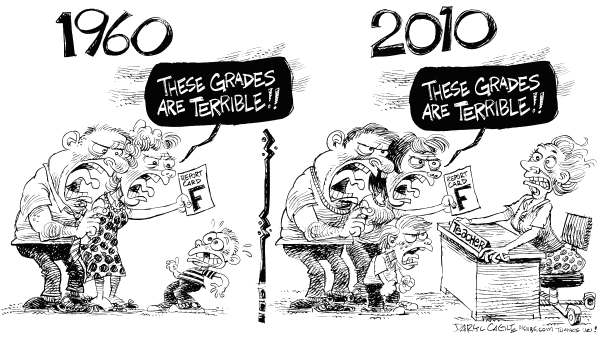
Sad but true..
My older daughter has problems with math. She doesn't like it and doesn't want to do it. Therefore, most of the problems she has with it I relate to her more than her teacher. I view it as a problem for both us as parents and her teacher to figure out ways to motivate her to try harder and to discover what problems she may have that we can work on.
On the other hand, she's a really good reader. She loves to read books and often does so without any outside motivation. When we moved to our current school district my daughter was tested for reading on a computer using software she had never seen before and was rated as a poor reader. We disagreed with this result and told the teacher that likely the problem lay with the system that she had never seen before. In her previous year in another school and at home she's a self-motivated reader that is slightly above average for her age group. The teacher stuck with the results and placed her in a lower reading group, where she quickly outpaced the other students in the group. Thankfully, after a few months, she was moved up into an appropriate group for her reading level. In that case I fully fault the teacher in that because she went with an automated system telling her what to do, didn't do an informal test of her own, and ignored her parents on the matter. Later the teacher even suggested that the sudden and large improvement in her reading was due to their reading programs at the school. The conspiracy theory part of me thinks it was intentional so that her reading scores would show a huge improvement through the school year.
You do have to keep that cartoon in mind as a general kind of thing because otherwise it suggests that there is no such thing as a bad teacher.
The reason for this is simple deduction. If you believe teacher quality is the primary drivers of educational outcomes and outcomes are not as you desire, it must be caused by low teacher quality.
(Personally I don't accept the premise that teacher quality affects educational outcomes much, but my views are way outside the mainstream...)
The reasons behind the dramatic decline in the American education system are obvious and known very well to any public school teacher: "No child left behind".
NCLB is a bad law, but it is not the cause of our education problems. Teachers like to point to it because it is an easy scapegoat and it allows them to evade all responsibility.
And the issues previous to the law were appallingly bad salaries. There are some people who love teaching so much they would do it even though they earn probably 40% of what they could be doing with their credentials. But not as many as we need.
Sprinkle in the problem of parents blaming teachers for bad grades instead of kids and it all gets worse.
I'll ignore your ad hominem attacks.
Wrong. If you believe teacher quality is the primary driver of educational outcome then anything effecting teacher performance could effect those outcomes. It does not follow that only teacher quality plays the only role unless the teachers are completely empowered.
I worry that reducing the respect given to teachers will result in fewer outstanding people choosing teaching as a career path.
From the smattering of events I noted above I do get the impression that teachers are operating scared. That they perceive that they are reluctant to make judgement calls that involve any kind of bureaucratic risk (as in the Kiera case). That zero tolerance approach seems to be a symptom of this fear and I have a lot of sympathy for both the teachers and the students. Its seems like a real shame :(
I can see how respect would contribute to the goal of education at younger ages, but in high school the successful teacher will have more resources upon which to draw than just "reverence".
Much like most things in life, sometimes teachers deserve the criticisms they receive and sometimes they don't.
Personally, I feel the most likely culprit is a combination of the government and education administrators.
(I think this is the result of many factors conspiring to undermine the ability, energy and willpower of parents to be truly engaged with their kids' education, but that's material for an entire book)