I was wondering about that too, but instead of declaring Uber to be lying here on HN, I went and looked for more information. What I found, was a news article that actually went and asked the Swedish Transport Agency for a comment[1].
STA's answer was that STA has had no direct contact with Uber, but had had contact with two companies that drive cars for Uber. Those two companies had asked for an exception from having an taximeter in the car (Swedish law requires one otherwise). STA denied the request, stating that to get an exception, one needs to follow the regulations of 1998, which states that exceptions are only allowed in exceptional cases, for instance when driving for royal families or prominent business leaders.
So, Uber is ... stretching the truth. Their claim is not a complete fabrication, but neither did they tell the whole story. I tend to put cases like this under the "company statement" category.
[1]: http://feber.se/webb/art/270558/transportstyrelsen_vill_kick...
So, yes, if they're insisting on using the "hybrid" payment model, they need a permit which is restricted to extraordinary events (essentially events where the customer won't care about the price, no matter how outrageous it is). In hindsight, I agree that calling it a lie is incorrect, I should have phrased it better. It does not, however, make me more forgiving w/r to their press release, as it's deliberately written as a factually lacking, misleading appeal to emotion.
- Permits exist for private car hire services in Sweden. The STA has issued them before.
- However these are currently reserved for circumstances eg members of royal families or prominent business leaders.
It isn't a stretch of the truth to say the STA are denying such permits to Uber, and that regular citizens should have the same services available to them as these other groups.
Lobbying isn't really a thing here, and is actually considered to be corruption. Whenever that sort of thing happens (which is pretty rare), the press is having a field day.
As an american, I would agree wholeheartedly that lobbying is most definitely corruption.
> Whenever that sort of thing happens (which is pretty rare), the press is having a field day.
Oh how I wish the US news would report something like this. Just once. But our media is in the government's pocket. Or, rather, big business' pocket, and the government in theirs. I guess that means I'm wearing a "tin-foil hat". Although I can't see it. Must be one of those government sponsored, brain-altering, invisible tin-foil hats. Bastards!
EDIT: Also, I've seriously considered moving to Sweden or one of the other Nordic (as we call them; don't know if it's the same over there) countries. Are Swedish people generally welcoming to newcomers or not? (And, yes, I know I'm generalizing; sorry.)
Generally, I think you will feel welcome. Swedes can be a bit reserved and tough to get to know, though. We don't talk with strangers on the bus, etc. Once you get to know us, though, we tend to be genuinely friendly. (Or so I'm told.)
There is some xenophobia, but the prejudice is mostly about arabs. I think if you are a caucasian/black american you will have a blast.
Really, the thing that scares me the most about moving somewhere like sweden is learning the langage ;) I don't really have a gift for (human) languages, and swedish seems pretty tough already.
There are courses in swedish offered to all immigrants. My wife did it in 4 months. Meanwhile, you won't have a problem getting around with english only. Virtually all swedes speak english, and most do it well.
In America we have a lot of laws governing the hotel industry. For the most part I think they are in place to protect the millions of Americans and tourists who stay in hotels here every year. However, if I understand correctly, some of those laws have made it difficult for new businesses to enter the market.
I went to school for finance and in my experience the social good of business decisions is rarely considered. What is considered is: Will this make a profit? Are we working within the law? I am fairly certain that, at least on Wall Street, businesses would totally run amok without regulation.
That said - sorry for going on an off topic tangent - I think that over all the consumer protection laws have public support, and the possible downsides they come with w/r to establishing new actors in a market are outweighed by the benefits they have to consumer. But nothing is without its cost, you say.
That's actually really interesting and I had no idea that was the case. In a supermarket, would such a list be in the isle next to the food? Or would it just be available from management or something like that?
You have a price per unit. Say a 0.5l bottle of beer costs 0.78 EUR and then you have the price per 100ml or 1l below it (1l = 1.56 EUR). It's marginally useful if you compare the price of rice to the price of Coca Cola but it's really useful if you want to know what's cheaper: Buying a package of 6 1.5l bottles of Coke or buying a crate with 18 0.33l bottles.
I'm a sucker for saving pennies ;)
    Item A: $3, $6/pound
    Item B: $4, $0.30/oz
Here
[1] http://2.bp.blogspot.com/-i80uxvW1SnA/Tp3zocKih4I/AAAAAAAAAJ...
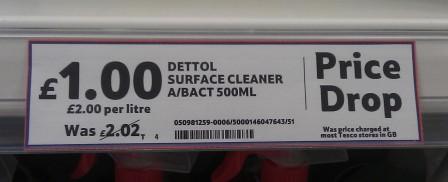
[2] http://www.freshfrom77.com/wp-content/uploads/tesco-multi-bu...

Usually, they just tell you on the shelf's price tag:
Bigger Font: 1.50€/£ Smaller Font: 0.75€/p per 100g/100ml etc.
That way, you can see that sometimes it makes sense to buy 2x 400ml ketchup (just as an example where I had it recently) instead of 1x 800ml, simply because 2x 400ml is actually cheaper.
> That way, you can see that sometimes it makes sense to buy 2x 400ml ketchup (just as an example where I had it recently) instead of 1x 800ml, simply because 2x 400ml is actually cheaper.
That applies to plenty of dastardly stuff too e.g. the big 3-5kg pots of Nutella you see around Christmas? The unit price is often twice that of the standard 750g pot.
Brand A, Orange Juice, 1L. 19.90 (Price per Litre: 19.90) Brand B, Orange Juice, 2L. 30.00 (Price per Litre: 15.00)
This is simply to spare the consumer of doing the math themselves, which can turn out to be quite tricky in some cases (although not in my example:)
Update: According to NIST, 21 of the 54 US states and territories have some form of unit pricing law.

It's on the price tag/label, there's the product price and the unit price (except bulk which only have unit prices).
Only if you swim between the isles. I believe you meant aisles.
The STA’s explanation for this is that the permit that is required should only be given to companies that drive members of royal families or prominent business leaders.
Sweden is fairly big on consumer protection, and price comparisons is generally a mandatory part of that (all groceries are mandated to list price per weight/volume/appropriate other unit so you can find out, say, which bag of rice is cheapest per kg, for instance - the same goes for taxi services and price per km). That they're being asked to follow those rules is hardly government bullying - in the eyes of most everyone here that definitely counts as "consumer protection".
It doesn't get better when they start spouting complete lies - the gibberish about certain unmarked taxi like services being exclusive to "royal families or prominent business leaders". Not related to reality at all.
To be honest, I'd never heard of this story before I saw it here. It certainly hasn't been covered by mainstream press. I don't live in Stockholm though, so it might be bigger there.