For example, computers have gotten faster, better, AND cheaper over time.
There definitely are women who are sane, smart, and beautiful. Are you kidding me? Just walk around any research university where they're doing graduate-level research and you will see lots of them.
As for the other gender triangle, pg is definitely handsome, sensitive and rich, so there's your disproof.
The "no silver bullet" thing is talking about something totally different. And it's an observation specific to software engineering (or, possibly, other specific domains, considered individually). There is a silver bullet for vaccinating against polio, but not for classroom teaching techniques.
faster, better, AND cheaper *over time*.
If you find a smart, sane and beautiful woman doing graduate research, it is highly probable that she is already married or planning for marriage with her boyfriend/partner as soon as she is out of school. (Well, this is from my experiences in Science and Engineering departments. Might be different for other fields.)
Yes, you're correct. No, she's not interested. :P
http://1.bp.blogspot.com/-7L9xAjgoZxo/ToydjJ7Hb8I/AAAAAAAABG...
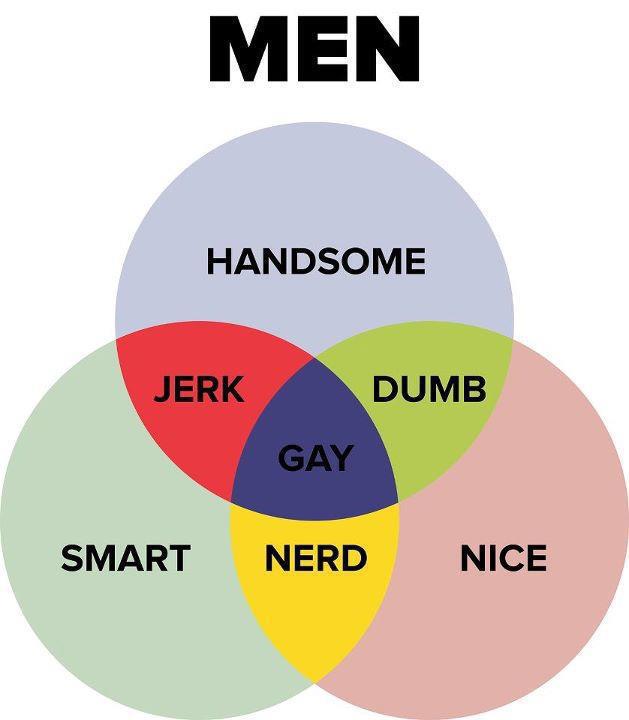
Inane crap like this helps absolutely nobody, and it perpetuates stereotypes that I think on HN we would be trying to avoid.
Why you would post this is beyond me.
Very talented people can easily accomplish all three, especially in tech.
I guess the lucrative and secure part are supposed to be in tension? EG, if something is lucrative, there will be lots of competition that fights and eats away the security? But that same lucrativeness causes security, eg, golden hand cuffs.
If a job is all 3 of interesting, lucrative, and secure, then everyone will try to get that job, and the competition will either drive the salary down, or drive the job security down, or both.
A more general version of this rule is that anything desirable (or "scarce" if you want to use an economic term) in life will soon be pursued by others to the point where it becomes no longer desirable. That's the essence of how markets work.
The trick to wealth is to know (through some combination of vision and luck) what is going to be desirable ahead of time and obtain it before everyone else knows they want it.
In an economy with a healthy labor system, someone skilled in a certain field (say, software engineering) can just get a new (sufficiently lucrative) job if they lose the one they have, so there's no _necessary_ tension between those two.
You get to pick two at most, and that's if you're lucky--most people only get to pick one, or none.
Jobs in academia are certainly no exception to this rule.