Hmm, I don't think so. I think at a fixed file size, chroma subsampling usually allows you to have fewer noticeable artifacts. Humans are so much more sensitive to luma that it doesn't make sense to treat it equally to chroma with respect to lossy compression. That said, if you don't like it, AVIF supports 4:4:4 just fine.
In my tests, AVIF beats PNG easily for lossless compression of actual photographs (for things like charts and screenshots, PNG wins of course). And for lossy, it's much smaller than jpeg and supports HDR unlike WebP. So if you need HDR and are doing lossy compression on the web, it's your best option as far as I know.
At low bpp, certainly. Though "certainly" is to be quantified since chroma is quite cheap in AV1, thanks to CfL.
> Humans are so much more sensitive to luma that it doesn't make sense to treat it equally to chroma with respect to lossy compression
The problem is that this is completely dependent on material. Sharp and/or bright red is too common a killer sample (cf https://gitlab.com/AOMediaCodec/SVT-AV1/-/work_items/2211). Make sense for video where you'll have a hard time seeing it, but for still pictures it's too problematic to apply indiscriminately unless you're encoding at potato quality anyway.
> That said, if you don't like it, AVIF supports 4:4:4 just fine.
I know, but libaom is basically a reference codec, SVT-AV1 is the only "real" one we got and it doesn't =(
> In my tests, AVIF beats PNG easily for lossless compression of actual photographs
You're right, I wrongly put photographs aside where AVIF certainly is better; probably better to compare it to JPEG2000 there. It did very well in my tests (NB: ImageMagick doesn't do "lossless" AVIF even with `-quality 100` unless you add `-define heic:chroma=444`) even though it's hard to compare because YUV => RGB is never lossless.
> And for lossy, it's much smaller than jpeg
At decent quality, is it that much better than jpegli (https://opensource.googleblog.com/2024/04/introducing-jpegli...) or even mozjpeg ? If we add FGS to the equation, AVIF has the potential to be much better, though.
  $ real_time() { command time -p sh -c '{ "$@"; } 2>&3 >&2' argv0 "$@" 3>&2 2>&1 | sed -n 's#^real ##p'; }
  $ magick identify DSC00191.ppm
  DSC00191.ppm PPM 5492x3672 5492x3672+0+0 8-bit sRGB 57.6972MiB 0.090u 0:00.042
  $ for s in 0 3 6; do real_time magick DSC00191.ppm -quality 100 -define heic:chroma=444 -define heic:cicp=1/13/0/1 -define heic:speed=$s DSC00191_s$s.avif; done
  76.71
  12.80
  1.73
  $ real_time magick DSC00191.ppm -quality 0 DSC00191.jp2
  3.315
  $ real_time sh -c 'magick "$1" -define png:compression-level=0 "$2" && oxipng -q -o2 -s "$2"' argv0 DSC00191.{ppm,png}
  7.746
  $ for e in 3 6 9; do real_time magick DSC00191.ppm -quality 100 -define jxl:effort=$e DSC00191_e$e.jxl; done
  0.53
  1.33
  7.71
  $ for m in 0 3 6; do real_time magick DSC00191.ppm -quality 100 -define webp:lossless=true -define webp:method=$m DSC00191_m$m.webp; done
  5.86
  10.41
  46.03
  $ du -k DSC00191* | sort -n
  20068   DSC00191_e9.jxl
  20608   DSC00191_e6.jxl
  21324   DSC00191_m6.webp
  21340   DSC00191_m3.webp
  21772   DSC00191_e3.jxl
  23744   DSC00191.jp2
  23848   DSC00191_s0.avif
  23896   DSC00191_s3.avif
  24212   DSC00191_s6.avif
  24556   DSC00191.png
  26428   DSC00191_m0.webp
  59084   DSC00191.ppm
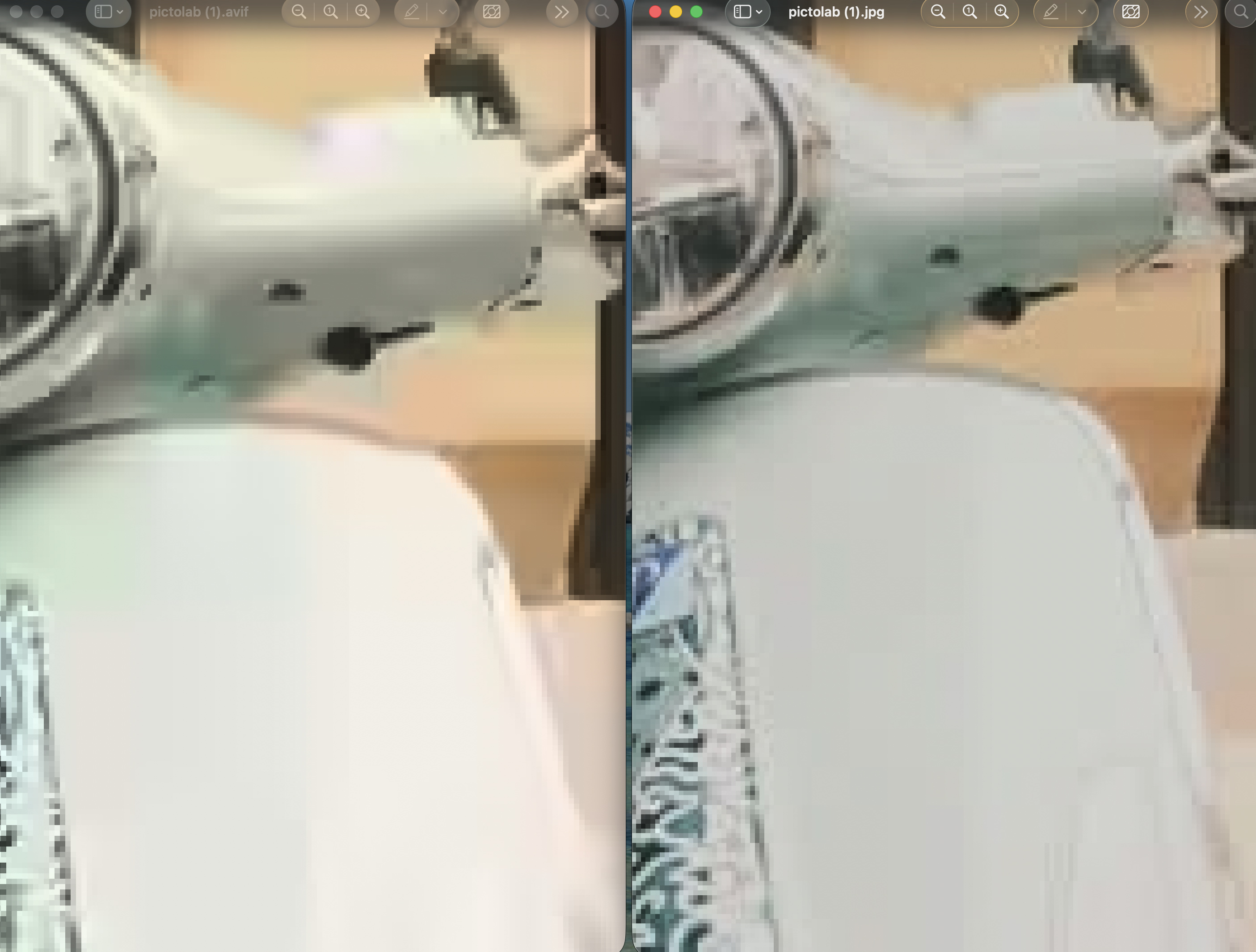
I was curious so I gave it a try and switched my photo editing site [0] to jpegli. Here's a comparison between a 29kb avif file (left) and a 146kb jpeg file (right), as produced by my site: https://files.catbox.moe/wdo9gf.png . The avif looks much better to my eye, and is of cource much smaller
[0]: https://pictolab.io
1. Lossless AVIF is a joke often beaten by WebP and even PNG. Even worse for grayscale.
2. Chroma subsampling remains a bad idea for still images unless the resolution is high enough to hide the artifacts.
3. Tooling is the worst part, AV1 encoders are basically focused 99% on video and leave a measly 1% to image; unlike JXL, of course. SVT-AV1 still doesn't do YUV444 and libaom was unusable. Fortunately, the unpaid enthusiasts were here: https://giannirosato.com/blog/post/the-multimedia-renaissanc... (and more recently https://giannirosato.com/blog/post/oavif/)
I don't see AVIF being used for lossless, which is the largest reason I'd prefer JXL to win: one codec to rule them all sure is an alluring future.