About "fine tune" part, this does not relate to PMIC(or VRM) at all, more like CPU design: How many power domain does this CPU have ?
I assume Apple probably do that more than I know, it is just interesting that their vertical acquisition history feels the most boring and the most interesting.
At least looking from the outside, it feels like relatively small pieces develop into pretty big differentiators, like P.A. Semi, Intrinsity and Passif paving the way to their SoCs.
Intel and AMD have implemented these improvements with Lunar Lake and Strix Halo. You can buy an x86 laptop with Macbook-like efficiency right now if you know which SoCs to pick.
Strix Halo battery life and efficiency is not even in the same ball park.
It's true that the perf/watt is still a lot worse than the latest gen M4 under heavy load, but it's close enough to the M1 and significantly better than prior laptops chips on x86.
It is a first gen product like the M1. But it does show the ISA is not as big of a limiting factor as popularly believed.
If you look the battery life benchmarks they did at around the 5:00 mark in the third video, you can see that it achieves similar battery life compared to the an M3 Macbook in typical day-to-day use. This reflects the experience most users will have with the device.
https://b2c-contenthub.com/wp-content/uploads/2024/09/Intel-...
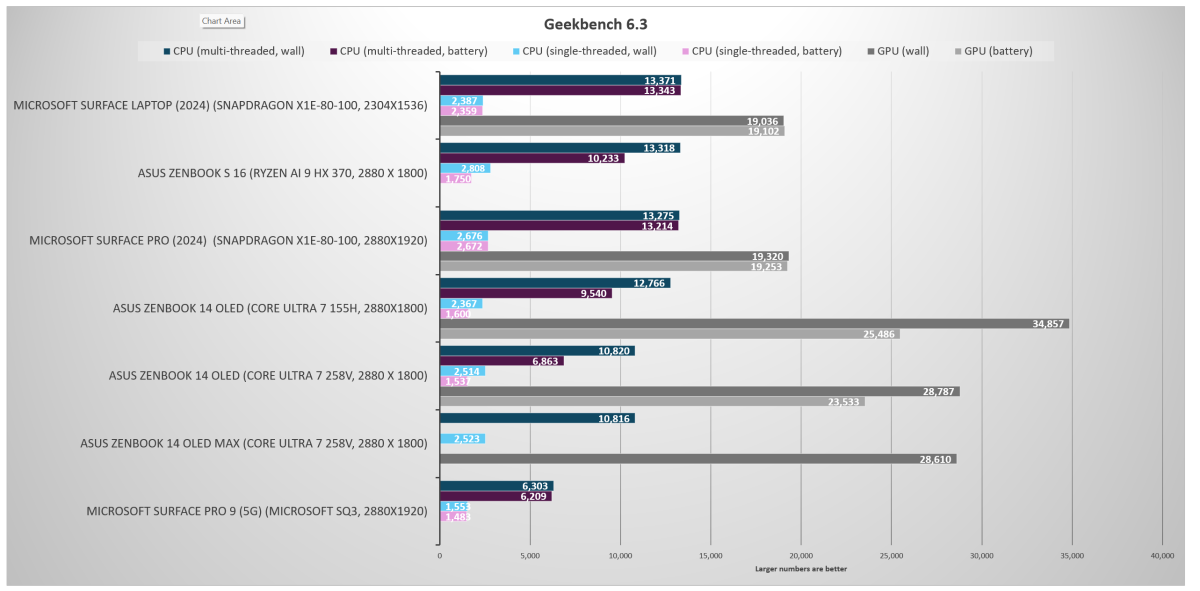
Intel and AMD have implemented these improvements with Lunar Lake and Strix Halo. You can buy an x86 laptop with Macbook-like efficiency right now if you know which SoCs to pick.
For Lunar Lake, base M4 is about 35% faster, 2x more efficient, and actually has a bigger die size than M4.[1] Intel is discontinuing the Lunar Lake line because it isn't profitable for them.
I'm not sure how you can claim "Mac-like efficiency".
[0]https://imgur.com/a/yvpEpKF
[1]https://www.notebookcheck.net/Intel-Lunar-Lake-CPU-analysis-...
In the same video, they also measure perf/watt under heavy load, and it's close to the M1, but not the latest gen M4. I think that's pretty good considering it's a first gen product.
Regarding the discontinuation, it's still on shelves right now, but I'm not sure if there will be future generations. It would be awfully silly of them to discontinue it as it's the best non-Apple laptop chip you can buy right now if you care about efficiency.
In the same video, they also measure perf/watt under heavy load, and it's close to the M1, but not the latest gen M4. I think that's pretty good considering it's a first gen product.
On battery life, M1 is a whopping 1.5x faster in single thread.[0] That makes M4 2.47x faster when compared to LNL on battery.
So no, LNL is very far behind even M1. That's why there are no fanless LNL laptops.
[0]https://b2c-contenthub.com/wp-content/uploads/2024/09/Intel-...
[0]https://www.pcworld.com/article/2463714/tested-intels-lunar-...
https://www.youtube.com/watch?v=ymoiWv9BF7Q
In this video, they show the perf/watt curves at 8:30. And they show the on-battery vs on-wall performance at 18:35 across a wide variety of benchmarks, not just Geekbench. They used a Lenovo YOGA Air 15 on Window 11's "Balanced" power plan for their tests. The narrator specifically noted the Macbook-like on-battery performance.
Meanwhile, PCWorld is one of the few that actually ran benchmarks while on battery life - which is what people will experience.
AMD and Intel chips run on loads of different hardware. On the other hand Apple is fully in control of what hardware (and software) their chips are used with. I don't know, but I assume there's a whole lot of tuning and optimizations that you can do when you don't have to support anything besides what you produce yourself.
Let's say it would hypothethically possible to put an M4 in a regular pc. Wouldn't it lose performance just by doing that?
Let's say it would hypothethically possible to put an M4 in a regular pc. Wouldn't it lose performance just by doing that?
It feels to me like we're kind of comparing speeds between a personal automobile and a long haul truck. Yes, one is faster than the other, but that's meaningless, because both have different design considerations. A long haul truck has to be able to carry load, and that makes the design different. Of course they'll still make it as fast as possible, but it's never going to be the same as a car.
Basically what I'm saying is that because it's impossible to strip away all the performance and efficiency improvements that come from apple's total control of the software and hardware stack; is it really possible to conclude that apple sillicon itself is as impressive as they make it out to be?
Well, I'm a consumer, and I certainly care. But I get your point that a lot of people just want a machine that allows them to browse for 10 hours without needing to be charged, and don't really care about anything else.
But do you also get my point? that on some level the chips/hardware are so different that it's like comparing apples to oranges?
- RAM on package
- PMIC power delivery
- Better power management by OS
Geekerwan investigated this a while ago, see:
https://www.youtube.com/watch?v=Z0tNtMwYrGA https://www.youtube.com/watch?v=b3FTtvPcc2s https://www.youtube.com/watch?v=ymoiWv9BF7Q
Intel and AMD have implemented these improvements with Lunar Lake and Strix Halo. You can buy an x86 laptop with Macbook-like efficiency right now if you know which SoCs to pick.
edit: Correction. I looked at the die image of Strix Halo and thought it looked like it had on-package RAM. It does not. It doesn't use PMIC either. Lunar Lake is the only Apple M-series competitor on x86 at the moment.