One of the biggest follies of the soy meat industry is trying to make their products healthy by default. Until they may a soy-based animal fat alternative, they don't have a fighting chance of competing. People who truly enjoy meat realize the importance of fatty tissue and how it contributes to flavor.
Go eat a slice of nicely prepared picanha, fat rind and all, and then show me a soy-based product that is even in the same ballpark.
And it still tastes awful.
In fact, if you look at a lot of soy meat substitutes out there, a lot of them are not at all good for you. The whole "soy meat healthier than real meat" thing is pure perception.
I have chosen to avoid meat substitutes, but I am aware of Quorn. I just didn't read the OPs post like that.
What happened here is that one particular luxury (meat) was cherry-picked, out of ideology, and then coated in the veil of population growth and sustenance.
Thats distorting the point, because as the population continues to grow exponentially, any luxury will eventually subside. That can be a car, electricity, a toilet, more than a few square feet for yourself or your basic human rights.
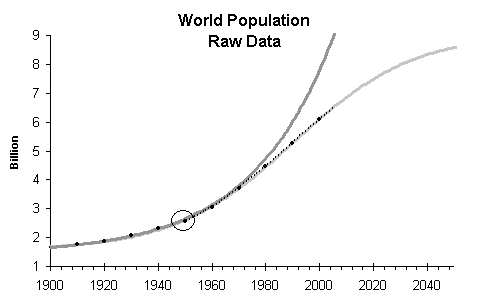
The "populations grow exponentially" argument was state of the art in 1798 [-1], but modern science has taught us that populations grow roughly logistically [0], not exponentially. It's easy to mistake for an exponential in the lower part of the curve (which is all the data we had in 1798), but once you know what to look for, you can see the difference clearly [1].
Of particular note, "exponential growth" means you'll see the same percentage growth rate every year, and larger and larger absolute growth. But what we actually see in humanity is that the percentage growth rate maxed out in the mid 1960s (about 2.2%; it's presently below 1.1%) and the absolute growth rate was at its peak in the late 1980s (88 million in 1989, down to about 75 million now) [2].
Every credible estimate of peak human population puts the number in the 9-12 billion range [3]. That's a lot of people, and will perhaps require some cutbacks, but it's nowhere near the dire levels you predict.
[-1] http://en.wikipedia.org/wiki/An_Essay_on_the_Principle_of_Po... is the origin of the idea
[0] http://en.wikipedia.org/wiki/Logistic_function#In_ecology:_m...
[1] http://www.growth-dynamics.com/articles/Kurzweil_files/image...
[2] http://en.wikipedia.org/wiki/Population_growth#Human_populat...
[3] http://en.wikipedia.org/wiki/Projections_of_population_growt...
And then we run out of oil. What happens as the mortality skyrockets and humanity downsizes to the new carrying capacity?
It very much matters which it is. It's the difference between stabilizing at 20% more population than we currently have and dealing with a little more overcrowding, and getting so crowded that we don't have toilets any more.
Running out of oil is going to change American lifestyles significantly. I'm not convinced it's going to change global carrying capacity by very much, though. Do you have a credible model that says otherwise? I would like to see such a thing (in its fullest form.)
"Until pressure from a ceiling is applied" is the difference between stabilizing at 9 billion people (a bit more crowded than right now), and growing to so many billions or trillions that the grandparent poster's "no more toilets" prediction would be realistic.
Neither you or alexchamberlain actually address his underlying point, so I downvoted you too.
http://www.thekitchn.com/twitter-co-founders-betting-big-on-...
Mince would be easy to make. A real cut of meat (like a rib-eye) would be much harder, but if it's $5/pound for mince "steaks" (patties) and $30/pound for real steaks (massive world-wide demand for tender cuts, but no demand for the tough bits which used to go in hamburgers) then ... well ... people will go for the mince.
And science will eventually give us 100% artificial steaks. Delicious, lab grown meat.
> credible plant-based meats in 20 years
What is a plant-based meat? I don't know of any plants with muscles.