The life expectancy of a 60-year old going from 74.4 to 84, or a 70-year old from 79.1 to 85.9, is significant and meaningful. Not as much as a newborn's LE going from 41.6 to 81.1. But far from "pretty stable in the 70s-80s range for most of human history."
Also, recent life-expectancy increases have come from adult morality reductions [1].
> adult morality reductions
LOL
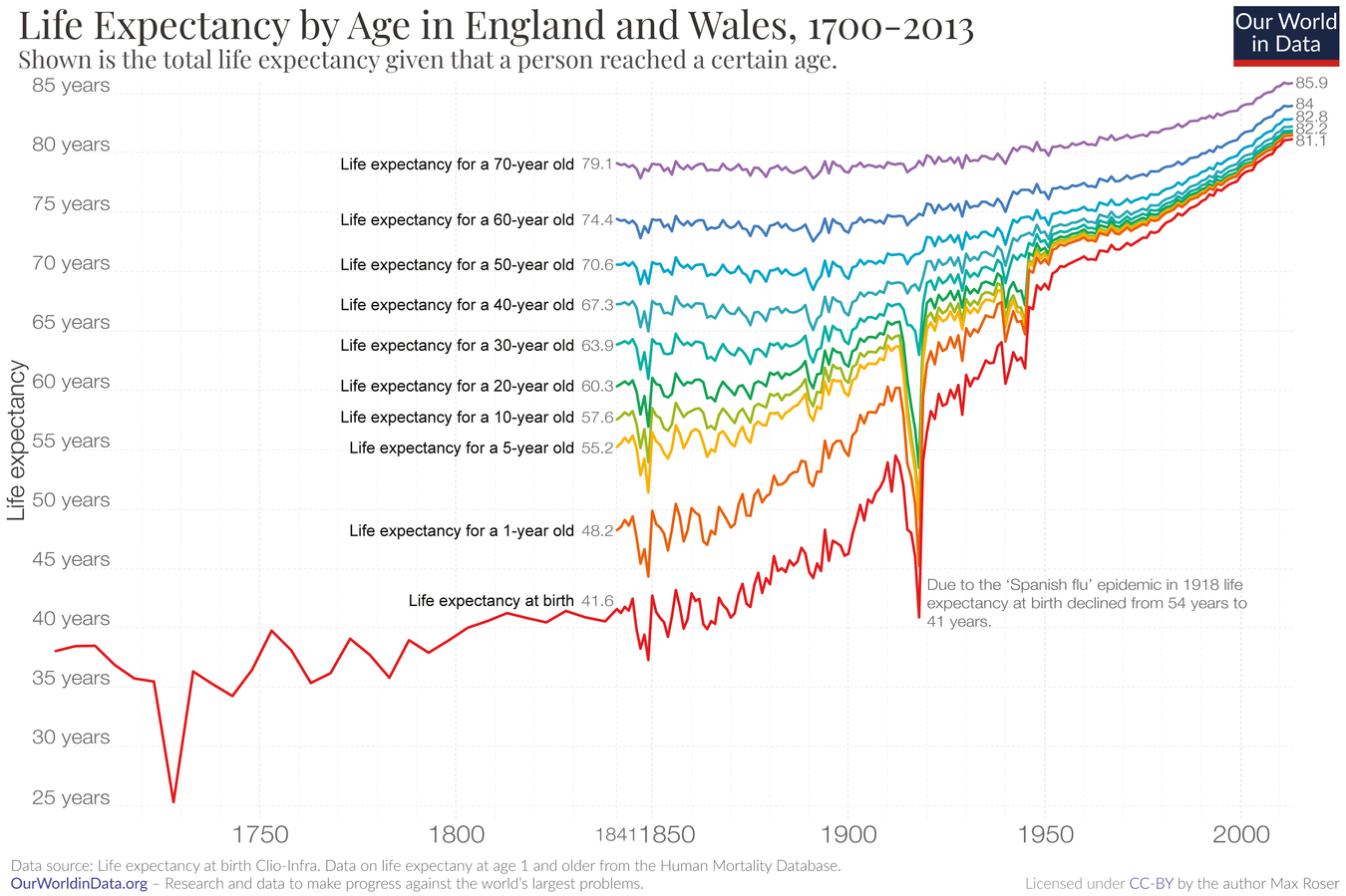
In 1850 a 0 year old would expect to live to 41.6 years. A 5 year old would expect to live to 55.2.
If we waved a magic wand and let all infants survive past childhood with nothing else changed in 1850 life expectancy would still be 27 years lower than it is today. Or put another way you'd have the same life expectancy as someone in South Sudan or Somalia.
Nobody waved a wand. The contaminated milk that killed infants killed adults too - alcohol and milk were alternatives to unsafe water. Public health, medicine and other factors improved things.
We don’t really have great stats from before the 19th century. Was 1850 a nadir in life expectancy? I’m not sure - but I suspect it varied by region and rural/urban conditions. 1750 NYC wasn’t as gross as 1850.
If by pedantry you mean that I'm not ignoring the cause of 70% of the improvement in life expectancy in the last 200 years then sure.
I am partial to using unform priors over all possibilities, and then just adding in the actual evidence for which you can actually quantify its quality/strength. Your "prior" for a new situation is constructed by applying the data you already had previously to a uniform prior- not by fabricating it from whole cloth via your biases. In practice this may be impossible for humans to do in their heads, but computers certainly can!