But shutting them down when you already paid all the costs is clearly stupid.
And he didn't say carbon free. He said "increase carbon emissions" (he probably meant carbon dioxide emissions), and it clearly will increase them.
Also a working nuclear "you already paid for"-plant costs money and produces carbon emissions.
edit: added link.
For the equivalent amount of energy wind turbines use hundreds of times as much raw materials as nuclear - even including building the nuclear power plant, not just the uranium.
500 tons of materials for 1MW (actual) wind turbine.
That would imply a 1GW reactor should be less than 500,000 metric tons in order to use less materials, and while I can't find figures for the weight of a nuclear reactor, they certainly are not that large!
A proposed thorium reactor: http://www.thorium.tv/en/thorium_reactor/thorium_reactor_1.p...
500 tons, for 100MW - meaning 100 times as much material is used for a wind turbine compared to thorium. Uranium uses larger buildings, but still much less than wind.
1) are the raw materials the same raw materials? (Iron is easier to get than tungsten for instance). Are the materials used in either type of generation actually hard to find or in danger of becoming scarce?
2) How much extra energy is spent on processing the raw materials to the finished product? The vast majority of weight in a turbine is the tower, which is relatively simple to build compared to the thousands of miles of piping welded together in a nuke plant. Even if weight of resources/watt of generation was a good measure, you are not factoring the weight of a) fuel to create energy consumed in manufacture, and b) weight of wasted resources in the refining and manufacture processes.
3) How reusable is the material base? How much of a nuke plant can be used to create the next plant? Presumably a wind down can have it's turbine or airfoils replaced independently of the tower structure itself, reducing tco. (and total resource consumption).
4) Your analysis is not including weight of energy production fuel put in, nor the weight of all resources needed for dealing with post energy production waste (not insignificant in nuclear waste storage).
Most of a nuclear plant is concrete (the containment building) and iron (the reactor body). And both those materials are easy to get. The pipes are minor in comparison (in terms of materials, not in terms of construction). There isn't much if any tungsten used in a reactor, it's all ordinary iron, copper, concrete, etc.
In contrast a wind turbine uses hard to get neodymium rare earth magnets.
Nuclear plants don't require exotic materials.
2:
It's about the same for nuclear plants and wind turbines - you make a mold and pour the concrete. You might have thousands of miles of pipe, but you also produce a thousand times as much energy.
Not much waste in either during manufacturing - any extra metals are reused, and the concrete is poured in place. So it's about the same for turbines/nuclear plants.
> weight of resources/watt of generation was a good measure
It's an approximation of how much resources are needed (mining, energy, etc). We are worried about CO2, but mining also causes pollution, and uses energy.
3:
In a turbine it's the tower and blades both that need to be replaced due to material fatigue. The generator can be reused. The tower is wasted (it's poured concrete). The blades can be melted down, but they are light, and it's not a lot of metal - making them is the hard part.
We've never reused a nuclear plant (that I know of), so it's hard to say what would happen there.
They last a lot longer than wind turbines though, in the range of a 100 years vs 20.
Most likely the nuclear core would be removed, and the building reused for the next power plant. The building itself doesn't wear out, but they might redo the control equipment (pipes, wires, all very recyclable stuff).
4:
The weight of the fuel is tiny - less than 100 tons of fuel for a 1GW reactor, and it lasts around 10 years. That's equivalent to a couple of bolts on a wind turbine (which produces 1/1000 of the energy).
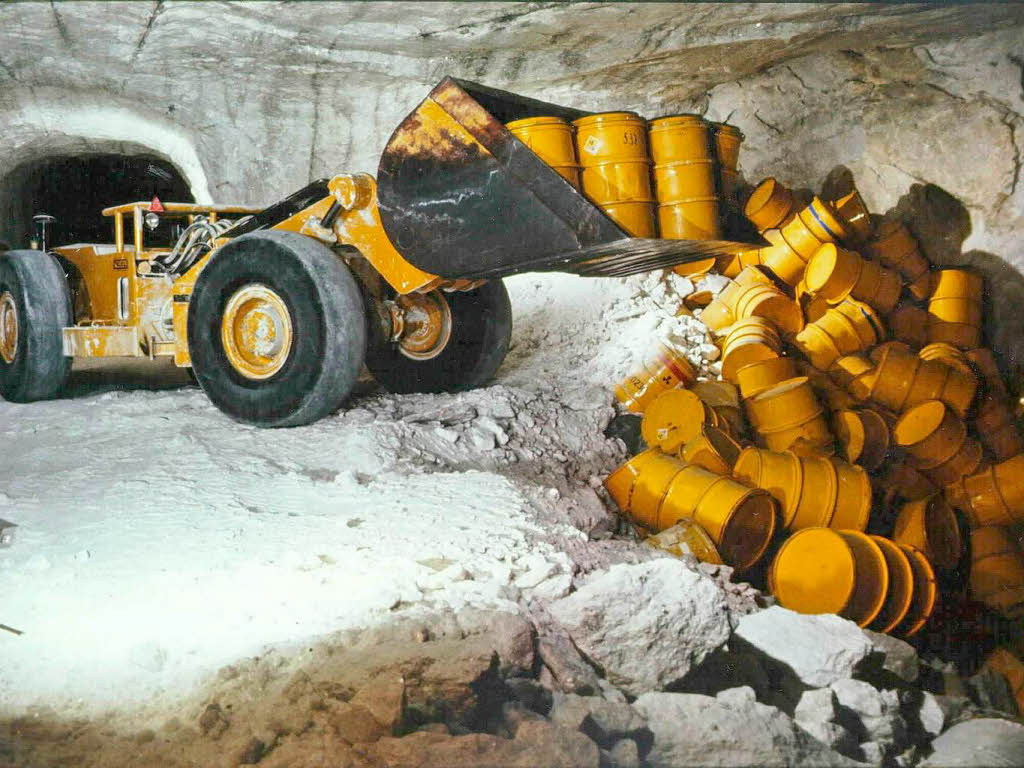
Waste is troublesome, but doesn't use a lot of materials. It's about one semi trailer load - every 10 years, for a plant that produces 1000 times as much as a turbine (which also fits on a semi).
Yeah, I bought 1 kilo of Uranium in the supermarket last week. Was pretty cheap.
I was saying that wind might have no emissions, but you still use lots and lots of resources in building it, so you have to include those when analyzing environmental impact.
No, but of course solar power isn't carbon free either by the same logic. The problem is that in the short term the power that those nuclear plants were providing is being made up for by coal plants, which are much worse for the environment.
This is exactly the point the article is missing. According to the german public, for the environment and the whole humanity the risks from nuclear plant are that high that coal plants, even though they are now used more and are unhealthy, are way less dangerous.
Keep in mind that the plan is to shutdown all nuclear plants, substitute them with green energy and use coal only as long as needed in between the change.
Yes, and the German public is flat-out wrong.
Accidents have happened, will happen again and carry a cost that's hard to accurately quantify (death toll among the hundreds of thousands of Chernobyl liquidators is approaching 10% according to their Union and still on the rise; a new sarcophagus is being built right now, and I won't even guess at the cost to public health).
Thorium reactors can help with some of the issues, but are decades away from being viable in Germany. Investing in a smarter European grid seems to me the most rational choice.
And to all these people talking about the environmental cost of coal plants - there are two things you should take into account: They are intended as a short to medium term solution, and only about 45% of the total C02 emission of Germany is due to energy production.
45% sounds very high; did you mean 4.5%?
I know that people on HN obviously like technology, and noticed that many people who like technology like nuclear plants. Maybe because they see them as great technology and are able to believe in that.
But given the facts, no, the german public is not wrong. They are undisputably right. The Super-GAUs prove that.
So what? Those accidents are miniscule in comparison to the everyday operation of a coal plant. The damage caused by the worst nuclear accidents in human history is still less than the every day operation of a coal plant. Hell, we've lost more people to coal mine cave ins than we have to nuclear accidents.
>But given the facts, no, the german public is not wrong. They are undisputably right.
No, they're not. You're insane. The German public thinks nuclear power is more dangerous than coal power, and they're just wrong. It's not even an argument.
2. We do coal mines way longer. Even if the number is right, that "we've lost more people to coal mine cave ins than we have to nuclear accidents", (which is hard to agree with, cause it is statistically a hard problem to count the ones still dying from cancer years later because of Tschernobyl for example), that number would be meaningless.
3. Coal power is highly disputed in Germany. It is only accepted as a transition-help while heading to green energy. And yes, i think that's a good thing - and no, i'm not insane.
Fukushima: a series of cock-ups magnified by one of the world's most destructive tsunamis. This nuclear plant should never have been built where it was, and its old technology should have been decommissioned years ago. Yet the death toll due to the accident is still, what, five?
Three Mile Island: injured fewer people than a single typical high speed road accident.
Just because there hasn't been a Tsunami in Bavaria YET doesn't mean we should take the chance.
http://en.wikipedia.org/wiki/Fly_ash
Over 71 million tons of the stuff per year (According to wikipedia sources) in the US alone that has to be stored somewhere. Mostly* in landfill sites or ash ponds which renders them "waste areas of uninhabitable land", and this is part of normal operating procedures, not when something goes catastrophically wrong.
* Recycling accounts for 43% according to wikipedia sources.
The estimates on radioation related deaths of infants is of the same order, and there are Russian claims that 90% of liquidators (at least 747,000 people according to the German Gesellschaft für Strahlenschutz) are invalid.
[1] http://www.scribd.com/doc/50890761/Nuclear-s-Endless-Nightma...
Citation needed.
What do the USSR nuclear accidents say about German or US or Japanese reactors? Look at how many nuclear accidents USSR Navy ships had compared to US Navy ships.
I can see an argument to 'close the old ways, we do it better now'. But 'close all of them, because I don't know the difference between them and I'm afraid of anything with the world nuclear in it' is just fear mongering and it's a shame that Germany fell for it.
As opposed to the air pollution from coal burning, and accidents installing solar and air; which are fatal every year.
That's excluding all the other pollutants they send out, from mercury to lead to carbon, which are far worse.
Edit: For the downvoters: http://www.cejournal.net/?p=410 - It IS disputed, I didn't say what is right. Stay fair.
For instance:
"What it really means is that radiation emissions to the environment from an operating nuclear power plant actually are lower than the radioactivity emitted from a coal plant through fly ash residues. That’s because the reactor vessel, fuel rods, and any radioactive waste on site are well shielded, whereas fly ash, with small amounts of deadly radioactive substances, simply is emitted into the environment."
The author appears to be saying, well, if you ran an un-shielded nuclear reactor and threw all the pollution in the air on purpose instead of containing it, then coal ash emits less radiation into the atmosphere. Well, okay, fair enough, but in practice we don't purposely take nuclear waste and fertilize our crops with it, and I don't think anyone's arguing for that.
Germans are always saying this. It was 90F in Berlin yesterday. That is air conditioner weather, period.
The part about most people not having them is true, though. This US expat is hooking his up this week, despite power costing twice here what it does in California.
So yes, we do get hot days, but it's still rare that people have air conditioning in their flats. Modern office buildings have air conditioning though and most shops as well. Still, when the temperature difference is lower you still need less energy to power them. Another point is that it's a rare occurrence to have no sun (hence no solar power) and massive heat.
(90F = 32 degrees Celsius)
Whine whine whine
The summer in Germany isn't that hot. Middle europe, not california. Accordingly, we don#t have air conditioners (in general)
These scenarios do happen. They're not always as straight-forward as the one suggested (low production/high demand). A few weeks ago there was a sunny/windy holiday in Belgium (May 28th). Due to overproduction and low demand they had to avert a national blackout by paying France to sink the surplus energy. In Belgium, renewables account for 7% of energy. That weekend it was 3 times as much.
Of course such scenarios happen, especially the situation you described.
Also, surely the obvious thing to do would be turn off some of the turbines in that situation?
- You don't have centralized access to all the facilities. E.g. small and medium-scale solar falls under the control of the owner AFAIK. Large scale wind also has other parties involved that don't want to miss out on income.
- Control of energy production on a national or regional scale follows prediction models, not only for demand but also price of resources such as gas and weather forecasts for renewables. So for a holiday they would shutdown a number of "classic" facilities to follow a day-ahead schedule. This probably increased the dependency on renewables for that day.
The big question "why didn't they shutdown wind farms": I don't know but I plan to find out.
EDIT: grammar
[0] http://eur-lex.europa.eu/LexUriServ/LexUriServ.do?uri=OJ:L:2...
[1] http://eur-lex.europa.eu/LexUriServ/LexUriServ.do?uri=OJ:L:2...
> Without prejudice to the maintenance of the reliability > and safety of the grid, Member States shall take the necessary > measures to ensure that transmission system operators and > distribution system operators in their territory guarantee the > transmission and distribution of electricity produced from > renewable energy sources. They may also provide for priority > access to the grid system of electricity produced from renew-able energy sources. > When dispatching generating installations, > transmission system operators shall give priority to > generating > installations using renewable energy sources insofar as the > operation of the national electricity system permits.
However, it is superseded by 2009/28, which states in Art. 16 - 2 (a):
> Member States shall ensure that transmission system operators and distribution system operators in their territory guarantee the transmission and distribution of electricity produced from renewable energy sources
I believe the confusion stems from the distinction between right to connect to the grid and right to offload power to the grid. It seems clear the latter is indeed mandated at the E.U. level.
>"If you close eight nuclear plants, which were carbon-free, overnight, you will increase carbon emissions,"
Nuclear plants are not carbon free. Getting the uranium, transporting the nuclear waste, transporting the people who run the plant costs a lot of carbon emissions. You need to look at the whole picture.
>Inevitably, some hot July week will come when a high-pressure system stalls over Europe, stilling turbines just when sunburned Germans reach for their air conditioners
The summer in Germany isn't that hot. Middle europe, not california. Accordingly, we don't have air conditioners (in general)
Look at who is cited - People from large companies loosing their monopoly and Sinn, a conservative "expert".