Although they were quieter about it, it has been quite clear that Apple was interested in resolution independence since at least 10.4, when such features started to show up.
Remember that very few third-party Windows applications use WPF. Most first-party stuff, even, doesn't use WPF. We're seeing on the retina Macbook that, while most Cocoa apps work well enough, most non-Cocoa apps are at least somewhat broken; imagine how much worse this effect would be on Windows, where so few apps use the current UI toolkits.
Microsoft had the software stack ready - imagine if they had released (via partners) high-dpi laptops and screens shortly afterwards? That actually might have made a Windows machine a compelling and desirable product, instead of just an expensive way to run a browser.
This new approach, where you have a point be an integer number of pixels, possibly with scaling after the fact (as with the non-standard resolutions available on the retina MacBook) is far simpler for developers, so more likely to work out okay.
I refused to let go of it for so long exactly because there was no LCD that would be an upgrade, with the sole exception of the expensive T221. Guess now's the time :-)
It was pretty nice a decade ago, when everyone was moving to LCD monitors that were vastly inferior in every measure beyond size or weight, but, at least in terms of ppi (and on consumer grade equipment), display technology eclipsed the CRT quite a while ago.
edit: I'd forgotten that CRTs were measured with the bezel included, so at 20" viewable, the display is 128ppi. So closer, but still pretty far behind.
Microsoft sells some rebranded hardware products (manufactured and designed by Samsung, Acer, IBM, ATI, Nvidia and Asus)... but it makes PROFIT by selling software.
Apples makes software, but it makes its PROFIT by selling hardware.
The 360 I give them more credit with, because they worked closer with partners and got off the WinTel brand... opting for PowerPC chips with ATI ... again, not manufacturing the hardware.
"That's because Apple isn't a real hardware company, it's all white-labelled." I guess?
Apple makes money by selling hardware. Microsoft makes money by selling software. Google makes money by selling ads. Amazon makes money by selling goods.
Graphic for the insanely dense: http://visualign.files.wordpress.com/2012/02/applemicrosoftg...
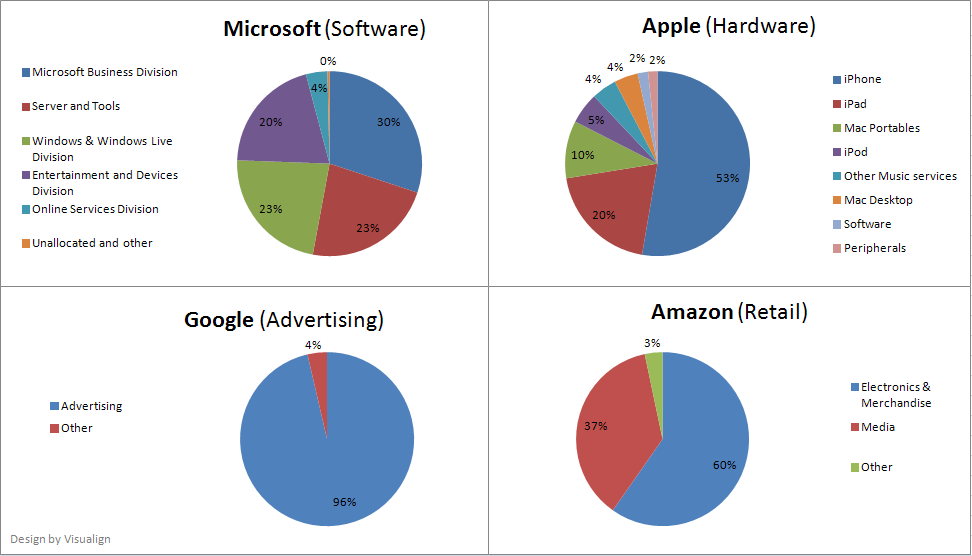
Let's move on from your inability to admit the silliness of classifying a large company with many different divisions as a "software company" and go back to your original contention: that Microsoft were unable to bring a new hardware device to market because they did not have a enough "supply chain dominance". Whatever "supply chain dominance means", you're wrong --- Microsoft have, in the past, released hardware products. The Xbox is an obvious example. So is Microsoft Surface. There is nothing more "whitelabel" about these products than there is about the MacBookPro.
Apple designs its own hardware, even does some FAB work now in regards to its chips.
Microsoft doesn't move enough hardware to have anywhere near the supply chain power of Apple. Microsoft is a pathetic flee in the hardware world compared to apple. Hardware (manufactured and DESIGNED by others) makes up less than 20% of Microsoft's business.
Apple is first and foremost a hardware company. Apple is known for its incredibly well run supply chain and operations which give them amazing power to lean on manufacturers.
Apple will guarantee and lock in massive purchases removing the vast majority of risk from the hardware vendors, allowing hardware vendors to take risks on stuff like the Retina Display.
Nearly all of Microsoft's non-trivial plays have failed pushing and partnering with people. They promised to market and move tablets for years... FAIL. Windows Phone was going to change the world... FAIL. Zune... FAIL. Hardware vendors or rightfully terrified of Microsoft as a partner, even when they fully commit -- you know why? MICROSOFT IS NOT A HARDWARE COMPANY.
http://www.businessweek.com/magazine/apples-supplychain-secr... ... and google "Apple Supply Chain" to find literally dozens of more stories about how good they are at this.
Back when WPF was still called Avalon, Microsoft were pushing the technology as a solution for the soon-to-be-arriving high-dpi displays (which, we were assured, were right around the corner). As an example, see a contemporary blog post: http://blogs.msdn.com/b/marcelolr/archive/2004/12/03/274213....
Given that Microsoft were (are?) deseperately trying to hold back the tide of web-based applications, wouldn't displays like this, combined with tchnology such as WPF, have been a killer feature of a desktop OS? And hence, shouldn't they have been a high-priority for Microsoft?
So why did Apple get there first? Why didn't Microsoft research/fund/introduce these high-dpi displays?
Edit: More links from a Coding Horror post from the same year: http://www.codinghorror.com/blog/2004/11/trapped-in-a-bitmap...