The people I know who could benefit most from budgeting do not think of money as fungible. They mentally allocate different incomes to different spending categories
This seems like an opportunity for a tool to break the mold and offer a solution that fits how people feel about money vs how they “should”
If I made $3000 this month and $300 of that went to a retirement account and $1000 of that went to tax withholdings and another $300 went to child support, and of the remaining $1400, I had direct deposit put $1000 in savings and $400 in allowance... how would that be represented?
I contend that for this (these numbers are purely made up for ease of talking about):
    (income 1)
    $3000 -> $300 child support
          -> $300 company retirement plan
          -> $1000 tax withholdings
          -> $300 allowance -> {various 'fun' expenses}
          -> $1100 savings  -> {various 'not fun' expenses}

    (income 2)
    $2000 -> $700 tax withholdings
          -> $200 allowance -> {various 'fun' expenses}
          -> $1100 savings  -> {various 'not fun' expenses}
Having $2000 and $3000 go into one big bucket of a 'main' account, while working under the 'all money is fungible' fails to capture some reality of how money flows. For example, if income 1 loses their job, child support goes to $0 (not $300 from income 2) as does the $300 for retirement and the $1000 for tax withholdings.
It's totally fungible though.
Money itself is fungible, else you'd be marking every single dollar bill specifically with some unique mark.
But still, I'm curious what you mean by your last paragraph, do apps that utilize the envelope method such as You Need A Budget not already help you do this?
Also, you can configure the flows completely freely, so each case you mention will work easily!
When you say freelance goes directly to savings, are you saying you want something like "no matter what I earn from freelance it goes to savings"?
Yes. Or another account so that you have clear accounting for tax purposes. "This account gets freelance money and this money was spent for home office expenses related to the freelance work which is deductible from that income stream."
Child support obligations come out of one income as a percentage of that income - but not the other. A two income family where the husband is paying 10% of wages to child support for example - its 10% of his $1000 / month that never hits the main account, but her $500 /month is untouched and goes to the shared account. This could be complicated if she was a 1099 worker and needed to keep track of that money separately so that it could have the proper taxes taken out of that and have the resulting "actual money" that is spendable go into the "can be spent" bucket.
While money is fungible, the depiction of money flows when it hits a "one big bucket" makes it so that the value behind the Sankey diagram is lost. Is all the money that your household makes taxed the same way? Do you file jointly or separately? Is there a separate account for isolating certain expenses for reporting purposes?
https://alternativeenergyatunc.wordpress.com/wp-content/uplo... is useful and one will note the lack of a big bucket. Or consider the original one - https://upload.wikimedia.org/wikipedia/commons/1/10/JIE_Sank...

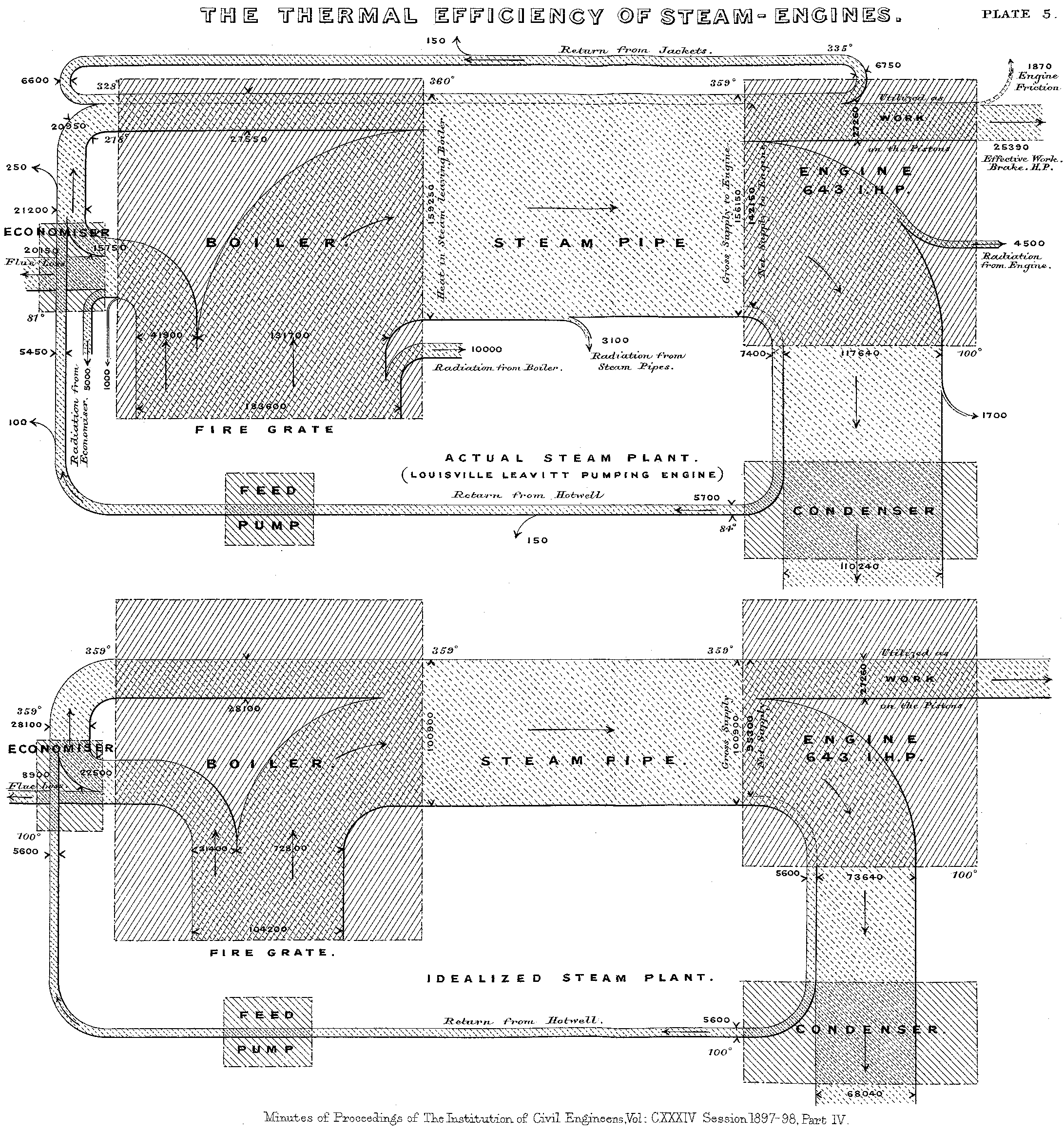
There is information lost when it goes to one big bucket.
Was spent? Are you sure you're not mixing up budgeting and accounting? I think you want to use Sankey to display your accounting.
You can see an example I quickly created for this here: https://sankeymatic.com/build/?i=OoQw5gpgzgBA2gFgKwAYC6MAqIA...
For example if I earn $500 from freelance work, but spend $200 on marketing and $400 on transport to do that, then a Sankey diagram like the one on the front page where everything gets intermingled in a main account and expenses get deducted at the end make it seem like this freelance work is a good thing and I should probably do more. In a good Sankey diagram I would immedately deduct the expenses from the freelance work, and see that instead of freelance income reaching my budget I'm actually subsidizing freelance work from my salary income.
Similarly in your example it's immediately obvious that if the wage would vanish a lot of the taxes would also vanish
An example of one that disappoints is https://www.reddit.com/r/dataisbeautiful/comments/15f01pb/oc... where that one big bucket of 'total applications' loses a lot of data. Was everything from Dice ghosted? That would be useful information. I would contend that there's no value in the 'total applications' bucket in there at all other than to sum up the leftmost column - which can be done separately.
One big bucket isn't necessarily wrong, but if one is trying to show off the features of the Sankey diagram, showing it with the stronger representations that it is capable of doing can be useful.
Having seen countless poorly done ones with an everything bucket in the middle that squashes valuable relationships between the inputs and outputs... and that's a turn off for me when they are presented that way.
It'd start to be a layout algorithm at that point, but example input arm 1 being orange (everything else blue) and the orange then subdividing into its ultimate destinations. Eg. 20% of this output, 15% of this one...
If you could do something like this automatically that would be really cool, although probably not and only useful in a few very specific circumstances.
- health saving accounts
- pre-taxable gross income
- tax rate for FICA (social security income tax)
- medicare tax
- medicare premium
- SSDI additional income tax (5-stage)
- 401K withholding
- stock matching by its company (3-stage)
- flow disruption by separate activation of retirement benefits (9-stage)
- long-term disability tax
- any local/state income tax and their eccentric stages.
What you want to avoid is a straight line to the "budget" bucket but instead toward a "taxed cash-on-hand" and "untaxed cash-on-hand" in general-ledger-speak.
So you have several Sankey groupings like:
- individual earnings
- pretaxed lockup
- taxes
- deferment to next year's tax return
- taxable benefits (payout of SSRB, 401k, annuity, student saving accounts, interest earned, capital gains/losses (including recent "bitcoins"
Then you can fan out to crazy spending stuff: I don't bother with that part myself.
In my own budgeting, my direct deposit can go to multiple accounts - and I do. Part goes to my "allowance" account and part goes to my "savings" account. Other people have alimony, child support, or similar withholdings from their wages.
So the question I have for the example budget on the page, can you have the freelance work go directly to savings? Or 300 be taken out of salary and go to child support without hitting the main account? If you have two incomes in a household and the breakdown is "two personal accounts and one shared account - each person contributes 10% to their own and 10% to the other person's personal account, and 80% to the shared account," can that be shown that way rather than one "main" account?