Yes. And when you do that they tend to buy more than they originally intended.
> I like to look at the boxes and visually scan the shelves and see things I might not think to search for on my phone.
Precisely. The store and those products are designed with this exact outcome in mind.
> but the dry goods and other stuff that's typically in center of the store could work.
That's why many warehouse stores have home delivery but put a hefty fee on those items. Unless, of course, you spend more than a minimum threshold. It's a narrow margin business so it's hard to reliably make any other type of model work.
On the Home delivery point. You're right free home delivery and narrow margins don't mesh. Yet, I have FREE home delivery options at dozens of stores/grocers in my area. I've never seen what I'd call hefty fees for this service. It's usually in the $1-10 range. They really compete for customers with this option; in my area anyway. Also, they push curbside pickup really hard now and it's always free. I've never seen that have a fee, yet someone in the store is being paid to walk around and pick your order off the shelves. We're paying for it somehow and this trend really took off during the same time as inflation ratcheted up, so my guess is it's being baked into prices and every customer is sharing the cost. In any case, I don't see why the in store shopping process couldn't be improved while home delivery coexisted. They each have their place and each customer has their preferences. Using myself as an example again, I do like pickup when it helps the logistics of my day or if I know exactly what I need and maybe I know it's heavy and want to be lazy.
Are you sure those aren't introductory offers?
> I've never seen what I'd call hefty fees for this service. It's usually in the $1-10 range
Is it being fulfilled by the store or Instacart? I'm referencing Costco which can charge $1 to $3 _per item_ for delivery, unless you order more than $75 in total. Those orders are fulfilled by the warehouse and not a third party.
> They really compete for customers with this option
They might just be outsourcing it and your subsidy is actually the third party investors.
> Also, they push curbside pickup really hard now
What does that look like? It's free, as you say, so what is the incentive, exactly?
> They each have their place and each customer has their preferences.
Which works as long as the cost of each preference is equal. Typically, it is not, which is my point. So you can set your expectations for the "future of grocery" around that, at least, until it changes.
I'm sure the free offers will go away at some point, but it's been available since the pandemic shook things up and is available to all. It's not like a Prime program type thing or a first delivery free promo. I have friends/family that have been using it for years now and never paid a cent (directly to delivery). Most retailers around me have their own pickers. Most employ drivers too, but some use the gig services on the backend as an outsourced delivery (customer wouldn't know at time of order). Pretty much all of them have gotten away from Instcart services although customers can still utilize it if they want to directly. It tends to be expensive so most people I know only use it if they need something from store that doesn't offer delivery. It's pretty rare now I think, but was pretty common pre-pandemic.
Curbside incentive is for customer is convenience. I live in a car dominant city. I think a common scenario I hear of is; can shop on device from anywhere, while taking kids to soccer or whatever, then you just quickly pick it up on the way home (it takes usually less than 5 minutes for them to bring it out). Incentive for business is that this is just expected at this point so they don't want you to shop at the competitor because they do this.
I don't think the cost has to be equal. I do like transparency though and would rather know how much I am paying above in store pricing if they are charging differently across the various channels. I don't always feel like paying extra for what I perceive as minor conveniences, and sometimes the same minor convenience could turn into a major convenience depending on many other factors (if I'm running late to something, can't find the time to go into a store for 30 minutes, kids are being fussy, etc)
Unfortunately argos isn't very fast, so the customer experience is not necessarily better than a normal retailer. They seem to focus on lowest cost, which means that they skimp on operatives and waiting times can be long. And of course, it isn't automated!
Here's the entire (customer-accessible) part of one such store:
https://c8.alamy.com/comp/2H6TX48/interior-of-an-argos-store...
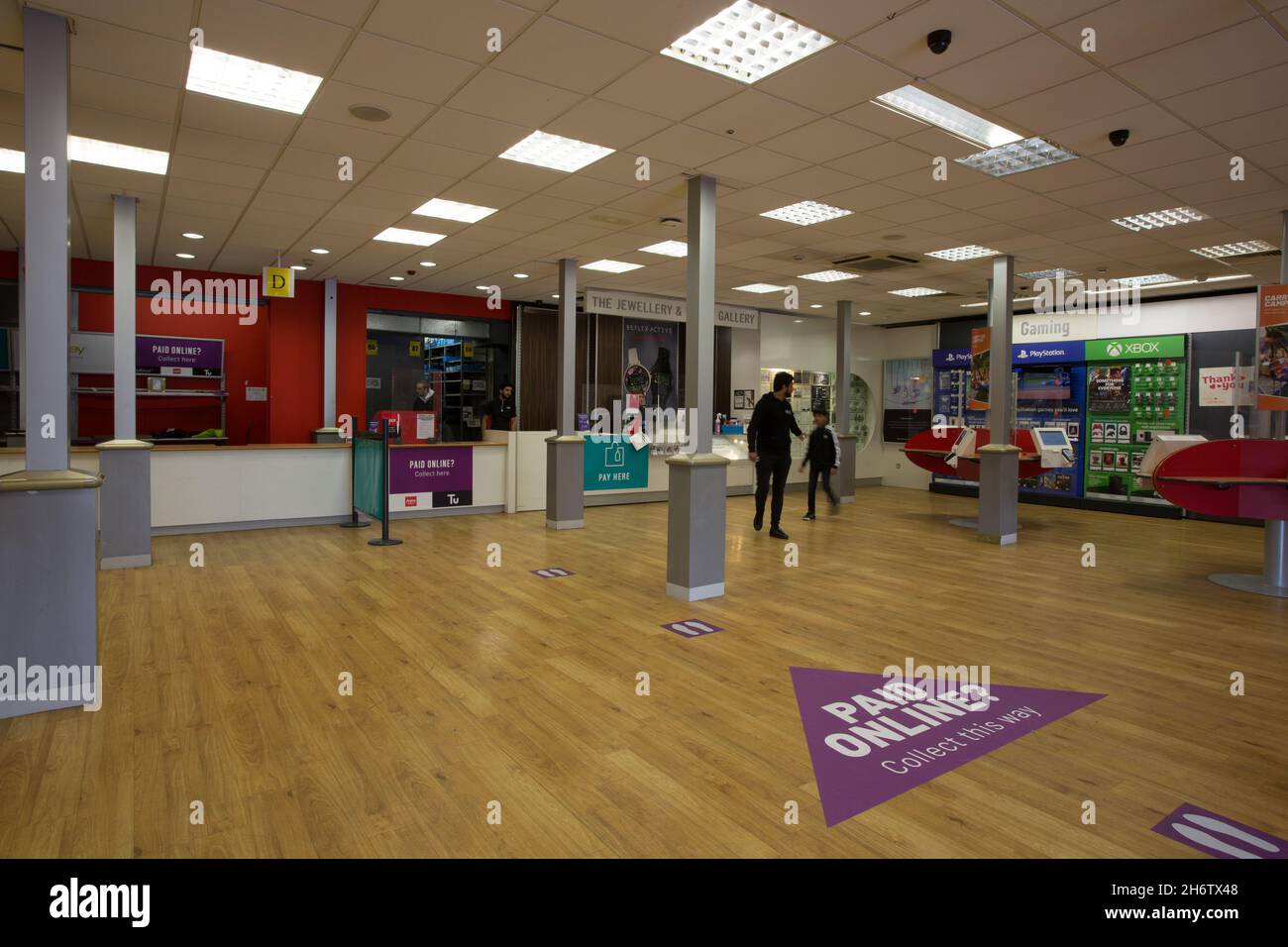
Beer stores in Ontario used to be like that, too. You'd place your order and pay for it, and shortly thereafter, it would come rolling out of the back of the store on a rolling conveyor.
Using a grocery store as an example. I'm not a fan of shopping on my phone for some things like groceries. I like to look at the boxes and visually scan the shelves and see things I might not think to search for on my phone. This would allow for it but remove the need to walk up and down 30 aisles. I would still want to pick my produce/meat so this would require a slightly different approach, but the dry goods and other stuff that's typically in center of the store could work.