I also work in the finance industry and I agree that Joe Doe outsider shouldn't gamble a significant chunk of his net worth in the stock market. Gambling being the key word here.
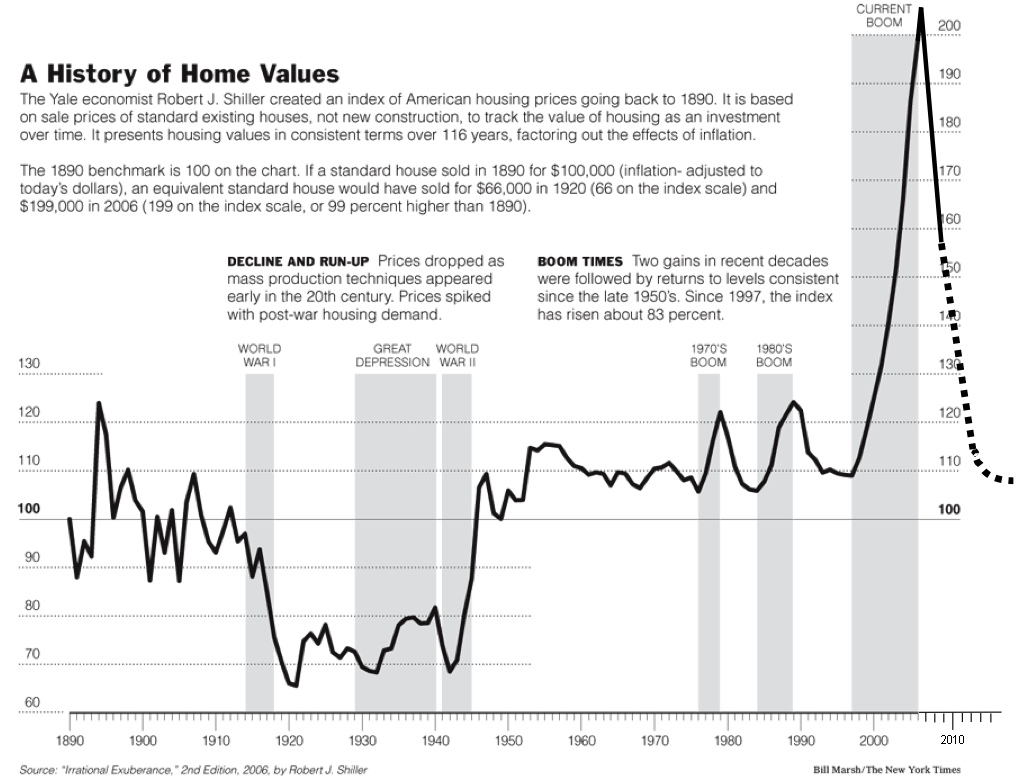
I'm dubious as everything I've seen shows equities winning over almost any 20-30 year period. And by equities I mean a minimal load index fund. It's well known housing pretty much follows inflation (http://www.ritholtz.com/blog/wp-content/uploads/2008/12/case...).
On the surface, it would seem bizarre if housing could beat stocks long-term. I can't speak much for gold.
1. housing: People have to afford their houses. As long as land is not scarce, this is just going to follow (housing-part) inflation. The reasonable maximum (across the US) is median income growth.
2. Stocks: As a first (0th?) order approximation, some weighted average of US and world-wide nominal GDP growth. Should easily beat #1.
3. Gold: Pretty complicated to track. Demand will rise as world incomes go up. But suppliers respond and pump more gold out. In theory, this makes gold more expensive but advances in technology can make production cheaper. As a naive investor though, I see no reason to invest in gold as I know little about the supply-side.
I'm curious why you claim that while providing a reference that clearly contradicts you: a reference house cost $100k in 1890, went down to under 70k in the 1920s and then up to over 200k a few years ago. Note that this is already corrected for inflation.
Overall, it tends to bounce back to ~110 year over year, implying the long-term real price increase is 0.
Unlike your average stock, which depends on many variables. You can do better or worse, but if you have no idea about these variables it's perfectly wise to stay away.
Shows the S&P 500 clearly outperforming gold from 1973 to 2010. Of course, there were massive fluctuations; what this says to me is to be diversified (and diversification includes stocks).
You see the big downward trends in the stocks in 1998 and 2007?
Now pretend you invested in 1997 or 2006 instead of 1973. All of a sudden the graph would be transformed to show Gold as the clear winner. The guy's clearly an amateur, even as someone who has no interest in stocks whatsoever, never take advice from someone like this.
If you invest at the wrong time you lose money. The problem with graphs like this demonstrating the 'long-term' is that people conveniently pick a year that works for their point. The other common one is that people always pick just after the great depression to demonstrate stock market growth over time.
The real takeaway is to not try and time the market. don't just buy all at once. if you continually invest over time you will have much less volatile returns, and continually investing over almost any period the stock market has higher returns than the other asset classes mentioned.
This is never shown in these fancy charts, but any investor will see his bottom line affected by these costs.
Also, companies can be ejected out of S&P and replaced by more successful companies. These events are also routinely hidden from graphs.
If a company is ejected from the S&P 500, tracking funds tend to eject it as well. Also these charts tend to not be dividend adjusted, further increasing the benefit of stocks. Check out SPY; it actually has out-performed the S&P 500 (I believe due to dividends and what not).
These charts usually include dividends. When they don't they are very crappy. In many international stocks dividend is too substantial to be possibly missed.
Those people who push equities generally are brokers (and thus get a cut of your transactions) or shareholders (who need people to buy their stocks). Unfortunately the capital formation goals have fell by the wayside.
[1] http://www.cityam.com/news-and-analysis/allister-heath/why-b...
I'm another person who worked for financial traders. I would never buy individual stocks. All my money is in low-load funds (e.g., index funds). I'll probably buy some income property soon. But I know exactly who is on the other side of stock market trades, and I know how hard it is to beat them.
http://www.mymoneyblog.com/impact-of-inflation-on-stocks-bon...
Real Returns from various asset classes: Stocks: 6.9% Bonds: 2.3% Bills 1.0% Gold 2.4% Housing 1.5%
Stocks crazy? Looks to me like the rational thing to invest in.