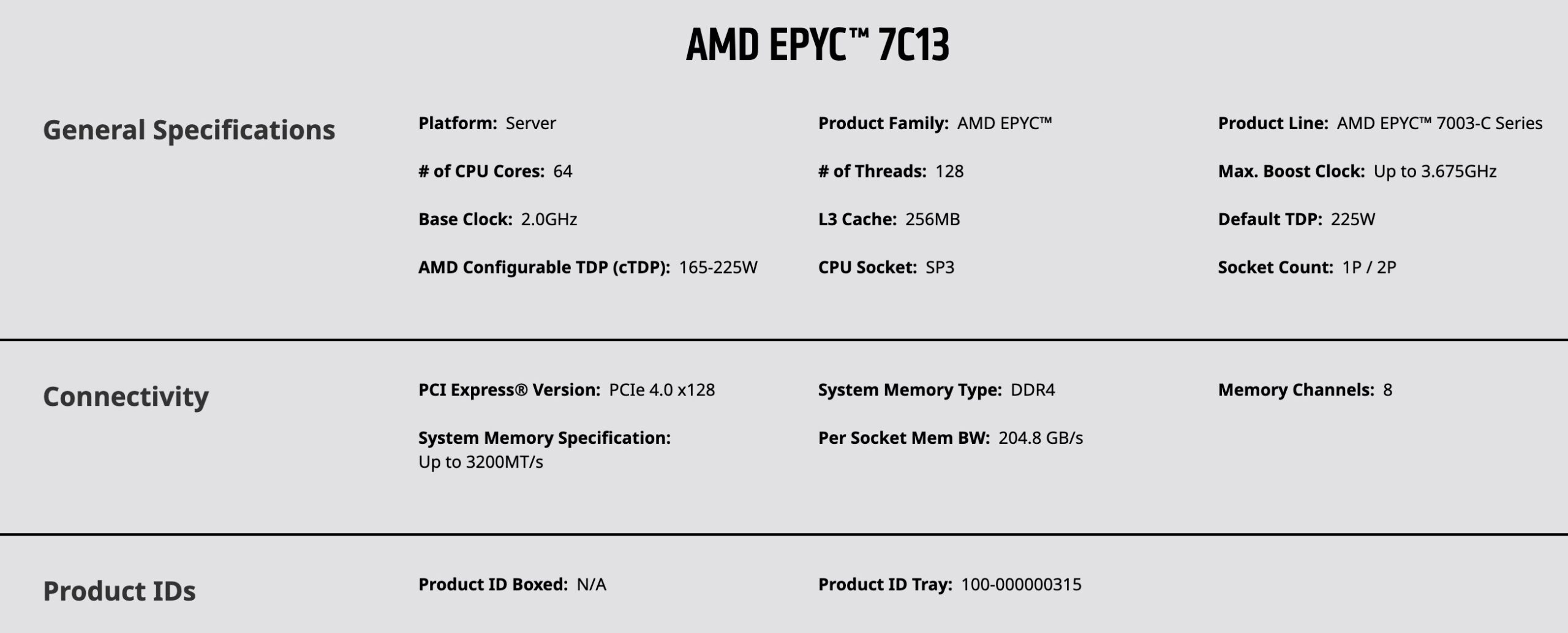
What are the practical differences between EPYC 7713P and 7C13, if any?
If there aren't any, that's an oversight by STH. I wonder where they got this scoop.
I was browsing one day looking for barebones to throw in one of our clusters and saw Newegg was selling these 1U servers cheap ($2200-2300)
Usually with AMD desktop and server CPUs buying high core counts at lower TDP yields a great perf/ W figure
https://www.newegg.com/p/2HE-001Y-000A5
https://www.ebay.com/itm/185284314106
https://www.ebay.com/itm/204640460566
Edit: from comparing https://www.servethehome.com/wp-content/uploads/2024/03/AMD-... and https://www.amd.com/en/products/cpu/amd-epyc-7713 it seems the only difference is the 7C13 has a Configurable TDP (cTDP, hence the "C" in product name) that is lower: 165-225W (7C13) vs 225-240W (7713). This would explain why the 7C13 is a tad more expensive than the 7713.
I've found the same thing even with old Xeon e-series v2, high core counts with low frequency parallelize fantastically. Cheers.
If you're pointing out used hardware, doesn't it make sense to factor in service life?
Google tells me that the service life of a processor can be as low as 5 years it it's subjected to poor cooling, and certainly those who are getting rid of those expensive processors are doing so due to a need to rotate their hardware.
https://www.ebay.com/sch/i.html?_from=R40&_nkw=amd+7713P&_sa...
https://www.amazon.com/dp/B0BRR2369B (listed by small third-party vendor)
https://starmicroinc.net/amd-epyc-7713p-2-0ghz-socket-sp3-64...
Of course these are sellers who sell low volumes and who are not well-known, but that's just because all these processors, 7C13 or 7713P, are at their end-of-life so none of the big retailers have them in stock.