tf-idf and similar heuristics are what we were using before attention came along, e.g. tf-idf weighted bag-of-words representation of word2vec embeddings. That approaches fails in so many cases.
If you don’t have attention and need a fast substitute for “forgetting” non important tokens, then BM25 is an intuitive hypothesis.
Attention makes it so that the weights of each token can be different in each sequence of tokens. Same token gets different weights depending on who its ‘neighbors’ in the sequence end up being.
This property allows the models to solve a variety of natural language problems and gets ‘used’ by the model to express context-aware dependencies.
My response was trying to clarify some confusion.
I am all for alternatives to attention. I don’t think BM25 cuts it. I don’t think anything that samples tokens based on BM25 weights (the idea in this subthread) would cut it.
"I was wondering if anyone has tried setting importance of a token as a TF-IDF or BM25 lookup."
So, I take it back. This is not a confusion. You are right to call it out. :)
I like this idea directionally. A lot of energy (literally) would be saved if we could get to the model accuracy outcomes with static weights like this.
However, I do think that this (as stated in your original message) would not work as well as transformer or SSM and I explained my reasoning as to why, already. I don't have an empirical proof (not having run the experiment) but if you believe in it, you should try it and share your findings.
These models aren't really RNNs- they have only a linear gate which cannot depend on previous tokens at this layer, so they cant update their state in a way which depends on the current state very much.
Something I've noticed is that B, C and Δ depend only on the current token. See this: https://www.kolaayonrinde.com/blog/images/mamba/ssm_algorith...
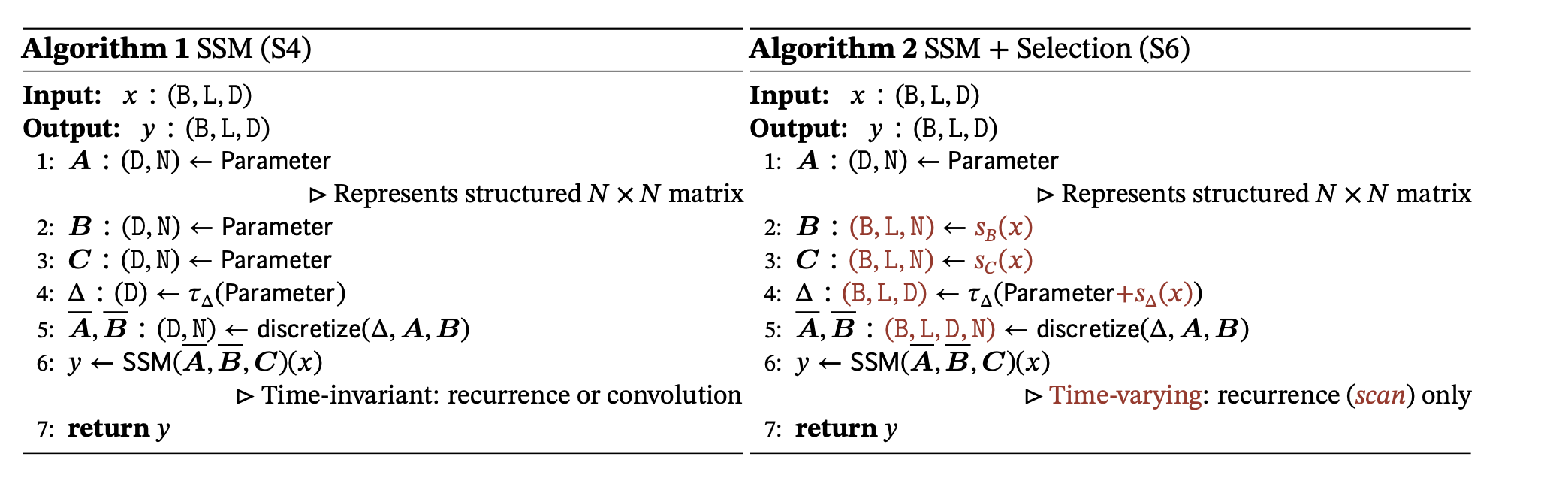
+1 though for making me go back to the article and read it more carefully! +1 also to the article.
SSMs are doing exponentially weighted moving averages (EMA). That's it- to summarize the past, you take an EMA of a variable output at each time step. Mamba changes one key thing- instead of decaying the past by a fixed amount each step as in a constant-time EMA, we have another output which decides how much to forget, or equivalently, how much 'time' has passed since the last observation in our EMA.
All of the matrix equations, continuous time, discretization, etc, will end up with a dynamic-forgetting EMA as I describe above. This also makes the benefits and limitations clear- finite state size, has to decide at a given layer what to forget before it sees the past at that layer.