I still think it would way more feasible to just to find 5-6 guys in the 25-30 year range to send on a one-way expedition. Instead of spending all of their time maintaining a factory making fuel these guys could be spending time exploring the planet and doing experiments. In return humanity would memorialize them and try to send them stuff to stay alive. After a few years we would try to send another crew to join the first crew to make more progress on the planet and build from there.
Some people are accused and convicted of a crime, know they are at fault, and even want to be sentenced for their crime. EG, they knew they were negligent, made a mistake they should not have, etc.
Such types could potentially feel almost relief with such exile, if their personalities aligned with that of an explorer. And if they truly desire censure, punishment, "doing their time" on Mars, instead of rotting in a jail cell, may seem very good to them.
Of course, lots of profiling would need to be done -- but, that is already done for such missions.
I remember something similar. The stoichiometric mix is 80% oxygen, but the actual mix is fuel rich, because CH4 is a light molecule, and the end result is a higher specific impulse.
Still, one could imagine that you could run the rocket in oxygen rich mode; you give up some specific impulse, but you might need to carry less CH4 with you for the return trip.
All that said, I just run the numbers, and I had a huge surprise: if I didn't make any mistakes, the Starship has enough fuel for the return trip, without any need for fancy refueling in Mars orbit. According to the wikipedia delta-v map [1], the delta-v needed to go from GST orbit to the Mars transfer orbit is only 1.16 km/s (yes, not a mistake). Then from there to low Mars orbit it's a further 2.1 km/s, but aerobraking is possible. Also out of the 1.16 km/s from Mars transfer to GST, 0.77 km/s can be done with aerobraking on the return trip. But let's be conservative and ignore all the assistance from aerobraking (although the Starship was designed specifically with that in mind). We end up with a total of 3.26 km/s for one way, and 6.52 km/s for both ways.
The exhaust velocity of the Starship is 3.56 km/s [2], which leads to a ratio of delta-v to exhaust velocity of 1.83, the exponential of which is 6.24. So you can have a ratio of initial mass to final mass of 6.24. The ratio of the Starship gross mass to dry mass is 1300/100 = 13, so more than twice the minimum. Of course, the delta-v map assumes the most economical routes, and for human travel you might need to splurge a bit, to get up there faster. Still, 13 vs 6.24 seems like a good margin to me.
[1] https://upload.wikimedia.org/wikipedia/commons/9/93/Solar_sy...
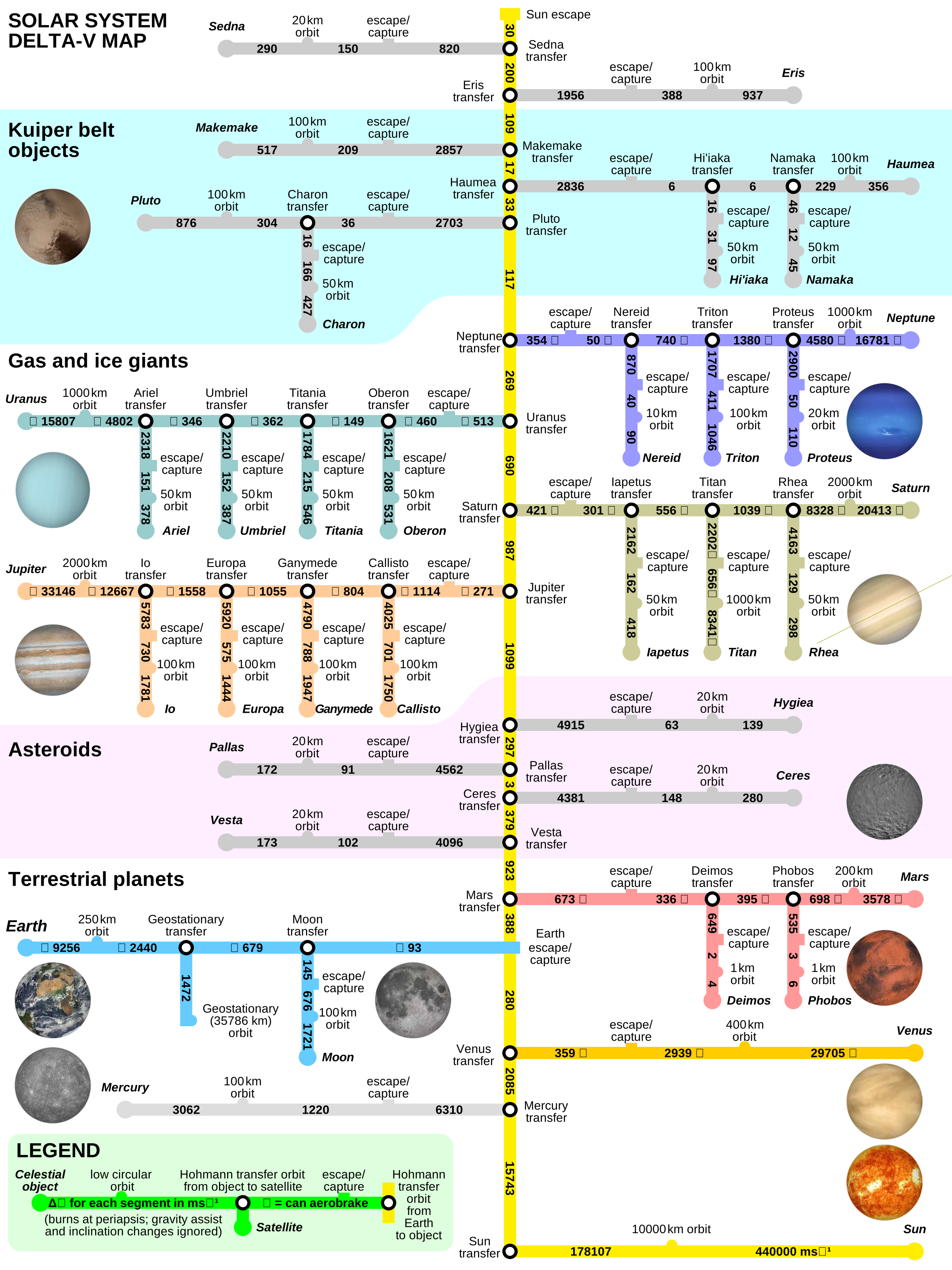
[2] https://en.wikipedia.org/wiki/SpaceX_Starship_(spacecraft)
While generating sufficient Methane is probably too big of an ask without involving extensive infrastructure, in methalox rockets (which many next gen rockets are), the larger mass is the LOX (iirc ~75% of propellant mass on Starship is LOX), which is a lot easier to devise automated methods for ISRU. Thus the problem becomes a lot more solvable. You send ahead a system to collect and store LOX, then you bring enough Methane for the return trip, and you also spend the 2 years till the return window collecting LOX.
Although, if you're sending stuff ahead of time and have the expected economics of Starship (ie down from hundreds of millions per ton to the Martian surface to millions per ton), you really can afford to just send ahead enough propellants for at least a round trip.