By comparison the entire world produces only 400GWh of batteries per year. Most of that is going to electric vehicles. Only 1% of vehicles on the road are electric. Making even a slight dent in grid storage demand is going to seriously delay EV adoption.
> Automotive lithium-ion (Li-ion) battery demand increased by about 65% to 550 GWh in 2022, from about 330 GWh in 2021,
https://www.iea.org/reports/global-ev-outlook-2023/trends-in...
and
https://www.iea.org/data-and-statistics/charts/lithium-ion-b...
Which puts global production of all battery usages at 1.5TWh in 2022
Wrong, production capacity (distinct from actual production) is at 1,500 GWh. But less than half (closer to a third) of that production capacity is utilized: https://www.spglobal.com/mobility/en/research-analysis/growt...
A quick review of terms:
Production Capacity is how much the industries hypothetically could produce if they had unlimited inputs and labor. This is around ~1,500 GWh
Production is how much they actually built. This is ~500 GWh per year.
Production Utilization is production divided by production capacity. Which hovers around 33% for lithium ion batteries right now.
Actual production figures is what matters, not what factories hypothetically could produce if they had unlimited input. Manufacturing costs are only a quarter of the cost of lithium batteries [1]. Battery production is already bottlenecked on the supply of input materials, so growing production capacity is not relevant until the input demands are fed.
1. https://www.visualcapitalist.com/breaking-down-the-cost-of-a...
> According to S&P Global Mobility (formerly IHS Markit | Automotive), demand for Li-ion batteries from light vehicle between 2021 and 2027 will increase a compound annual growth rate (CAGR) of nearly 40% to about 2,050 GWh. Installed battery capacity in the same period will grow a 23.5% CAGR to 3,371 GWh in 2027.
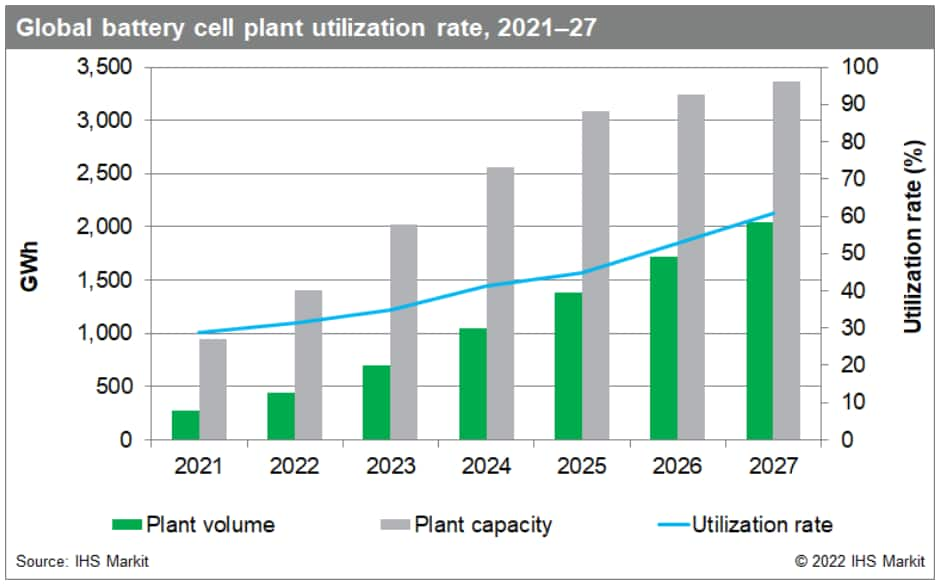
The green bar is actual production (the figure that actually matters). The gray bar is production capacity. Notice how the green bar is one third to one half that of the gray bar? This is why it's important to distinguish between production capacity and actual production figures.
The way you're conflating production capacity with actual production is exaggerating the availability of batteries by a factor of 2 to 3.
> Compared with 56% of the installed capacity in Greater China being used for light vehicle segment, Europe will have a much higher capacity utilization of about 74%.
Show me a source claiming that 1,500 GWh of batteries was actually produced. Not installed capacity. Not demand. Actual production. 1.5 TWh is an incredibly high number, and would represent a 200% increase over the previous year.
This source talks about demand (not production) of 670 GWh for 2022 [1] but who knows how much of that demand was actually fulfilled. But even if it was 100% fulfilled that's still less than half of 1,500 GWh.
The latest data I could find on actual production was 476 GWh in 2021 [2].
1. https://www.utilitydive.com/news/battery-raw-materials-pose-...
2. https://interactanalysis.com/insight/lithium-ion-battery-mar....
Batteries are only going to offer on the order of hours or maybe days of energy storage to manage short term hiccups in wind and sun.
You will always need a backup that can spin up quickly in in the long tail events where you have weeks of not enough sun or wind.
And realistically, you have to exercise those backups regularly to keep all the infrastructure and systems in working order so you aren't surprised in an emergency that the system is broken from months or years of disuse.
Lots of legacy fossil generation is going to end up stranded [2], from a capital markets perspective. No one is going to touch nuclear with their own capital, the LCOE speaks for itself [3]. Keep existing nuclear running as long as safe, but it'll sunset too eventually. Don't get mad at the math, it's just math.
[1] https://www.reuters.com/sustainability/us-power-regulator-we...
[2] https://www.nature.com/articles/s41558-022-01356-y
[3] https://lazard.com/media/2ozoovyg/lazards-lcoeplus-april-202...
Simply comparing production figures without considering intermittency is one of the most common oversimplifications people make in decarbonization discussions.
Indeed there is much work to be done to drive fossil fuels out of all modes of transportation.
We're already noticing that wind farms can't be too close together, because upwind farms slow the wind, degrading the output of downwind farms. https://www.sustainability-times.com/low-carbon-energy/placi...
Solar is limited by available surface area, but more importantly by environmental impact. You're going to start destroying ecosystems if you blanket the land with panels.
Hydro has been mostly tapped out for a long time. At least in the developed world, all the geography that can be dammed, has been. And even here, there's a strong push from environmental groups to destroy the dams to restore ecosystems disrupted.
https://www2.deloitte.com/us/en/pages/energy-and-resources/a... ("Global energy storage: Digitization and market innovation accelerate battery storage deployment")
https://www.eia.gov/todayinenergy/detail.php?id=56880 ("The duck curve, however, has created opportunities for energy storage. The large-scale deployment of energy storage systems, such as batteries, allow some solar energy generated during the day to be stored and saved for later, after the sun sets. Storing some midday solar generation flattens the duck’s curve, and dispatching the stored solar generation in the evening shortens the duck’s neck. Battery storage is swiftly being constructed in California; it’s grown from 0.2 gigawatts (GW) in 2018 to 4.9 GW as of April 2023. Operators plan to build another 4.5 GW of battery storage capacity in the state by the end of the year, according to our Preliminary Monthly Electric Generator Inventory.")
https://electrek.co/2023/05/31/north-america-battery-factori... ("North America is now the growth leader for new battery factories")
https://e360.yale.edu/features/in-boost-for-renewables-grid-... ("Batteries are beginning to reach a size that enables renewables to replace medium-sized natural gas generators.")
https://evmarketsreports.com/300-billion-in-new-lithium-ion-... ("According to Benchmark, worldwide manufacturing of lithium ion batteries will more than fivefold by the end of the decade as a result of these expenditures. Last year, the world added 102 gigafactories to the ten-year pipeline, with a total capacity of 3.1 terawatt-hours.")
https://www.bloomberg.com/news/articles/2023-03-07/end-of-co... | https://archive.today/2owbd ("Battery Bonanza Is Being Sparked by Coal’s Exit in Australia")
https://lorenz-g.github.io/tesla-megapack-tracker/all-big-ba... ("Big Battery Tracker)