News for hackers. Stuff that matters.
Re:SR-71 Blackbird Astro-Nav System (a.k.a. R2-D2) worked by... by porphyra on Monday September 25, 2023 @06:59PM (#37651927)
How does it see the stars? Even modern CMOS image sensors cannot see the stars during the day.
Re:SR-71 Blackbird Astro-Nav System (a.k.a. R2-D2) worked by... by jpm_sd on Monday September 25, 2023 @07:02PM (#37651956)
Probably by flying above most of the atmosphere.
Re:SR-71 Blackbird Astro-Nav System (a.k.a. R2-D2) worked by... by porphyra on Monday September 25, 2023 @07:05PM (#37651981)
That makes sense. What kind of sensor does it use to track the stars though? Stars are very dim.
Re:SR-71 Blackbird Astro-Nav System (a.k.a. R2-D2) worked by... by geon on Monday September 25, 2023 @07:27PM (#37652181)
Stars don’t move a lot, so exposure time can be high.
Re:SR-71 Blackbird Astro-Nav System (a.k.a. R2-D2) worked by... by numpad0 on Monday September 25, 2023 @07:52PM (#37652416)
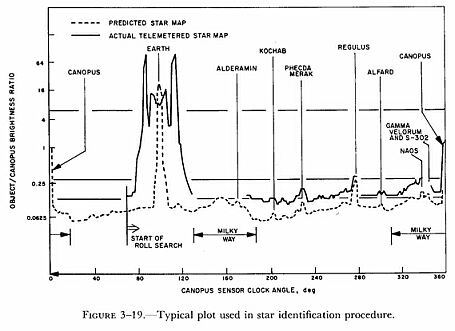
Simplest implementation of star trackers I've seen is the Canopus sensor[1] used in old spin stabilized satellites: the "tracker" is just a light intensity sensor and a computer on a spinning spacecraft. I don't know if that has to do with this implement or not, but a star tracker in general could be that simple.

1: http://petermasek.50megs.com/starplot.jpg

Re:SR-71 Blackbird Astro-Nav System (a.k.a. R2-D2) worked by... by stevenwoo on Monday September 25, 2023 @09:48PM (#37653284)
The navigator verified their position with the device while they were still on the ground.
Re:SR-71 Blackbird Astro-Nav System (a.k.a. R2-D2) worked by... by txnf on Monday September 25, 2023 @07:15PM (#37652070)
With a big enough aperture and low enough f-number you can definitely see the stars during daylight even from the ground
Re:SR-71 Blackbird Astro-Nav System (a.k.a. R2-D2) worked by... by bhhaskin on Monday September 25, 2023 @07:01PM (#37651937)
Likely not much of an issue at the altitude the SR-71 flys at
Re:SR-71 Blackbird Astro-Nav System (a.k.a. R2-D2) worked by... by gmiller123456 on Monday September 25, 2023 @08:29PM (#37652727)
Modern, and even old, sensors absolutely can see stars during the day. It's really a question of magnification. When you magnify the image, the pixels a star falls on don't change much, but the background gets darker because the background is spread over more pixels.

I was talking to a grad student who was having an issue getting descent flat frames (images of a uniform field, used to account for dust and optical train effects). I asked why she didn't just take a picture of the sky in the daytime like most amateurs do, and she said she always ends up with stars in the image doing it that way. They tried finding the least populated part of the sky, but still always picked up stars.

Re:SR-71 Blackbird Astro-Nav System (a.k.a. R2-D2) worked by... by photoGrant on Monday September 25, 2023 @08:47PM (#37652872)
Put a lens cap on! Then shoot.
Re:SR-71 Blackbird Astro-Nav System (a.k.a. R2-D2) worked by... by gmiller123456 on Monday September 25, 2023 @08:58PM (#37652962)
That is for taking "dark frames". "Flat frames" need light going through the optics so that things like dust and vengetting can be detected.

This link explains them in more detail:

https://www.highpointscientific.com/astronomy-hub/post/astro...

Re:SR-71 Blackbird Astro-Nav System (a.k.a. R2-D2) worked by... by photoGrant on Tuesday September 26, 2023 @04:23PM (#37665321)
You're right! I read too quick.

Instead, you want one of these!

https://support.phaseone.com/knowledgebase/article/KA-01239/...

Re:SR-71 Blackbird Astro-Nav System (a.k.a. R2-D2) worked by... by porphyra on Monday September 25, 2023 @09:08PM (#37653023)
That's a very cool anecdote. What did she end up doing?

I guess you'll need something like an integrating sphere? https://en.wikipedia.org/wiki/Integrating_sphere

Photography reviews often measure vignetting by putting a piece of tissue paper on the lens lol.

Re:SR-71 Blackbird Astro-Nav System (a.k.a. R2-D2) worked by... by gmiller123456 on Monday September 25, 2023 @10:12PM (#37653465)
That was the only time I got to talk to her, so not sure how she ended up solving it. She was searching for transiting exoplanets, so looking for a star's dip in brightness of less than 1%. Even a bug temporarily flying in front of the star could throw it off.

Some people do use tissue paper, or a t-shirt over the lens, and that works for making pretty pictures. But she said none of them come close to 1% accuracy.

But now you have me wondering how the big telescopes do it. Things like the JWST or HST, or even large ground based scopes don't really have any of those options.