I don’t know what the color management situation is on iPad apps now, but when I last was looking at iOS development a couple years ago, iPhones/iTouches did no color management of anything, meaning that colors of all apps & content changed from one device generation to another. If that’s still the case, then I think sRGB is the best target display gamut.
For example, the Asus Transformer Prime on those charts is shown to have very bright whites and black blacks (which makes it look like the leader in the first few charts), but then you see that it has fairly unsaturated and somewhat odd primaries (the choice of these rather substantially shifts the hue of any images/colors assumed to be sRGB, and makes them a bit dull).
Because these displays work by shining a bright white backlight through colored pixels which block out most of the light, there’s an inherent trade-off between how much light the pixels block (how colorful they can be) and how bright the display is. Since color gamut is three-dimensional, I wish they’d show these kinds of comparisons using some slices through a space like CIECAM02 brightness/colorfulness/hue (QMh), which would actually reasonably show the differences.
Anyway, the new iPad’s primaries and white point are impressively close to the sRGB spec: http://images.anandtech.com/galleries/1821/iPad3-CIE_575px.p...

Compare with the Asus: http://images.anandtech.com/galleries/1821/TFPrime-CIE_575px...
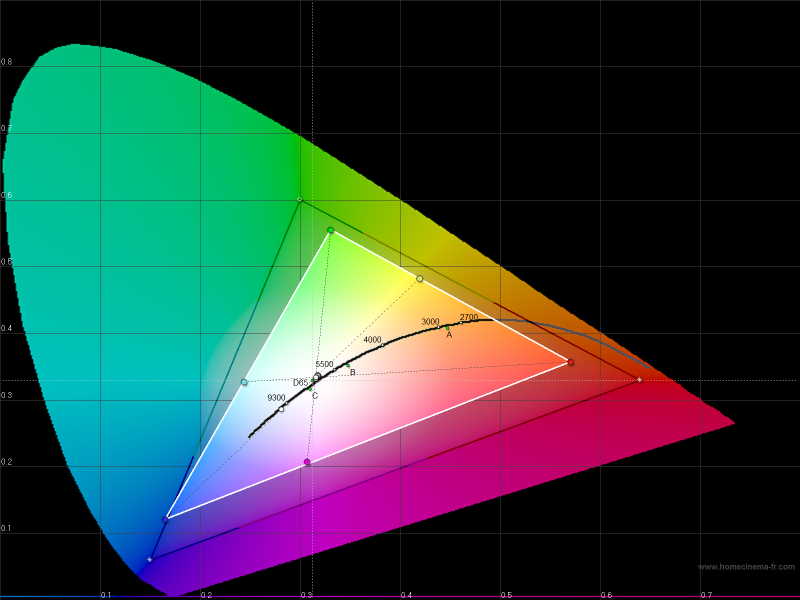
http://www.anandtech.com/show/5689/the-new-ipad-retina-displ...
Essentially it covers sRGB but "only" 65% of Adobe RGB colorspace. For reference, the Apple 27" Cinema Display covers 84% and the Dell 2408WFP covers 104%.
So it's the best mobile display by a margin, but hasn't caught even the consumer studio desktop monitors out there when it comes to Color Gamut.