Side note, I did not notice the button to show the reference until I was almost finished. I would most likely have done better if I had known :)
You moth..f.... piec. of sh..! Now I can't sleep!
EDIT: After having played it a few times, I think you should expand on the idea, because it seems to be a great tool for training visual memory.
Needless to stay I best stick to software engineering:


The scoring system could try to account for perceptual color differences, perhaps by ramping up the saturation of both images when calculating the differences. Since the original painting is relatively desaturated the current scoring mostly incentivizes focusing on light/dark rather than shades of color.
Lots of other great suggestions in the thread — would be fun to see a leaderboard!
Drawing something that complex in such a short amount of time is quite a challenge, keeping within a minute is strictly in party game realm. I used to do ultra low-res versions of paintings (in Pico-8) and the shortest I could do for things like this would be 10 minutes I think (upwards to 20).
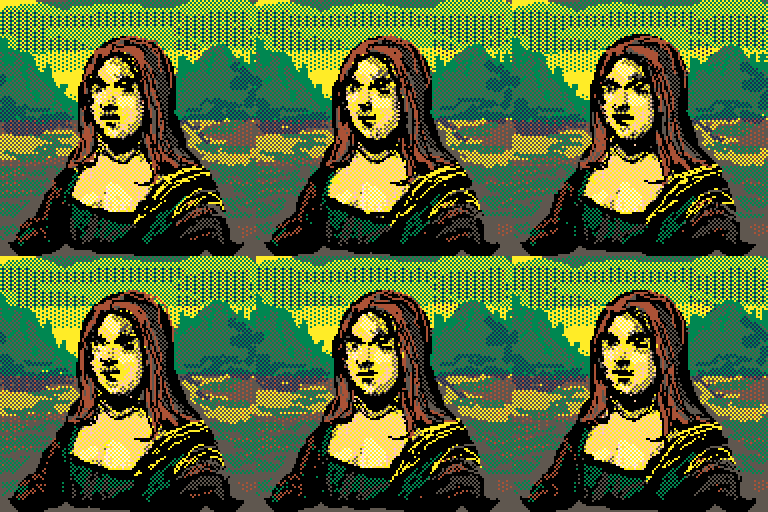
For reference, the Mona Lisa: https://woolion.art/assets/img/wobblepaint/017(joconde).gif
I think that makes it much more fun for most people, so improving the scoring would actually make it worse.
It looks like, if every pixel is colored using the closest color from the palette, the score would be 94.7%: https://imgur.com/a/wiltqay. So 90% would be quite close to the theoretical max score.
In terms of game mechanics, I love the percentage score that updates in real time. That immediate feedback is really compelling.
Darker areas have the biggest initial difference, and the whole pic is darker than the initial canvas, so get a lot of paint down and pay most attention to the dark bits, you'll soon get over 70%. 85% is v good, and I think 90% is probably possible with enough skill and speed.