How hard do you scrape your pans when you cook?! Does your pan end up half a gram lighter every time you cook or something?
And even then, if I am scraping it enough to actually abraide some of it, it's not being aerosolized. It's gonna get worked into the fats and oils I've got in the pan. Which, sure, some small amount eventually flings out, but by that point it's such a tiny minute amount.
Maybe if I was a chef it might be enough to actually care a tiny slight bit. But like, cooking with it a few times a week, I can't imagine I'm getting much of any bits of the pan in my lungs. I'd be more worried about the stuff burning in the pan over the bits of the pan being a problem.
Also eating iron oxide is fine, it's breathing it that is bad.
> though it is non stick in the same sense that things are harder to stick to burned things :)
The usual way I've heard this explained, which seems reasonable, is that steel and iron are porous, and what causes sticking is the contraction of those pores when heated. A smooth covering prevents that sticking, and polymerized cooking oil provides that.
> I don't season anything though - if i want to protect something from rust i dry it. If seasoning was a super good rust protectant we'd use it as one in other cases.
Funnily enough, I have. I built a bookshelf that uses raw steel beams, and I seasoned it to protect it from rust. 3 years in, it's still rust free (amusingly, except for the inside of the pipes).
But I don't think anyone really argues that it's the best way to do things in non-cooking applications, just that it's food safe (again, the point of what we're discussing) and works. Seasoning does demonstrably prevent rust... For furniture you'd more often spray it with a protective coating, but I don't think anyone's recommending spraying pans with polyurethane. ;-)
Pushing back on 'DannyBee though: the narrative about cast iron vs. nonstick is easy to understand: nonstick pans are shitty, expensive, and overused; lots of people cook in nonstick exclusively (:scream-emoji:) and don't realize their pans have been worthless for years because the coating is all scuffed up. It's not a health thing so much as a "nonstick pans are evil" thing.
It has more thermal momentum, thus when I am pulling stuff out of my sous vide cooker, it's better at quickly adding char (because the temperature drops less than in carbon steel or anything else).
(The only other reason I use cast iron is for the cases where the pan size is just more practical than my carbon steel pans.)
I will admit that I'm conflicted by this since there's also a distinctive way that my 3.5 kW induction wok cooker chars stuff in a very limited amount of time, but that involves me removing the smoke detectors from my kitchen and the two rooms adjacent.
It's like saying that pure salt has "no added sugars or preservatives" Of course it doesn't, it's salt, not a salt-sugar mixture, and you don't need to add a preservative, it is a preservative.
Colloquially, the word "nation" can mean something as simple as "country", but when you use the term "nation-state", you're going out of your way to invoke the technical definition.
On the other hand, "carbon steel pans" is just what they're called. Can't dunk on me for my metallurgical naivete; gotta take it up with Lodge.
Not blaming you, but this is just wrong and a fundamental misunderstanding of steel and iron.
Cast iron (and steel) does not have pores. It is not like wood. SAE 304 (stainless steel commonly used in cheap pans) does have micro-cracks in the surface. These can be removed through honing or surface polishing, and the substructure is weird. Let's put it aside for a second, and stick with cast iron, carbon steel, and other stainless because 304 is just super strange stuff at the microscopic level.
Cast iron simply has no pores at all, just surface roughness. The average surface roughness is not that high (125 microinches or better)
Here is a high magnification photo of cast iron with the different microstructures pointed out: https://www.researchgate.net/publication/325977459/figure/fi...

here's one colored a little nicer: https://www.struers.com/-/media/Struers-media-library/Knowle...
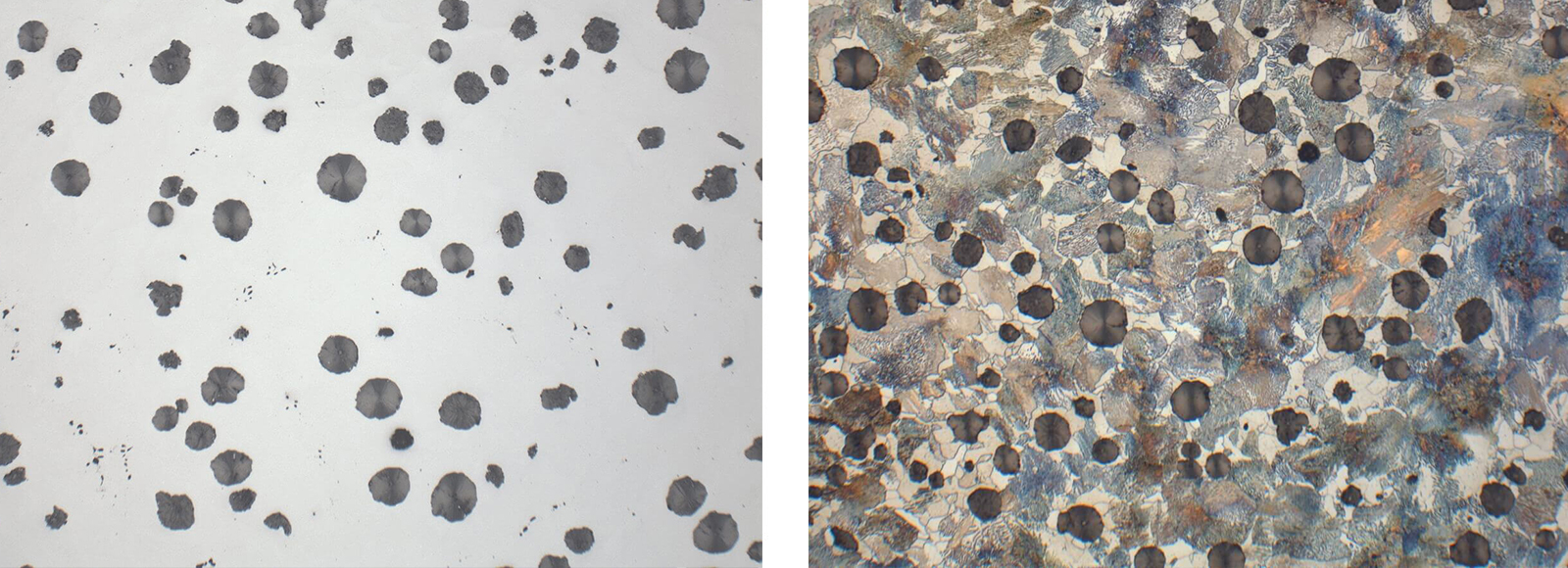
You can see there are no holes and no pores. There are just some different types of microstructures.
Here is normal stainless steel: https://www.researchgate.net/publication/327401795/figure/fi...

(the one on the right is after sandblasting :P)
Liquids theoretically fill the surface roughness of either but not like massively. You can see on the stainless there just isn't a lot to even fill.
For all of them the overall flatness changes when heated, and the surface roughness changes slightly, but that's it. Not a lot. it definitely does not expand pores, or change the surface roughness by a factor of 10, or any of this.
This is why cast iron is used to make precision laps - to surface things like lab grade surface plates to like 0.000005 inches and such: it stays flat once machined and surfaced, it has lots of thermal inertia, and doesn't get screwed up by things sticking to it once polished[1].
If your goal is to make it so nothing sticks, by adjusting the surface roughness, you could also just sand it outside with a respirator on to like 2000 grit or 4000 grit and never worry about it. This would cost you about 5 minutes of time, maybe 10, and you can do it by hand if you want (though it's like 1 minute with an ROS).
I can show you a non-seasoned, "polished once 8 years ago to 8000 grit" cast iron griddle that has 0 rust, and is quite non-stick.
Manufacturers would do this except now they get you to do it for them, because people won't buy it unless they can season it to "add flavor" and such.
The whole thing has become a silly cargo cult honestly. The number of people who now think that like cast iron and steel have pores is also way too high :)
Besides sanding, there are other ways to change surface roughness that don't involve burning cooking oil onto something that doesn't need it. They also last much longer.
Also note that depending on temperature that people season at, they can release really toxic stuff. 300C (572F) is totally achievable on most stoves, by people just leaving them on to season, and will generate some very toxic byproducts.
"Funnily enough, I have. I built a bookshelf that uses raw steel beams, and I seasoned it to protect it from rust. 3 years in, it's still rust free (amusingly, except for the inside of the pipes)."
Visibly, or did you check under the coating? Most seasoning just hides rust. It's still rusted, and as it gets removed it's just taking the iron oxide with it so it looks like it's not.
[1] Here's a fun side video of someone making precision laps out of cast iron using nothing but the 3 plate method, timecoded to when he puts the optical flat on it: https://www.youtube.com/watch?v=Whyw5v7L70c&t=810s
The lines are straight because this cast iron is flat and not rough to at 1/10th or 1/20th the wavelength of light used here, which translates into an average roughness below 25-50nanometers.
You do not need to go this far to get a non-stick pan out of cast iron :)
It just sounds like we're picking our flavor of poison when we pack our food, something we've done since pre-historic times.
Unlike steel, cast iron generates dust when abraded. Dust that is really bad for you. Known to cause lung issues, etc.
I machine it all the time (both ductile and non). It is usually is machined dry with vacuum because it will clog coolant systems. It basically turns into a horrible mud when mixed with coolant or water I happen to filter the coolant system so i can machine it wet, but that's not all - i also run a dust extractor to avoid these issues.
Cast iron is popular, but i've seen no science that suggests it should be used. There is no evidence i've seen that it's particularly better at anything, none of the "seasoning" thing is a real rust protectant for either cast iron or steel (and steel will usually rust slower), though it is non stick in the same sense that things are harder to stick to burned things :)
Steel won't generate the same kind of horrible dust when you abrade through the seasoning.
I don't season anything though - if i want to protect something from rust i dry it. If seasoning was a super good rust protectant we'd use it as one in other cases.
If i want something to be non-stick i spray a light coat of oil on it.