News for hackers. Stuff that matters.
Re:The lesson about the end of nuclear in Germany by bad_alloc on Wednesday April 26, 2023 @06:34AM (#35711638)
While people continue to push nuclear as a silver bullet, the painful fact is that nuclear won't be reliable enough in the dry Europe we are facing: Italy, France and Spain are in extreme drought and France in particular had to shut down nuclear power plants due to lack of water. In Germany rivers are also low and having plants like Isar 3 evaporate 770L/s is not sustainable in summer.

Wind and Solar can be intermittent but the drought is here to stay. A flexible system which reacts to electric availability is needed for the future. Wasting water in huge cooling towers will threaten food security.

Re:The lesson about the end of nuclear in Germany by illiarian on Wednesday April 26, 2023 @06:38AM (#35711665)
> won't be reliable enough in the dry Europe we are facing: Italy, France and Spain are in extreme drought and France in particular had to shut down nuclear power plants due to lack of water.

No, no they didn't. The shutdown due to "lack of water" (which is also bullshit) affected 0.18% of power generation.

The shutdowns happened due to planned maintenance when French government finally got its head out of its ass long enough to realize that power plants need to be maintained.

Re:The lesson about the end of nuclear in Germany by bondarchuk on Wednesday April 26, 2023 @06:36AM (#35711653)
What is the sea?
Re:The lesson about the end of nuclear in Germany by bad_alloc on Wednesday April 26, 2023 @06:40AM (#35711678)
Not usable without desalination and far away from most reactor sites.
Re:The lesson about the end of nuclear in Germany by pjc50 on Wednesday April 26, 2023 @06:51AM (#35711755)
Power plant coolant does not require desalination, but it does obviously require that the plant be built next to the sea. Which works fine for the UK and France but Germany has less coastline and more of it is either national park, tourist destination, or busy port.
Re:The lesson about the end of nuclear in Germany by perihelions on Wednesday April 26, 2023 @07:22AM (#35711997)
Then why not simply build them on unpopulated coasts in Scandinavia, and run HVDC links under the Baltic? If it's good enough for solar power (not enough sunlight in Europe? Just offshore it to Africa [0]), it's good enough for nuclear fission. Extra plus, it's much closer, and all of the countries involved are low-risk, stable democracies.

[0] https://news.ycombinator.com/item?id=35611806

Re:The lesson about the end of nuclear in Germany by pjc50 on Wednesday April 26, 2023 @08:06AM (#35712383)
While it is not within the remit of the Bundestag to build reactors in Scandinavia, it looks like things might be heading in that direction anyway: https://www.ft.com/content/f55b69a4-ee37-4182-88bb-3a8dec93b...

(and of course the last time Germany tried to use Norway to help build a nuclear reactor, the Allies blew it up https://en.wikipedia.org/wiki/Norwegian_heavy_water_sabotage )

I do think lots of things might be feasible for European energy, but they all cost money, and in the case of Germany the lignite lobby has been far better at not getting shut down by environmentalists despite doing a lot more damage.

Re:The lesson about the end of nuclear in Germany by phicoh on Wednesday April 26, 2023 @10:16AM (#35714016)
The obvious thing for Germany was to replace lignite with gas powered plants. Gas plants have to advantage that they are very compatible electricity from sun and wind. And even without that directly reduce CO2 emissions.

Where this plan went wrong was when they picked the cheapest supplier of this gas, Russia.

Re:The lesson about the end of nuclear in Germany by trashtester on Wednesday April 26, 2023 @11:50AM (#35715690)
Actually, Norwegians blew up the heavy water plant.
Re:The lesson about the end of nuclear in Germany by _ph_ on Wednesday April 26, 2023 @07:04AM (#35711871)
The problem of course is the proximity to power consumers or you have to expand the grid. Besides, coastlines are ideal places for wind power generation, which is why the north of Germany has no energy scarcity.
Re:The lesson about the end of nuclear in Germany by illiarian on Wednesday April 26, 2023 @07:07AM (#35711900)
> The problem of course is the proximity to power consumers or you have to expand the grid.

What's your opinion on UK-Morocco powerline then?

Re:The lesson about the end of nuclear in Germany by _ph_ on Wednesday April 26, 2023 @07:32AM (#35712056)
Sounds like a P+R stunt so far to me. But it is doable, there is a working power line from Germany to Norway already. The only question is: is it a good idea to build a direct Morocco-UK power line or would it be more clever to connect Morocco with a shorter line to the central European grid and from there to the UK? Why should they sell to the UK and not central Europe?

But power lines can be built, no doubt. But then, as I said, you can as well transport wind energy from the coast to the rest of the country.

Re:The lesson about the end of nuclear in Germany by illiarian on Wednesday April 26, 2023 @07:37AM (#35712089)
> But it is doable,

Funny how for renewables it's "certainly it's doable" and "powerlines can be built", but for nuclear "The problem of course is the proximity to power consumers"

Re:The lesson about the end of nuclear in Germany by _ph_ on Wednesday April 26, 2023 @07:39AM (#35712108)
You are twisting my words. It isn't a fundamental problem with nuclear, but with placing the power plants at the coasts. You might have made cooling easier, but increased the demand for the grid. That can be done, but should be mentioned. Especially in the context I wrote, but which you didn't quote, that at coasts there is no scarcity of wind, so it is way easier to build wind power there than nuclear.
Re:The lesson about the end of nuclear in Germany by illiarian on Wednesday April 26, 2023 @07:42AM (#35712130)
> but with placing the power plants at the coasts. You might have made cooling easier, but increased the demand for the grid

How is this any different from offshore wind farms or power lines from Norway to Germany?

> it is way easier to build wind power there than nuclear.

Why not both?
Re:The lesson about the end of nuclear in Germany by bayesian_horse on Wednesday April 26, 2023 @01:19PM (#35717094)
Because nuclear power projects are never finished on time and within budget. Partly for political reasons (as in: People really don't like it), partly because engineers suck at estimating large projects.
Re:The lesson about the end of nuclear in Germany by throw__away7391 on Wednesday April 26, 2023 @07:33AM (#35712064)
Nuke plants can use seawater for cooling. Most people live near the water.
Re:The lesson about the end of nuclear in Germany by igravious on Thursday April 27, 2023 @12:45AM (#35723442)
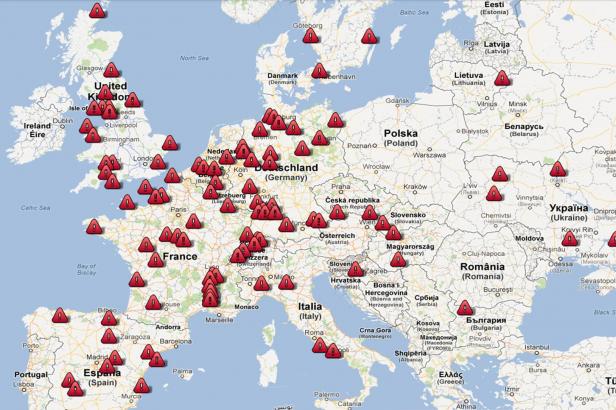
Here's an idea – build newer reactor sites near the sea, like (as you'll see from this map) a lot already are: https://www.nuclear-transparency-watch.eu/wp-content/uploads...
Re:The lesson about the end of nuclear in Germany by goodpoint on Wednesday April 26, 2023 @07:01AM (#35711843)
A large body of water that impacted Fukushima.
Re:The lesson about the end of nuclear in Germany by illiarian on Wednesday April 26, 2023 @07:06AM (#35711895)
Fukushima:

- hit by earthquake at or above upper structural limit. The most powerful earthquake ever recorded in Japan

"maximum ground g-forces of 0.56, 0.52, 0.56 at units 2, 3, and 5 respectively. This exceeded the seismic reactor design tolerances of 0.45, 0.45, and 0.46 g for continued operation, but the seismic values were within the design tolerances at units 1, 4, and 6"

- hit by tsunami exceeding that limit

The largest tsunami wave was 13–14 m (43–46 feet) high and hit approximately 50 minutes after the initial earthquake, overwhelming the plant's ground level, which was 10 m (33 ft) above the sea level

---

This resulted in 1 (one) death directly attributable to the incident

Re:The lesson about the end of nuclear in Germany by goodpoint on Wednesday April 26, 2023 @07:26AM (#35712029)
> This resulted in 1 (one) death directly attributable to the incident

Plus more that 200 billion $ paid by tax money that are NOT accounted into the cost of nuclear energy.

Plus more deaths, injuries, loss of property value, etc due to the evacuation.

Plus the economical impact of having stricter building regulations in future to prevent the same from happening again in future.

Re:The lesson about the end of nuclear in Germany by illiarian on Wednesday April 26, 2023 @07:30AM (#35712050)
This was the very definition of a black swan event.

Imagine if all dams were subjected to the same insanity after dam failures like Banqiao Dam failure

Re:The lesson about the end of nuclear in Germany by bayesian_horse on Wednesday April 26, 2023 @01:20PM (#35717115)
Most dams carry way more risk and way higher benefits.
Re:The lesson about the end of nuclear in Germany by igravious on Wednesday April 26, 2023 @06:49AM (#35711741)
If the Chinese can “channel 44.8 billion cubic meters of fresh water annually”[1] with one of the world's largest mega-projects then I imagine Europe as a continent putting their heads together can figure out how to provide/redirect sufficient water for a bunch of nuclear power stations.

Also, there may be areas prone to drought but there's simultaneously plenty of precipitation[2] across Europe; heck – build nuclear power stations along the West coast of Ireland and send the juice across the interconnectors[3][4] to the UK and France

[1] https://en.wikipedia.org/wiki/South%E2%80%93North_Water_Tran...

[2] https://vividmaps.com/precipitation-in-europe/

[3] https://www.soni.ltd.uk/customer-and-industry/interconnectio...

[4] https://www.eirgridgroup.com/the-grid/projects/celtic-interc...

Re:The lesson about the end of nuclear in Germany by bayesian_horse on Wednesday April 26, 2023 @01:21PM (#35717123)
Once you do any of the sort, nuclear power loses the rest of its cost advantage (if there is any to begin with).
Re:The lesson about the end of nuclear in Germany by weberer on Wednesday April 26, 2023 @06:57AM (#35711813)
Finland's new 1.6GW nuclear reactor, the largest in Europe, uses sea water for cooling.

https://en.wikipedia.org/wiki/Olkiluoto_Nuclear_Power_Plant

Re:The lesson about the end of nuclear in Germany by skrause on Wednesday April 26, 2023 @08:06AM (#35712391)
Just 1.6 GW for 11 billion euros and a 14 years delay...

Meanwhile Germany has added 2.65 GW of solar power in Q1/2023 alone: https://www.pv-magazine.de/2023/04/20/photovoltaik-zubau-im-...

Re:The lesson about the end of nuclear in Germany by MagnumOpus on Wednesday April 26, 2023 @09:38AM (#35713473)
2.65GWpeak... all of which runs at a capacity factor of about 11% on average, and delivers energy at inconsistent inconvenient times. Won't run your heat pump in a December night for sure.

So the solar energy gets supplemented with bulldozing villages every year to mine lignite in Garzweiler instead. Yay?

Re:The lesson about the end of nuclear in Germany by bayesian_horse on Wednesday April 26, 2023 @01:14PM (#35717021)
Bullshit. Germany is still a decade or two away from needing energy storage to even out renewable power peaks. Until then, all the capacity provided by renewable sources reduces the overall emissions, which is the reason we are doing this at all.

The purpose of building up renewable energy sources right now is NOT to sustain peak loads entirely from renewables. But such simplifications are convenient, right?

Re:The lesson about the end of nuclear in Germany by weberer on Wednesday April 26, 2023 @04:11PM (#35719324)
That's great that Germany has that option. Finland is quite a bit further north, and doesn't get much solar during the winter months when it needs it the most. There's a lack of mountains an fjords as well, so hydro is also hard to come by.
Re:The lesson about the end of nuclear in Germany by BenoitP on Thursday April 27, 2023 @04:53AM (#35725158)
TL;DR: No

Some physics: raising 1kg of water by 1k takes 4184 J. Evaporating 1kg of water takes 2260 kJ. Notice the k in kJ. That's 500x better.

Regulation has changed, and you can no longer cool down a react by heating river water. You can't raise it more than 4 degrees anymore. And that's taking down about 1% of the reactor's operating time, at a time of the year there's no hard need for energy anyway.

Now, you just change the cooling system. That's a fairly simple, non-risky modification, though a bit costly. And you get more than 100x bang for the buck. For like a drop in the river's capacity that would have evaporated anyway elsewhere (and goes up in the atmosphere to rain down at a much needed time in the summer). But it's gonna be an eyesore, which might have been why they didn't build them like that originally.