News for hackers. Stuff that matters.
Re:Do You Speak VCili? (like Swahili, but more difficult to ... by celoyd on Friday February 03, 2012 @10:12PM (#3550095)
Off-topically, it’s a little odd to pick Swahili as a byword for a weird language for an English-speaker. It’s a popular second language (which tends to sand down a language’s most complex features), it’s written in the Latin alphabet, it has borrowed vocabulary from European languages including English, and it contains no unfamiliar sounds – unlike, say, Mandarin, French or German.

Like any language short of Ido, it has its tricky parts. But all in all it’s probably among the easiest non-Indo-European languages for an Anglophone to pick up. Not the best symbol of the abstruse.

Re:Do You Speak VCili? (like Swahili, but more difficult to ... by wvoq on Saturday February 04, 2012 @01:59AM (#3550515)
> unfamiliar sounds

Kiswahili has implosive stops, which are pretty weird for English speakers, but it's certainly possible to make yourself understood if you treat implosive consonants like their closest English counterparts.

As a Bantu language, Kiswahili also has a very elegant (and reasonably regular) noun class system that makes grammatical agreement easier, IMHO, than in Latin or Greek. On the whole, I'd agree that it's among the best bets for an English speaker interested in learning a non-Indo-European language.

Re:Do You Speak VCili? (like Swahili, but more difficult to ... by 100k on Saturday February 04, 2012 @02:07PM (#3551751)
I liked "VCili" because of the nice rhyme, but your comment reminds me of an amusing throw-away line in a SF book, "The Dechronization of Sam Magruder".

Some future paleontologists discover a journal written in stone by a man transported back to the Cretaceous. The stone tablets are written in English, but the paleontologists "were speaking Interlingual Swahili, of course."
http://books.google.com/books?id=AZEfCnVK_VkC&lpg=PP1...

Re:Do You Speak VCili? (like Swahili, but more difficult to ... by tesseract on Friday February 03, 2012 @11:25PM (#3550226)
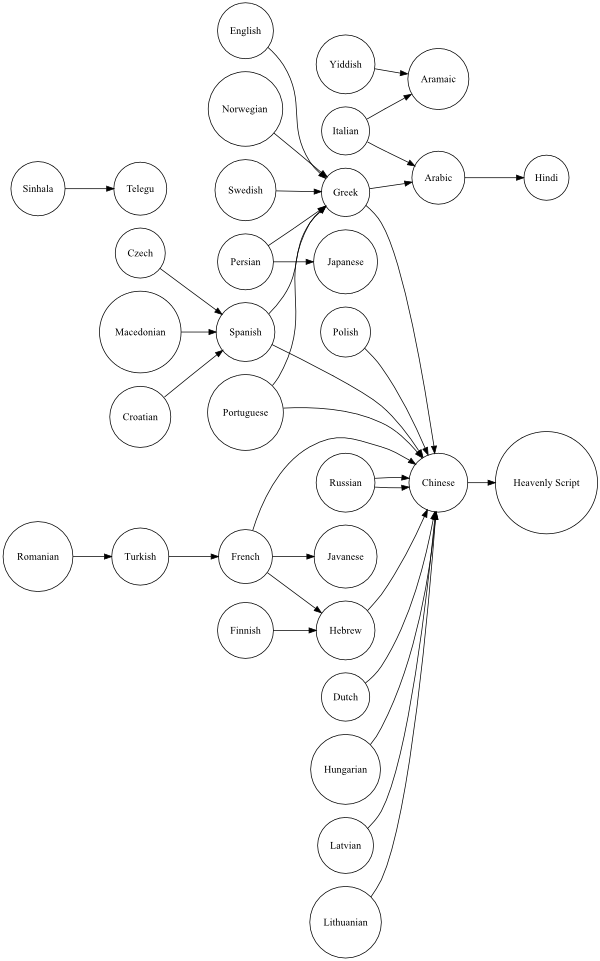
To English speakers, Greek is the traditional exemplar of incomprehensibility.

See also http://languagelog.ldc.upenn.edu/myl/graph2.png

Re:Do You Speak VCili? (like Swahili, but more difficult to ... by daeken on Friday February 03, 2012 @11:36PM (#3550251)
My girlfriend has been teaching me Greek for a little while, and I agree wholeheartedly. There are still sounds I simply can't make; it definitely serves as a great source of entertainment for her, though.
Re:Do You Speak VCili? (like Swahili, but more difficult to ... by 100k on Saturday February 04, 2012 @02:10PM (#3551759)
It used to be worse. Ancient Greek had tonal accents, instead of just stresses as now.

http://en.wiktionary.org/wiki/Wiktionary:About_Ancient_Greek...

I learned this reading "Empires of the Word", a book recommended in the HN 2011 best books thread.

http://www.amazon.com/Empires-Word-Language-History-World/dp...

Re:Do You Speak VCili? (like Swahili, but more difficult to ... by celoyd on Saturday February 04, 2012 @03:33PM (#3552034)
I took a semester or two of Ancient Greek, and it wasn’t a walk in the park, but it also wasn’t a headache.

It’s the Indo-Europeanness: it’s full of cognate vocabulary and even idioms,[0] and while it has some new grammar, its basic structure is reasonably familiar. It doesn’t do anything freaky (to an Anglophone) like, say, http://en.wikipedia.org/wiki/Ergative–absolutive_language or what Wikipedia says about the Salishan languages:

They are characterised by agglutinativity and astonishing consonant clusters — for instance the Nuxálk word xłp̓x̣ʷłtłpłłskʷc̓ (IPA: [xɬpʼχʷɬtʰɬpʰɬːskʷʰt͡sʼ]) meaning ‘he had had [in his possession] a bunchberry plant’ has thirteen obstruent consonants in a row with no vowels.

A-Greek is nothing like this. And its tones are different from the ones in, e.g., Mandarin in that they’re almost never the only way of distinguishing words. It’s rare that ábà means one thing and àbá means an unrelated thing. Plus, a word’s tones are reasonably predictable from the way it’s spelled (about like stress in English or Spanish), so you just learn the tones as part of the word and then you don’t really have to think about them much. It’s trickier than not having tones, but not by much.

0. For a trivial example, if you translate I have in mind to overperform in a naïve word-by-word way to A-Greek, it would end up perfectly idiomatic: both to have in mind and the pervasive figurative use of over and under (hyper and hypo) are the same.

Re:Do You Speak VCili? (like Swahili, but more difficult to ... by stan_rogers on Saturday February 04, 2012 @04:02AM (#3550661)
"Graecum est; non legitur." It's not just English; until Chrysoloras et al and the cheap Greek printing of Aldus Manutius, that was pretty much true across Europe. It has probably remained the idiom in English because of Shakespeare (he had a habit of supplying stock phrases to the language at an alarming rate, only matched by the King James Bible and the Book of Common Prayer).
Re:Do You Speak VCili? (like Swahili, but more difficult to ... by yread on Saturday February 04, 2012 @06:42AM (#3550831)
What is the graph showing?
Re:Do You Speak VCili? (like Swahili, but more difficult to ... by Natsu on Saturday February 04, 2012 @03:19AM (#3550615)
I grant that it was just an example, but I can only think of one unfamiliar sound in all of French. I only remember having to practice that eu vowel in feu (fire).

I will agree that Mandarin is much harder, though. Hanzi are difficult enough, but learning to pronounce the tones properly makes it that much harder.

Re:Do You Speak VCili? (like Swahili, but more difficult to ... by m_for_monkey on Saturday February 04, 2012 @03:49AM (#3550640)
There's the guttural R, the nasal vowels, and maybe others, too.
Re:Do You Speak VCili? (like Swahili, but more difficult to ... by Natsu on Saturday February 04, 2012 @04:15PM (#3552174)
Maybe I'm weird, but I don't remember ever having had any trouble pronouncing those. Now that you mention it, though, I'm less sure about them existing in English.
Re:Do You Speak VCili? (like Swahili, but more difficult to ... by cgag on Friday February 03, 2012 @10:32PM (#3550122)
Where do you live that swahili is a popular second language for an english speaker?
Re:Do You Speak VCili? (like Swahili, but more difficult to ... by daeken on Friday February 03, 2012 @11:39PM (#3550258)
I don't believe that was what he was saying. It was that it's a common second language in general, which tends to round out the hard parts.