I had the same concern you have about finding "just the right lens", but was pleasantly surprised to find the $180 camera/lens combo linked in the post worked just fine. In fact basically every piece of optics I had in my lab could pass light at 1050nm, and I have a bit of everything from cheap stuff bought over the counter in Shenzhen to brand-name microscopes. I tried lenses from 6 different vendors and they all worked about the same in terms of passing light (but of course the fidelity of the image scales with cost, better lens tolerances are just more expensive).
My guess is that uncoated glass should be transparent in the 1050nm band, but some lenses have AR coatings that limit the bandwidth. A lot of my lenses do have AR coating (based on the greenish tint I see in the reflections), but I guess the bandwidth of the coating used on most visible-light lenses is just wide enough for 1050nm to slide through.
And then there's of course the famed "black silicon". [2]
My money would be on InGaAs sensors [3] being the best in this range. I would also suspect these are subject to funny import/export restrictions, nevermind the price.
[1] https://www.pco.de/scientific-cameras/pcopanda-42-bi/ ~10% QE at 1050 nm [2] https://1.bp.blogspot.com/-wrj9PudX2YM/WkSB-PL-9vI/AAAAAAAAQ... [3] https://www.princetoninstruments.com/wp-content/uploads/2020...
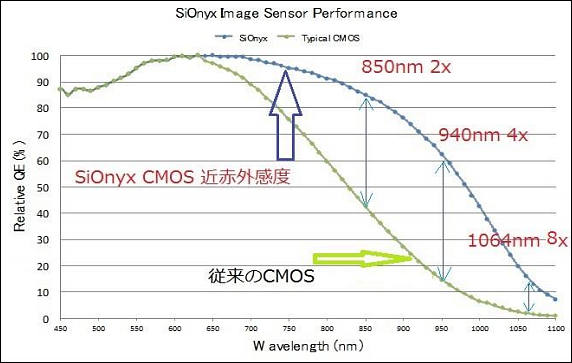

However, the sd Quattro is sensitive enough from 1000 nm - 1100 nm that I can take handheld shots outdoors on a sunny day while stopped down to f/5.6, and the smaller aperture gives more consistent sharpness across the frame. It also only takes a few seconds exposure on tripod to capture astrophotography of red giant stars that emit significant infrared like Betelgeuse.
Incidentally, the original reason I wanted an infrared-sensitive camera and a 1000 nm long pass filter was to photograph stars in the sky during the middle of the day, taking advantage of the quartic dependence on wavelength in Rayleigh scattering to remove the overpowering brightness of the sky.
[1] https://alexbock.github.io/blog/nir-examples/near-infrared-8... (note: this image used an 850 nm long pass filter rather than 1000 nm but was taken with the same doublet described before)
I wish there was a bit more detail on possible lenses, its hard to find optics that work well past 1000nm.
It’s pretty interesting how much the fall off is between 920 to 1070nm - on my camera, 920nm can be exposed perfectly in daylight at around 1/10th of a second, 1070nm needs 4 minutes worth of time to match the same exposure!