https://raw.githubusercontent.com/xtdb/xtdb/master/docs/conc...
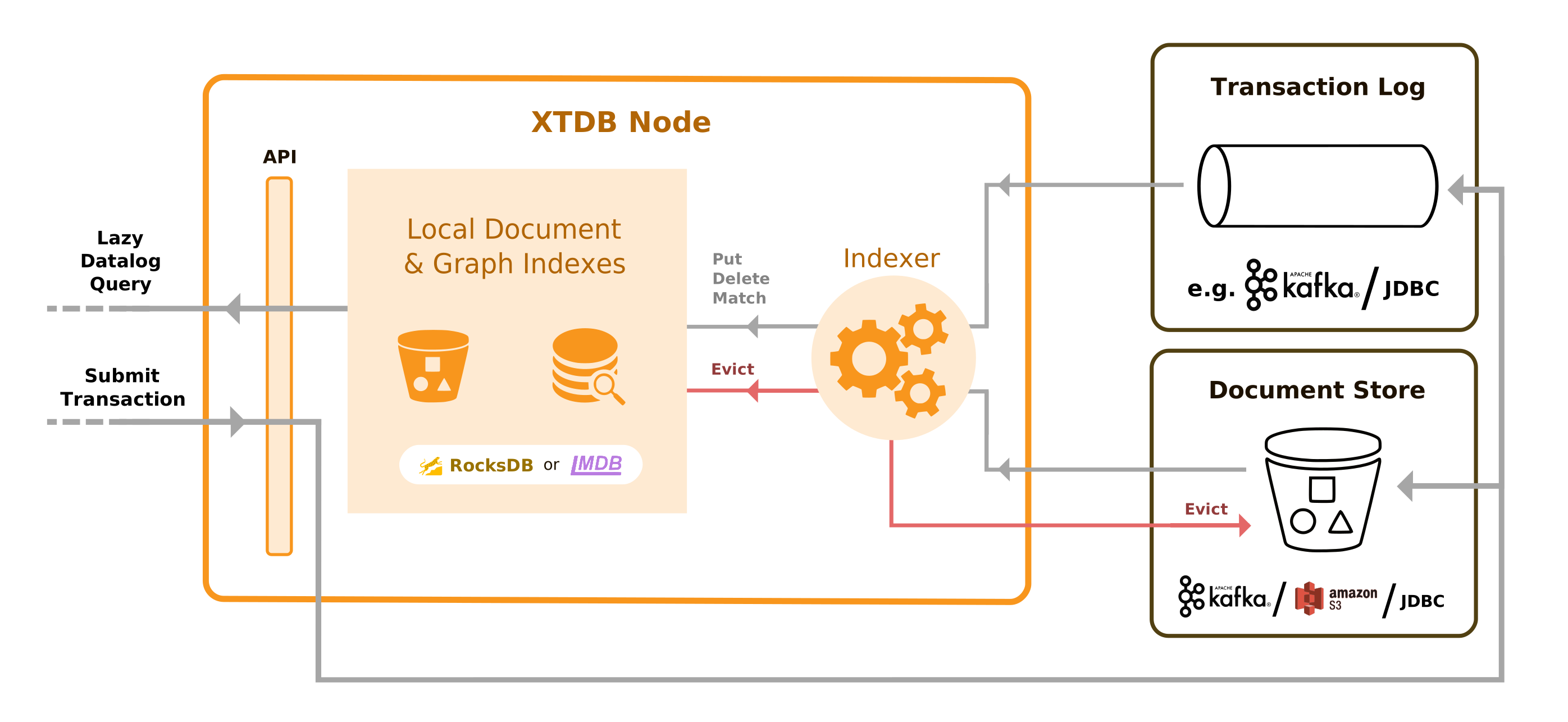
Btw, is that 'RocksDB or ?' for the local store current or other storage engines can get plugged in?
p.s. this is datomic's architecture for comparison.

Treats graphs as binary relations ("graph normal form"), has a Datalog-ish query language.
I recommend this talk: https://www.youtube.com/watch?v=WRHy7M30mM4
In the case of RelationalAI, as far as I understand there is no way to even try it out without becoming a customer? I just wish there were, because I really do like the approach!
I have this fear because there's a history of that with novel query languages and DB platforms tossing in network/hierarchical/"document"/object-oriented features, and creating a dog's breakfast which loses the compositional/expressive power of the relational algebra. Think MongoDB or Redis. Conceptually a big mess.
RDF itself has a history of this as well. Appeals to novelty.
Or even Google's F1, which smashes hierarchical tree-structured protobufs into a SQL DB, and so has really weird behaviour on joins and projections.
Well, whatever, you know my opinions on this stuff, I think :-)
At this point I'd settle (or ask for) for a network available tuplestore which just receives relational-algebraic operators from a client, and optimizes/executes, and returns pure tuples, and the client-side could formulate whatever query language (or API) it wanted on top of that. I started playing with building something like that between the two jobs, but never got far.
[1] https://thesearch.space/episodes/5-kevin-feeney-on-terminusd...
RDFS and SHACL (and OWL) are optional in a triple store, which expects the subject and predicate to be string URIs, and there is an object datatype and optional language:
  (?s ?p ?o <datatype> [lang])

  (?subject:URI, ?predicate:URI, ?object:datatype, object_datatype, [object_language])
`a` means `rdf:type`; which does not require RDFS:
  ("#xyz", a,        "https://schema.org/Thing")
  ("#xyz", rdf:type, "https://schema.org/Thing")
  (?g ?s ?p ?o)

  ("https://example.org/ns/graphs/0", "#xyz", a, "https://schema.org/Thing")

  ("https://example.org/ns/graphs/1", "#xyz", a, "https://schema.org/ScholarlyArticle")
Looks like they ended up needing to update basically most of the current specs: https://www.w3.org/groups/wg/rdf-star/tools
"RDF-star and SPARQL-star" (Draft Community Group Report; 08 December 2022) https://w3c.github.io/rdf-star/cg-spec/editors_draft.html
GH topics: rdf-star, rdfstar: https://github.com/topics/rdf-star, https://github.com/topics/rdfstar
pyDatalog does datalog with SQLAlchemy and e.g. just the SQLite database: https://github.com/pcarbonn/pyDatalog ; and it is apparently superseded by IDP-Z3: https://gitlab.com/krr/IDP-Z3/
From https://twitter.com/westurner/status/1000516851984723968 :
> A feature comparison of SQL w/ EAV, SPARQL/SPARUL, [SPARQL12 SPARQL-star, [T-SPARQL, SPARQLMT,]], Cypher, Gremlin, GraphQL, and Datalog would be a useful resource for evaluating graph query languages.
> I'd probably use unstructured text search to identify the relevant resources first.
[1] https://stackoverflow.com/questions/29192927/a-graph-db-vs-a... (2015)