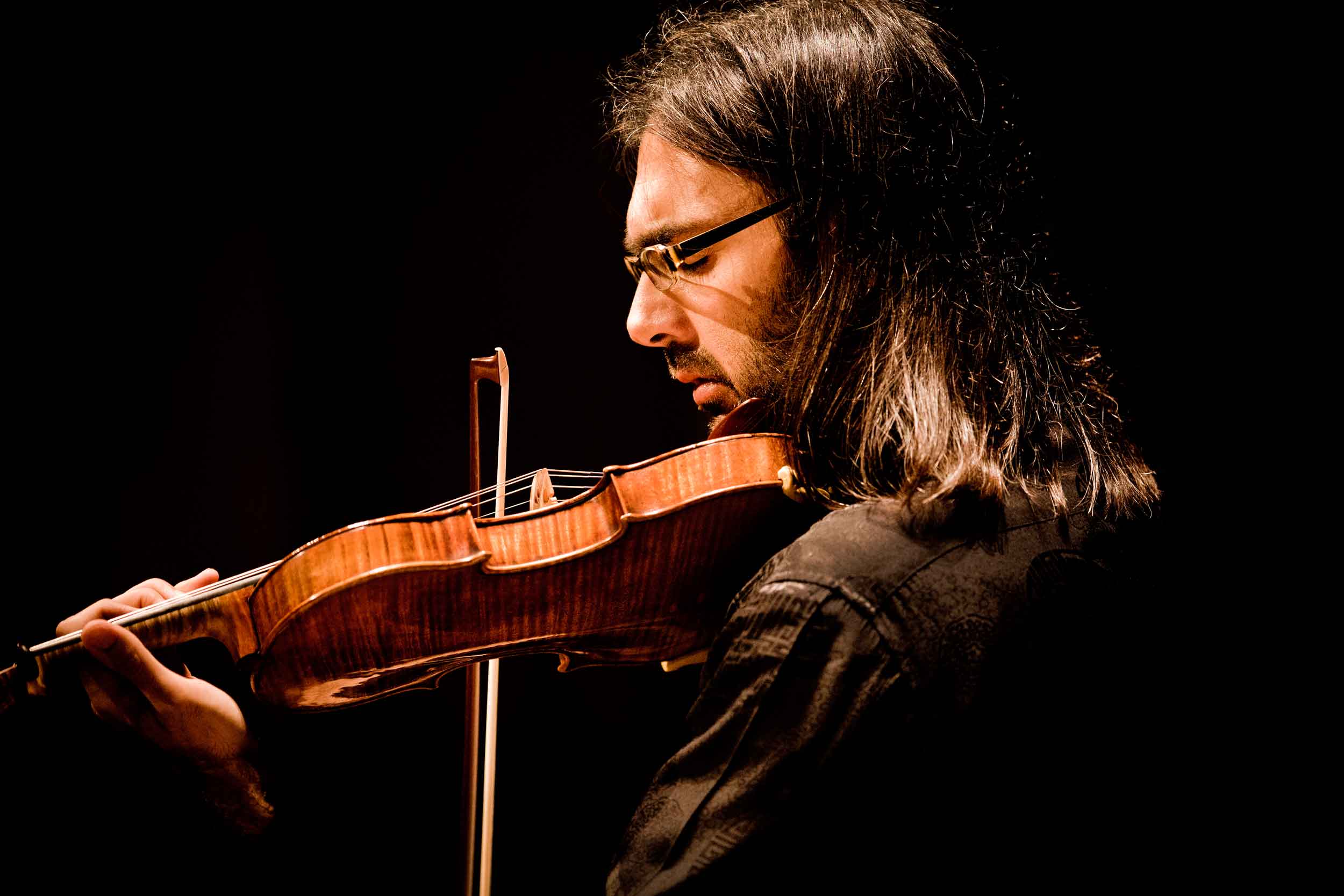
The first one, generated by AI has you looking at the camera. The other one has you looking at an instrument. They don’t look much like each other to me, in terms of pose or anything.
The first images suggested by Stable Attribution looks a lot more like the AI image to me, in terms of pose and everything.
As another comment[1] points out:
> This appears to be just looking for the nearest neighbors of the image in embedding space and calling those the source data.
Stylistically similar images are not the same as source images.
Sounds very much like a human would do it.
If I 'know' how to recognize saurik and I know how anime is supposed to look like, I can check my digital photo library for a picture of saurik and than use that picture as a template to draw an anime version of saurik. If someone later asked me what pictures I used the photo is the only one I'd present. Not the thousands of anime pictures I have seen teaching me what anime looks like, nor the picture my eyes took meeting saurik.
> these people aren't 'luddites'
This is just total bullshit. I know plenty of artists who are embracing this technology to make all sorts of things that tools like SD were not designed to do, like psychedelic music videos, etc.
What the author means is that a few loud blue check marks on Twitter who claim to be artists have been tweeting, get ready for it, inflammatory claims.
It’s called Sony v Universal, and the legal doctrine for fair use that resulted is a test for “commercially significant non-infringing use”, of which a tool used for inpainting to remove power lines, latent space psychedelic visuals, and photo booth-painterly-style all are.
Imagine if Stable Diffusion was made illegal. Someone accuses me of using this illegal tool for one of these non-infringing uses, that is an image that doesn’t look like anyone else’s image as far as the court is concerned for copyright. I put the image on my website. If the image itself is not at all infringing, then what is the evidence that Stable Diffusion was used? Should the police be issued a warrant to search my private property for proof that I used Stable Diffusion without a shred of evidence or based on a tool that will always have both false positives and negatives?
My conclusion is there is an argument to be made for infringement in some cases, but it's based on degrees instead of absolutes. If infringement is defined as "copyrighted works were used in this dataset", then at a certain point (low enough learning rate) it becomes impossible to tell if infringing data was used. You'd be working with weight amounts that are so miniscule they could be rounding errors, yet by that definition would still be infringing.
And since any arbitrary data can be used with some set of keywords, the standard for what constitutes "infringing" changes with each model. As in, it would probably be hard to have a benchmark test that can definitively state "this model violates copyright." Any number of keywords can be trained on to obfuscate the prompt needed to reproduce the data, assuming there was even a high enough LR for the data to be reproduced similarly enough.
I'm unsure if there can ever be one standard for when a set of a bunch of floating point numbers can pass the threshold for constituting infringement. This is applying an absolute standard to a fuzzy algorithm. It's like compressing a JPEG, at some level of compression on the scale a picture of Mickey Mouse becomes unintelligible. But with JPEGs it isn't really useful to have an unintelligible picture of Mickey Mouse. However, it can be extremely useful to have a LoRA with the weights underfit just enough to where the diffusion gives novel outputs.
However, the key thing here is: do you really think "avatar for saurik" is going to come up with something out of the blue--out of all the numerous random images of people that exist and who have avatar/profile photos... people wearing lots of different clothing and in different orientations--where we can even be talking about such silly things as props and gaze direction? I will assert that would be ridiculous. Clearly seeing at least one photo of me (and AFAIK it was only trained on thousands of copies of that single photo) was absolutely crucial to the construction of this image, and yet this website isn't finding any such to show as it isn't really doing what it is claiming to do (and it isn't clear to me how it could without the original prompt).
From there, SD is upscaling from memory a lot and filling in a ton of details (as almost all of the copies of my photo it was trained on are very small, embedded in screenshots of tweets), but the cornerstone of that construction is clearly my Twitter profile photo... and then, once you do that, you can go back and attempt to rationalize "these were the photos that were most similar to the photo that we generated, and so I guess those were what the algorithm used to generate this image", but--at least in this case--it is pretty obvious that that isn't how this worked as there's no way you start with "avatar of saurik" and arbitrarily pluck an image that is this similar to the one photo of saurik you have.
I think there are two separate ideas that are being conflated here. The first idea is that there is a mapping between text input and a joint text/image embedding space. For that mapping, yes, your profile photo (paired with some caption text that says saurik) would have to be the most important training input because, as you say, how else does SD know what “saurik” looks like?
But the second idea is the mapping from the shared latent space to an image output. It is NOT necessarily true that your profile photo is the most significant training example for the generated image. That’s because the text “saurik” can map to a neighborhood in the latent space that has all the photos this tool retrieved — photos which are indeed very similar to the generated image.
As an example, let’s say that I resemble Ben Affleck. And you type in “throwaway1851” and you get back an image that does look like me, but also looks an awful lot like Ben Affleck. In this case I really wouldn’t be surprised if my one profile photo didn’t contribute much to the generated image as compared to a dozen different photos of Ben Affleck. Perhaps the original mapping just pointed to Affleck anyway, because I wasn’t significant enough to end up taking space in the model’s parameters.
To take your example: let's say its knowledge that "throwaway1851" looks like Ben Affleck comes from your one profile picture--the only time the multi-modal embedding model was ever able to associate that word and Ben Affleck's photo into a similar location in the vector space--then if it wasn't allowed to see that photo during its training there is no way that would have happened. It simply doesn't matter if it seems to mostly rely on its knowledge of Ben Affleck to conjure up a photo of you: it has so many photos of Ben Affleck that none of them really matter anymore, but that single photo of you that made it even realize you looked like Ben Affleck in the first place is absolutely critical and probably deserves most of the attribution.
For that, if you wrote down the latent embedding for “saurik”, then retrained CLIP and Stable Diffusion from scratch without any of saurik’s profile pics in the training data, it is quite possible that you could generate an image from the embedding you wrote down and it would look the same.
Pure speculation on my part - perhaps your profile pic is the real source material and this website is junk. I just think it’s an interesting and worthy question the site is trying to answer, even if it’s not possible to answer it with much certainty.
https://rom1504.github.io/clip-retrieval/
https://github.com/rom1504/clip-retrieval
Ironically, the stableattribution.com authors didn't give any attribution or credit to clip-retrieval and its developer
The above copyright notice and this permission notice shall be included in all copies or substantial portions of the Software.
Whether or not this tool works (assuming it does not, or at least I can’t see how it could), expect it to make the rounds on any tech publications that have previously written “stable diffusion bad” -type stories.
This just needs to be done at the source. Ie whatever AI service is generating the image should generate attribution as part of the result
I was surprised that they even had a prototype. I thought this was just a really good CTA
https://www.stableattribution.com/?image=e89f1e94-067b-4ab8-...
https://pbs.twimg.com/profile_images/1434747464/square_400x4...
Given that I only said "saurik" and SD came up with something that not only looks more than quite a bit like me but is more than quite a bit similar to the pose of my profile photo, I'd say clearly that photo would be one of the most important photographs in the database to show up when asking "which human-made source images were used by AI to generate this image"...
...and yet, whatever algorithm is being used here--which I'm guessing is merely "(full) images similar to this (full) image" as opposed to "images that were used to make this image"--isn't finding it; which, to me, means this website is adding more noise than signal to the discussion (in that I think people might learn the wrong lessons or draw the wrong conclusions).