This then would put the responsibility on the creator, not the software. If I use a prompt "Mickey Mouse fighting Thanos" then the images produced are clearly derivative. But is this fair use? There's plenty of fan art out there like that. In fact, I typed that string into google and got fan artwork of Mickey as Thanos and the infinity stones are different media centers that Disney controls[0]. Making the image quite a high quality parity. I'm not a lawyer, but I don't feel like this image should be illegal. If so, doesn't that make this conversation far more complex than what you're writing here? I'd agree if I was trying to sell pictures of Mickey Mouse and claim to be Disney (and that there was no case for parody), but this does seem like a really hard line to draw and I don't think people are being honest about that.
[0] https://www.reddit.com/r/thanosdidnothingwrong/comments/9z7a...
Now, a tool that burdens an individual with a torrent of copy-written material might not be worth using, but that is separate from the data embedded in the latent space of the model itself.
I'd be careful with this terminology. These models are able to generate more diversity in data than they are able to memorize. So I just want to make sure readers do not read this as "copying and combining things to make an image" in a copy/paste manner rather than the same manner that humans do (very different mechanisms) of having a broader understanding of shapes and fuzzy concepts. But I'm also a generative modeling researcher and so I'm biased to be pedantic.
> In copyright law, a derivative work is an expressive creation that includes major copyrightable elements of an original
The key part here is "major copyrightable".
To be clear, my argument doesn't show that statistical generative approaches to art are violating copyright by using copyrighted data. It only shows that the argument "humans learn on copyrighted stuff therefore it's legal for AI to do it" isn't a sound argument.
Another argument that relies on the definition of derivative work might be able to show that you can train a model on copyrighted data without producing works that violate copyright.
"humans learn on copyrighted stuff therefore it's legal for AI to do it" - Learning can never be a violation of copyright. A work (digital or physical) can potentially violate copyright.
So there are two potential "work" here:
1. The model itself
2. Images created with the model.
I would argue that (1) can't violate copyright as it's not a derivative work
(2) may or may not violate copyright but if it does, then it does so to exactly the same degree as it would if it wasn't AI generated.
In other words "You're not allowed to plagarize copyrighted works no matter what production method you use".
We can break this into (1) and (2):
(1)
The model is a copyright violation as it contains untransformed copyrighted material. You can show this by simply asking for a picture of Mickey Mouse.
To preempt a few (obvious) arguments about what it means to be "transformed", keep in mind an encrypted zip file containing images of Mickey Mouse would not be considered transformative, even if it happens to contain images that aren't copyrighted.
(2)
> then it does so to exactly the same degree as it would if it wasn't AI generated.
This is the conclusion of an argument, but I'd need to see how you show that "it does so to exactly the same degree". Right now, it looks like you're taking that as a base assumption.
This is a strong argument and gave me pause. I think if Disney sued they could probably win.
However - examples such as this are probably quite rare. Mickey Mouse is so uniquitous that is massively overrepresented in the training and data and that has resulted in overfitting. For the vast majority of artists and almost certainly for the plaintiffs in this case, the demonstration wouldn't work. You most likely cannot produce an infringing image from a concise text prompt.
Arguably one of the outcomes of legal action might be the need for a lot of effort to remove examples similar to the Mickey Mouse example. This would be a good thing but wouldn't prevent AI image generation from broadly doing the things that the plaintiffs want to stop it doing.
> (2) but I'd need to see how you show that "it does so to exactly the same degree".
Not sure I follow? If I produce an infringing image and a court agrees it's infringing then I'm liable. It doesn't matter how the image was produced. I don't see what there is to dispute here?
For (1), I think it's handy to think of an encrypted zip file that contains a bunch of images. If you give it a valid password, it'll give you a corresponding image. If it produces an image that violates copyright, it clearly violates copyright, even if most of the images contained in it don't.
It's possible that if the model required sufficient instruction to reproduce Mickey Mouse ("create a line from (0,20) to (20,30) of thickness 2, then a line from ..."), and could not do so without that, then the argument wouldn't apply. And there's definitely a grey area once we're outside of the territory of reproducing images. But we definitely aren't anywhere close to that with these models, and looking at the "AI Safety" work, it doesn't seem possible to get these models to "behave".
> This would be a good thing but wouldn't prevent AI image generation from broadly doing the things that the plaintiffs want to stop it doing.
Yeah, I agree that the plaintiffs aren't suing solely because the model can easily regenerate their images. But I think we'll find its insanely hard to get these models to avoid producing copyrighted images. They may be forced to license the training images.
You, and only you, are liable.
If someone was distributing a password protected zip-file where if I type in "Mickey Mouse", I get a photo of Mickey Mouse, the zip file violates copyright. It doesn't matter that the underlying representation of Mickey Mouse is distorted in storage and recovered later. It doesn't matter that in order to retrieve the image, I have to go through a series of operations.
Of course, if I opened the zip file and put the image on a t-shirt, I would also be violating copyright. But the zip file itself is copyright infringing.
At this point we can just wait until the courts clarify this for you because you seem to be missing a fundamental aspect of how our legal system operates. I’d much rather go and watch football.
Without litigating if the model is "learning" in a human analogous way, instead I think the burden is on showing that the model is "substantially copying" and to an equal or greater degree than what would be needed to consider a work derivative.
The user is liable. The user is also liable for using a photocopier to create and sell copies of someone else’s work. Anyone can photocopy anything they want and plaster their own walls with that work. In all cases the manufacturer of the photocopier is not liable…
Now, if these tools consistently plagued users with being liable for copyright violations then these tools become more trouble than they are worth.
And to preempt a likely counterargument, intent is not a required factor for establishing copyright violation.
If I take a JPEG of Mickey Mouse and then turn it into a PNG, it's not a "copy", as the bits are different. But it still contains copyrighted material.
You can try to argue that the bits of PNG itself aren't an image of Mickey Mouse, but rather the algorithm that reads the PNG produces an image of Mickey Mouse. But that isn't really a relevant distinction in so far as copyright is concerned.
In addition, this statement is false:
> The important distinction is that the model does not contain a copy of a copyrighted material.
It has been shown repeatedly that the model produces copies of training data. The copies are of course not stored as JPEGs/PNGs in the model, but they are retrievable from the model, given the correct password (prompt).
These models do not contain copies. One way to describe the data is they contain a statistical breakdown of the artwork, which is substantially different from a JPEG -> PNG conversion you mention.
Here's a whole paper, complete with citations:
https://arxiv.org/pdf/2212.03860.pdf
> These models do not contain copies. One way to describe the data is they contain a statistical breakdown of the artwork, which is substantially different from a JPEG -> PNG conversion you mention.
I don't understand the distinction you're making. What legally separates a "statistical breakdown" representation from a zip file representation, JPEG representation, PNG representation?
Food for thought: if I write instructions for generating an SVG of a black square, does my program contain copyrighted material (Malevich's Black Square)? You and I could argue about that, but you will probably quote more research that disproves your own point. So let's skip that.
If you're convinced that a photo of Mickey Mouse with slightly larger ears, or slightly reddish pants isn't copyright infringement, then sure, neither is any of this stuff. It would also mean that republishing copyrighted images with lossy compression algorithm (IE, JPEGs) would also not violate copyright.
I would suggest looking at the actual laws around copyright instead of relying on what you feel copyright should be.
Isn't this already well-established? For example, this image, used in The Simpsons:
https://static.simpsonswiki.com/images/d/d4/Mickey_Mouse.png
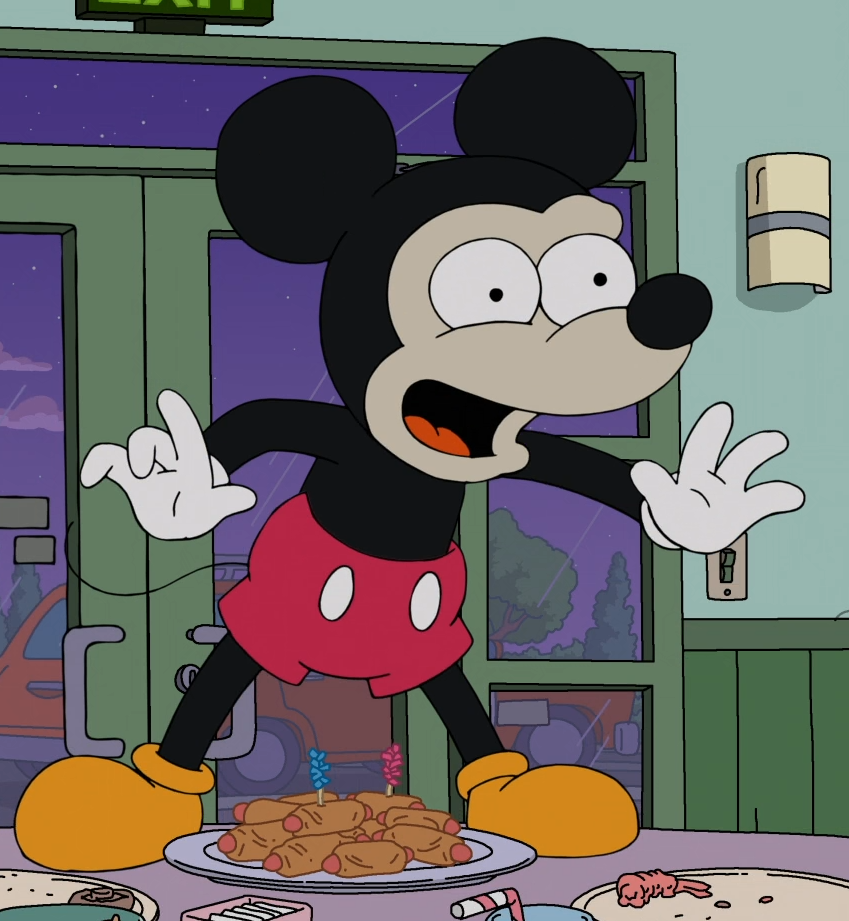
is clearly Mickey Mouse in intent, but not in a copyright infringing way.
Also, that usage of Mickey Mouse might be copyright infringing, but fall under fair use (probably parody), which is a specific defense of copyright infringement (similar to "self defense").
What I am saying is that:
1) If your model returns images which look near-identical to your training data, then any copyright infringement that applies to the training image will also apply to your image.
2) If your model can consistently return copyrighted imagery, there's little difference between explicitly sharing those images (with a password) and implicitly sharing them (via a model + prompt).
What you mean to say is that if someone just so happens to write a story that is significantly similar to another work that their intent doesn't matter... most importantly their intent is unknowable.
This doesn't mean that courts will not be interested in the intended use of specific mechanical tools such as VCRs, computers, and statistical models.
Let's tease apart this "zip file containing Mickey Mouse photos" because it seems to be from where your errors in reasoning stem.
Here is a website that gives you instructions on how to draw Mickey Mouse:
https://courses.cs.duke.edu/cps004/fall01/examples/mickey/St...
These instructions are not violation of copyright because they draw a picture of Mickey Mouse. Copyright does not protect the mere existence of an image. Copyright gives a monopoly on distributing copies of that image to the rights holder. Not the idea of the image, not the instructions that could lead to the image, not the 1s and 0s that make up the image.
As I've mentioned before, a t-shirt with the 1s and 0s that make up the zip file that contains those photos is not in violation of copyrights on those images. You'll notice that CafePress still has t-shirts with the DeCSS code for sale: https://www.cafepress.com/+,954530397
Imagine a mathematical formula that when plotted in polar coordinates draws Mickey Mouse. The mathematical formula is a fact and it cannot be copyrighted. There's another step required for copyright infringement: Someone renders the image and distributes copies of the rendered image.
https://en.wikipedia.org/wiki/Sony_Corp._of_America_v._Unive....
Take a note of the majority opinion in the Supreme Court ruling:
> The question is thus whether the Betamax is capable of commercially significant noninfringing uses ... one potential use of the Betamax plainly satisfies this standard, however it is understood: private, noncommercial time-shifting in the home.[7] [...] [W]hen one considers the nature of a televised copyrighted audiovisual work... and that time-shifting merely enables a viewer to see such a work which he had been invited to witness in its entirety free of charge, the fact... that the entire work is reproduced... does not have its ordinary effect of militating against a finding of fair use.
Stable Diffusion is also capable of commercially significant non-infringing uses. It is to be expected that the lower courts will continue to follow the precedence set by the Supreme Court that there is a clear distinction between a mechanical device capable of making copies and the distribution of those copies.
To put in the context of Stable Diffusion, this is why legal experts keep saying there are two things to consider: The model, which is almost guaranteed to be protected by fair use, and the outputs of the model, in which the users of the model are liable for any copyright infringement.
Or derivative works.
> not the instructions that could lead to the image,
And yet torrent sites have been found to violate copyright, despite not hosting any of the copyrighted content.
> not the 1s and 0s that make up the image.
Now this is plainly false. I cannot start selling a Mickey Mouse JPEG stripped straight from Disney's site.
> You'll notice that CafePress still has t-shirts with the DeCSS code for sale: https://www.cafepress.com/+,954530397
1) This is covered by a trade secrets law, and not copyright.
2) It still being for sale doesn't mean it doesn't violate copyright; only that the copyright holder hasn't litigated to stop it. Put differently, getting away with something doesn't make it legal.
Look, I think Stable Diffusion is pretty neat. But all of this "it's just math"/"it's just data"/"it also creates non-copyrighted images" stuff doesn't cut it as far as the law is concerned. If your point is that being in possession of the model isn't violating copyright, sure.
I'm talking about distributing or otherwise providing a service that uses the model to generate images. If they figure out how to get it to stop generating training data, they'll be fine. But with existing approaches, that'll be nigh impossible.
> Now this is plainly false. I cannot start selling a Mickey Mouse JPEG stripped straight from Disney's site.
You can absolutely go to the Disney website right now, download any JPEG, convert that image to a series of 1s and 0s, and then print that series of 1s and 0s on a t-shirt that you sell on your website.
Once those 1s and 0s are in a new non-digital medium they are no longer a copy of the image. Historically, the digital copy is a special case because practically there is no difference between the "expression" of a byte sequence in a digital medium and the "idea" of a byte sequence in a digital medium.
A t-shirt is not a digital medium so the rights holders don’t get to extend their monopolization of speech to a screen print of bunch of 1s and 0s.
Can you point me to a ruling where this form of expression is successfully defended via fair use?
Seems unlikely that a judge would agree that a simple transformation between "digital" vs "non-digital" medium avoids copyright infringement (ex: if I produce a digital image, I definitely maintain copyright over digital and non-digital forms of that image; you can't just start printing and selling posters of my image).
You could try to argue that the change of medium is transformative, but that's not a generic argument for "digital" vs. "non-digital"; that's particular to the circumstances of the case.
Finding the relevant case law is going to take me a little bit of time and it will probably require a bit of exposition so please be patient!
What are you missing about the fact that a t-shirt with Mickey Mouse on it and a t-shirt with a pattern of 1s and 0s are completely different. Is anyone buying and wearing the 1s and 0s shirt instead of buying and wearing a Mickey shirt?
You can’t say the same thing about digital copies! Is anyone buying the 1s and 0s of a JPEG in a digital medium and expecting to just have a bunch of 1s and 0s?
BTW, if anyone wants access to those 1s and 0s they only need to go to the Disney website to download the JPEG… they don’t need to buy my 1s and 0s shirt.
You’re just not thinking about this in legal terms: who has wronged who and how did they wrong them. These lawsuits are not criminal, not public wrongs, but rather private wrongs. People must show that there are concrete damages against their specific property!
What you mean is that you would prefer if Stable Diffusion was not considered fair-use by our legal system.
However, based on my more than cursory understanding of copyright law in the US, it seems more likely that the courts will find these tools fair-use than otherwise.
I think you misunderstand me. Despite my feelings about Stable Diffusion and laws around copyright, I believe the law will find in favour of the artists, assuming they have the funds/will to see it through. The law unfortunately doesn't really care how I feel about it.
Granted, they're up against some fairly large corporations that have both time and money to stall for a while, so I don't know how far their lawsuit will go.
How does that change anything at all? Take any of the plaintiffs in the Stable Diffusion lawsuit. Let’s say that their work was left out of the training data or if it was allowed to remain that the tool never reproduced training data… is Stable Diffusion any more or any less useful? Is literally anyone using Stable Diffusion with the intent to reproduce one of the plaintiff's copyright protected works?
This doesn't really have much to do with copyright.
> Is literally anyone using Stable Diffusion with the intent to reproduce one of the plaintiff's copyright protected works?
Intent isn't really a factor in terms of damages for copyright infringement. But I assume we'll figure out the extend of the damages if/when damages are awarded, since that's when they measure it out. Granted, I expect the liable parties to settle far before it gets to that; the payout seems cheap (~100k - 1m) relative to the risk (penalties for copyright infringement are per unit, and it's easy to hit millions of units on the internet).
The intentions of Sony when they manufactured the Betamax VCR were absolutely taken into consideration in the judgment.
Like, literally no one who made or uses SD knows or cares about the plaintiffs, is interested in their drawing style, and even remotely interested in any of their individual protected works. If I were the defendants I would train a model without any of the plaintiffs’ work and then show the court that the results for an astronaut riding a horse are no worse without their works.
And no, some lawyer is not going to scream out “objection, intent has nothing to do with copyright”, because, again, all that is meant by the intent is this: if Stable Diffusion output an image but your intent was not to copy another image… well too bad, you’re still infringing… this all happens where the liability for disseminating the copy and foregoing any fair use is on the person using the tool. Is using the tool worth the risk? Maybe not!
The intentions of the toolmakers are very important to the courts. A tool like a torrent website that does literally nothing to police their content and even actively promotes piracy is going to be treated differently than publicdomaintorrents.info.
> This doesn't really have much to do with copyright.
It is not specific to copyright but any private wrong heard by the courts needs a clearly defined plaintiff, defendant and property in question.
How can the plaintiffs accuse anyone of infringing on their copyrights when no one has used the tool to produce the protected works? Which of their specific works was infringed upon? Is that specific work a requirement for tool to function?
The plaintiffs seem to be “everyone” and their property “every single digital image”, which is legally incoherent. How exactly would someone reasonably ask permission for every single digital image? Is everyone entitled to part of the settlement or just the plaintiff’s and their lawyers?
BitTorrent itself is legal. The torrent sites that were shut down were found to have basically no non-infringing utility. There were and still are other torrent sites that have non-infringing utility which are of course allowed to exist.
Yes, and so is Winzip, and the code that trains Stable Diffusion. But that doesn't have much to do with the resulting data that is used and generated by those files.
> There were and still are other torrent sites that have non-infringing utility which are of course allowed to exist.
Can you point me to a torrent site that withstood a legal challenge for copyright infringement?
If I take a picture of Mickey Mouse, add 1 to each RGB value, it would still be covered under copyright.
I think the term 'learn' is doing the heavy lifting in your argument here. Specifically, your argument seems to be:
1. We use the term 'learn' as shorthand for 'fitting a machine learning algorithm to data'.
2. We also use the term 'learn' for a human looking at copyrighted material to practice their craft.
3. Humans using copyrighted material to learn doesn't make their works derivative.
4. Therefore, machine learning algorithms that are trained on copyrighted material aren't producing derivative works.
This argument holds an implicit assumption: if we use the same term for a process, it should covered by the same rules/laws. Which I think isn't very sound.