You guys wouldn't have to do all this social rigging if you hadn't broken the web's tried-and-true link graph in the first place by making sites' feel like they had to 'hoard' pagerank and link-condom every outgoing link citation with a no-follow flag.
Unintended consequences for sure, as no-follow was well-intentioned and designed to help with blog comment spam, but unintended consequences can be a bugger. The result is still sad.
I'm sure there's no rolling back now to the 'old' google with 10 blue links, but I sure miss it.
What do you think of today's announcement?
http://googleblog.blogspot.com/2012/01/search-plus-your-worl...
Specifically, "unpersonalized results"?
I don't think search is an easy problem. And (where it is not conflicted by self promotional interests) Google does an amazing job of indexing, filtering & scoring.
It is nearly unbelievable how good Google is in many areas. But that is also the problem...Google set the bar for itself rather high through its own performance.
A gold medal sprinter doesn't get a pat on the back for running a 23 second 100-meter dash.
When most companies put out a product they have to make it better than existing products to win marketshare. They can't put out something sort of average and then just arbitrarily promote it in the results through bundling (the way Google has with things like Checkout, places, product search, flight search, and +)
In the past Google did a much better job at search when it wasn't actively subverting itself.
If I searched on Google 3 or 5 years ago I didn't see Avis-rent-a-car ranking near the top of the search results for "Las Vegas hotels" ... it was only after Google decided to displace & monetize the organic results that Avis started ranking on hotel searches.
http://www.seobook.com/images/hotel-price-ads.jpg
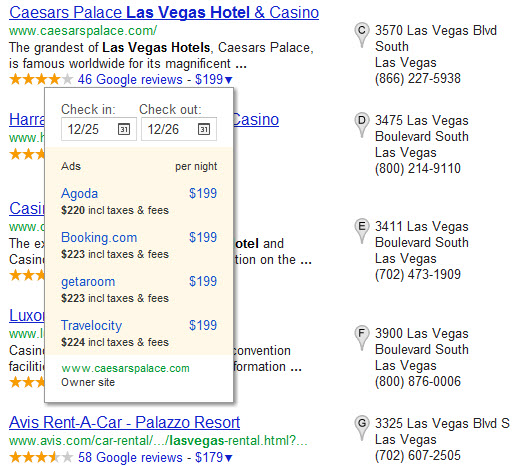
And who's fault is that?
Google's.
If the monetary incentive wasn't there, I am sure Google wouldn't be polluting their own search results, especially as they have put thousands of man-years in trying to do the opposite.
~~~
I also think the suggestion that a person should switch their default search engine is a bit inauthentic for 2 reasons:
1.) Google is spending BILLIONS of Dollars per year buying search & browser distribution + buying default search rights on 3rd party browsers
2.) even if I change my default search engine that personal choice wouldn't impact how other users search & for those other users the copy of copyright content hosted on Google.com will often still outrank the original source.
And then it would be easy to blame companies for having products that weren't perfect.
You could discount all of their efforts to try to make something new, original, and helpful - if it weren't absolutely perfect in its first iteration.
Let's all switch to the search engine that is perfect, and does everything you describe. Since it's so easy to do, clearly there must be a search engine like that. Which one is it?
...or maybe, it's actually a really hard problem.