News for hackers. Stuff that matters.
Re:When did the First Peoples arrive in America? by jcranmer on Saturday December 31, 2022 @02:06PM (#34199597)
The current uncontroversial bound is roughly 15kya--as the article notes, the White Sands fossil footprints are still controversial. The Clovis First hypothesis has been considered thoroughly discredited in the academic community for about 20 years now.

The Cerutti Mastodon site is not compelling to me, because a date of 130kya would put it before any other site of homo sapiens outside of Africa. Being so far out of line with other evidence means that the evidence in favor of hominids needs to be exceptionally rock solid, which it isn't.

Re:When did the First Peoples arrive in America? by masklinn on Saturday December 31, 2022 @02:38PM (#34199898)
Cerutti being real doesn't mean it's H. Sapiens tho does it? It could be an older hominin, an other descendant of H.Erectus (after all as far as we know H. Neandertalensis did not evolve in africa, and H. Erectus reached the sea of china and the pacific ocean)

Although Fuyan also shows H.Sapiens may (its datation is also disputed) also have reached out of africa much earlier than otherwise supported.

Re:When did the First Peoples arrive in America? by merpnderp on Saturday December 31, 2022 @03:04PM (#34200192)
Absolutely. Many H. subspecies were tool using.
Re:When did the First Peoples arrive in America? by AlotOfReading on Saturday December 31, 2022 @03:09PM (#34200239)
The problem of cerutti's dating is that the archaeological record of hominids in the high Arctic begins <50kya, 80k after the hypothetical dating. There's some middle paleolithic stuff in southern/central Siberia, but also few options to get to the new world without boats or beringia (which was submerged during previous interglacials).
Re:When did the First Peoples arrive in America? by moloch-hai on Saturday December 31, 2022 @09:22PM (#34202938)
That is not, in fact, a problem of Cerutti's dating. Its dating is rock solid.

The problem is clearly in preconceptions about H. migration, and beliefs about the capabilities of our ancestors long ago.

People constructed boats and settled Crete 200,000 years ago. Like it or not. Were they H. sap., in Europe already? Maybe!

Re:When did the First Peoples arrive in America? by maxbond on Saturday December 31, 2022 @02:23PM (#34199748)
For sure, thanks for keeping me honest. I'm a decidedly a nonexpert, I just watch some documentaries and such.

As a side note, I've seen people strike through stuff out on HN, and I'd like to strike through this claim to emphasize there's a correction; it's not in the undocumented features repo[1], and I've tried a few standard things like ~this~ and ~~this~~ and -this- and --this-- and have never figured it out. Can anyone tell me what the markdown is?

[1] https://github.com/minimaxir/hacker-news-undocumented

Re:When did the First Peoples arrive in America? by actionfromafar on Saturday December 31, 2022 @02:36PM (#34199882)
I think they use Unicode strike-through characters.
Re:When did the First Peoples arrive in America? by maxbond on Saturday December 31, 2022 @02:38PM (#34199897)
T̵e̵s̵t̵i̵n̵g̵

Beautiful, thank you.

Re:When did the First Peoples arrive in America? by TedDoesntTalk on Saturday December 31, 2022 @04:11PM (#34200786)
Are you able to generate those characters on mobile, or were you on a laptop?
Re:When did the First Peoples arrive in America? by maxbond on Saturday December 31, 2022 @04:24PM (#34200914)
Re:When did the First Peoples arrive in America? by kuhewa on Saturday December 31, 2022 @05:49PM (#34201558)
> I would submit we should be cautious with metaobservations like, "this is much older than other sites," because we should be trying to prove ourselves wrong, whereas these sorts of metaobservations amplify confirmation bias.

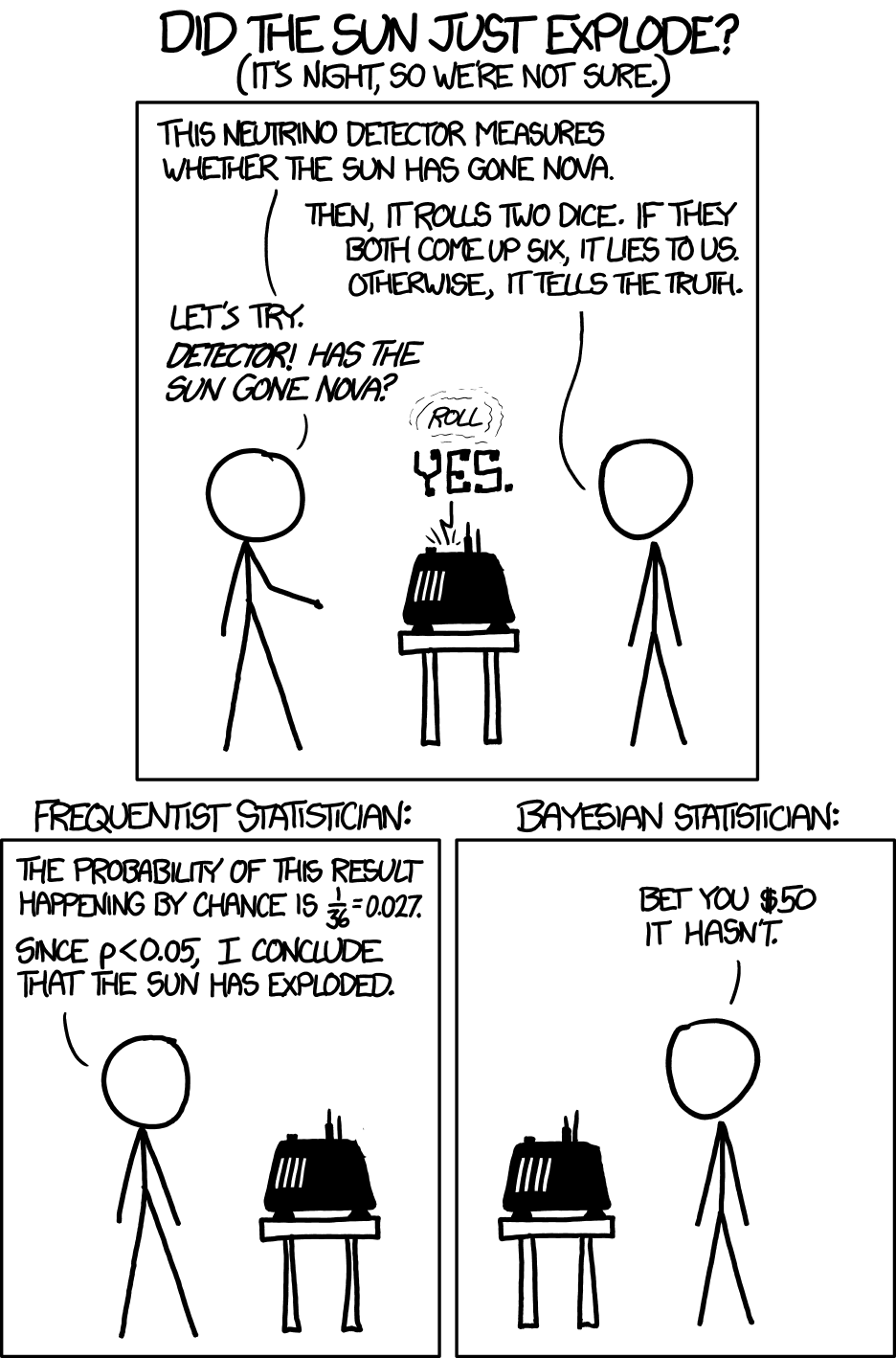
Both 'we should be trying to prove ourselves wrong' and 'Being so far out of line with other evidence means that the evidence in favor of hominids needs to be exceptionally rock solid' can both be valid at the same time. The base rate of a 'false positive' for extraordinary claims that conflict with an existing body of evidence is typically much higher so confidence in the evidence would need to quite strong for that piece of evidence to move the consensus.

I'd consider myself largely a frequentist but the relevant xkcd [1] comes to mind

I'd argue that ignoring that aspect can amplify one's susceptiblity to confirmation bias if one is predisposed to believing in a very early American hominid story for whatever reason.

[1] https://imgs.xkcd.com/comics/frequentists_vs_bayesians_2x.pn...