I claim that circuit diagram symbols aren’t particularly intuitive (e.g. the symbol for a resistor is just a longer wire? The symbol for a transistor is very non-obvious, I think. The symbol for a potentiometer is pretty difficult even if you know how one works.)
And another example of a visual representation that works well even though it is for something intangible is the kind of grammar diagram you can see in the SQLite documentation where terminal symbols are in rounded rectangles, non-terminal symbols in regular rectangles, and arrows indicate concatenation (I.e. production rules).
To be clear, I don’t want to disagree with your overall opinion that UML is bad or that the symbols are intuitive, and perhaps that is the reason that UML failed, but I think the reasoning about visual notations and the reasons they fail in general is faulty and I don’t think the answer is to find ever narrower definitions of the cases where visual notation systems don’t work.
Electric circuit notation could probably be improved. Same for math notation. But both of these are pretty deeply entrenched at this point. (I will note, however, that I am currently working on maintaining a chip design tool that describes circuits using S-expressions so the situation is not hopeless. :-)
There are graphical representations for the layout as well. But the text is primary.
It might be easier to understand as a flow diagram for a major industrial plant, functions and programs like robots and major machines.
This was, as the name implies, a dictionary that was the single source of truth for definitions of data items: meaning, representation, meaning of enumerated values, synonym and their business contexts, examples, caveats, etc.
Easily implemented as a single table in your database. Never done these days, although it would probably simplify learning a system quite a lot.
The root of all the blessings and curses of software.
> The reason graphical notation works for circuits is that circuits are actual physical things and so there is a natural correspondence between the graphical notation and the thing that notation describes.
This really just boils down to complexity and verbosity, so 'fundamentally' it has nothing to do with virtual nature of software. Hardware people lucked out (in this case) but as the semantics of components get more involved, so do the component notations:
https://www.electrical-symbols.com/electric-electronic-symbo...
(amplifier, cache? semantics of the cache? ...)
https://www.electrical-symbols.com/electric-electronic-symbo...
https://www.electrical-symbols.com/electronic-electrical-sym...
Right now it is unmanageable to do this for software. OP's write up actually mentioned the cause: they were trying to bootstrap UML with UML, defining 'semantics' using the core notation. This is the sort of 'elegant' approach that generally ends up getting buried under its own weight. So the question boils down to 'Is this complexity irreducible and open ended?'
Not sure about the reducible but am definitely bullish on it being 'closed'. [Software may lack physics, but it certainly has both form and structure.]
p.s. I think in isolation, specific aspects of software components can be [completely] described simply. For example, there are only so many ways bits can go in and out of a black box. Same for interaction patterns, there are a handful of modalities (such as caller, server, peer). Etc.
p.s.s:
Consider https://circuits-diy.com/wp-content/uploads/2020/01/push-but...
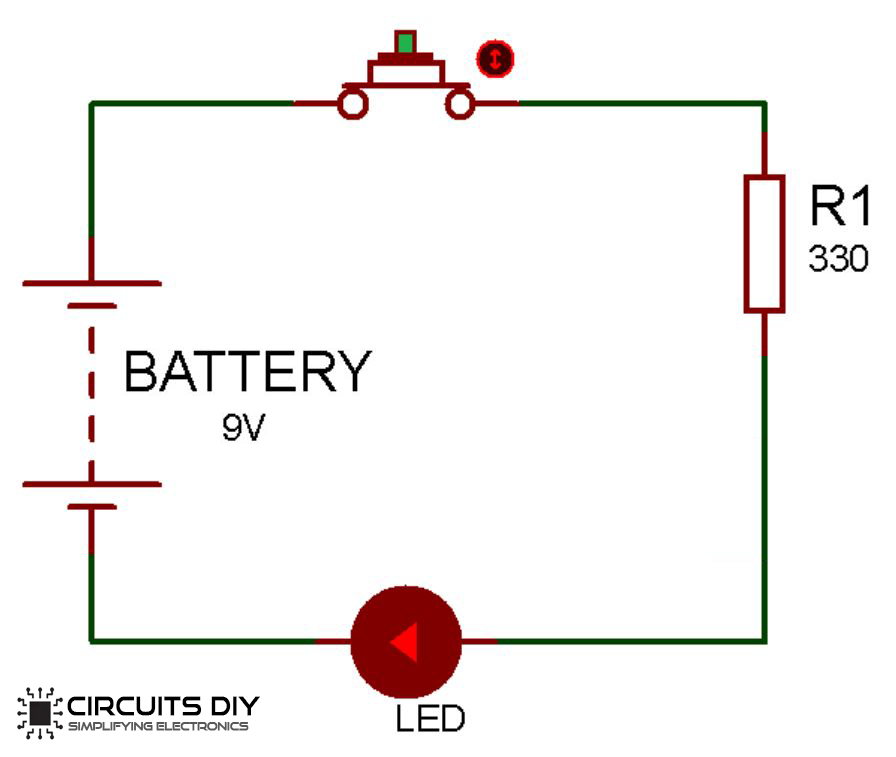
Will you still insist there is a 'natural correspondence' if I naively decide to run wires from DC to LA for a that 'circuit'?
Would it work? [spoiler: no, it won't]
No, it doesn't. Hardware really is fundamentally different from software because it is constrained by the laws of physics (and economics) in ways that software is not. So, for example, even complicated components tend to get fabricated in a way that the constituents are physically co-located with each other. That's why you can take a photo of an actual physical chip and draw boundaries around the various parts. Not only that, but those boundaries tend to be rectangles. So even complex hardware naturally lends itself to simple representations in 2-D space with intuitive mappings between the representation and the underlying (physical) reality. None of that is true for software.
Fundamentally (as significant to software), physics gets you Pauli Exclusion, relative time, distance, and of course energy (computational power). This has huge ramifications for software and why it resists becoming an 'engineering' field. But it does -not- imo preclude the possibility of effective and comprehensive notation for software definition.
p.s. since you are a lisper, you are already 1/2 way there to a universal modeling approach. I assume you would answer in affirmative to the question 'is there a viable universal textual notation for defining software?' with "Yes, it's called s-expression'. [In that case you would be] simply denying that a graphical analog can be developed. On that, consider the janky [early] attempts of everyone's ancestors in developing their alphabet/glpyh systems, currently in use.
The operative word being events. Hardware design is not about events, it's about putting the right kind of atom in the right place, which is a lot harder than moving some electrons from A to B at the right time.