Have a look:
http://www.bloomberg.com/news/2011-11-03/americans-work-too-...
There are also less super-rich people here since people are overall taxed more. The oil industry also adds to the general income level, but this doesn't explain the entire effect. I'm pretty sure the same can be observed, in Sweden and Finland.
http://rationalrevolution.net/images/EPI_Productivity_vs_Com...
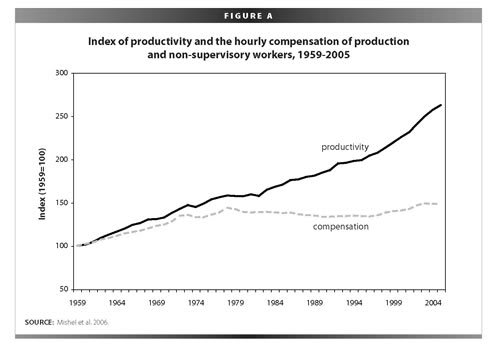
The theory is that employees should be paid more for producing more value per head. However if everyone produces more then wages can't go up without a corresponding increase in prices.
The alternative is reduced prices, new improved goods and services, and a steady wage giving the misleading sentiment of "everything is getting better, but I'm still being paid the same".
Now some massive productivity increase comes along and doubles output with the same workers. Now you're producing enough TVs for each person to have two TVs per year. Either the price of TVs will drop by 50%, or salaries will double. (Or half of the workforce will be fired....) Approximately. If everyone produces more then everyone has to be able to buy more, otherwise there's no reason to have the additional production in the first place.
My theory? Well somebody has to pay for all the useless people (Washington employes a ton of them and so do nearly all large companies in the world).
Rather than working ~20 hours a week, work ~40 hours a week, half your life.
Note particularly that statistics only work when applied to large enough populations. I will not be 70% dead at 70, I'll either be 100% dead or 0% dead.
http://jerryjousting.blogspot.com/2011/04/statistical-single...
So work 40 hours/week for until you pile up enough money to buy a lifetime annuity, and let the insurance company do the averaging over large populations.
$60k in one year is taxed at a higher rate than $30k/yr for each of two years.
RRSPs in Canada mitigate this... But you're probably still better off with $X/2 income.
People could get by with a much smaller salary (or keep the same salary but save a ton of it) by having an older car, a smaller house, less fancy food, etc. but everybody else has nicer things. I see people buying really nice cars on credit and then they don't have much time to drive it recreationally because they spend all their time working to pay for it. "Well there's your problem!"
For the other side, let's say I make $X but only need $X/2 to live. Try finding an employer who will let you work half time for $X/2. It's pretty tough, especially if you make $X at something "professional", rather than, say, digging ditches. Worse, for Americans, is the current link between employment and health care. Half-time employment generally means having to buy your own health insurance, which doesn't come cheap.
In short, it seems like it's pretty hard to work less and make less, and when you do work full time and make good money, it's very tempting to spend a larger portion of it on luxuries.