https://en.wikipedia.org/wiki/Singularity_%28operating_syste... [1]
Joe Duffy has some great blog posts on Midori (OS based on Singularity) here: http://joeduffyblog.com/2015/11/03/blogging-about-midori/
I have been following CHERI. I note that in order to create the first FPGA implementation they had to first define the HDL for a virtual memory system -- all of the research "processor" models that were available did not have working / complete VM implementations. CHERI doesn't replace VM, it is in addition to having VM.
I've found that memory bugs (including virtual memory ones) are difficult to debug, because the error is almost never in the place where the failures show up and there is no easy way to track back who ought to own the object or how long ago the error happened. CHERI can help with this by at least being able to identify the owner.
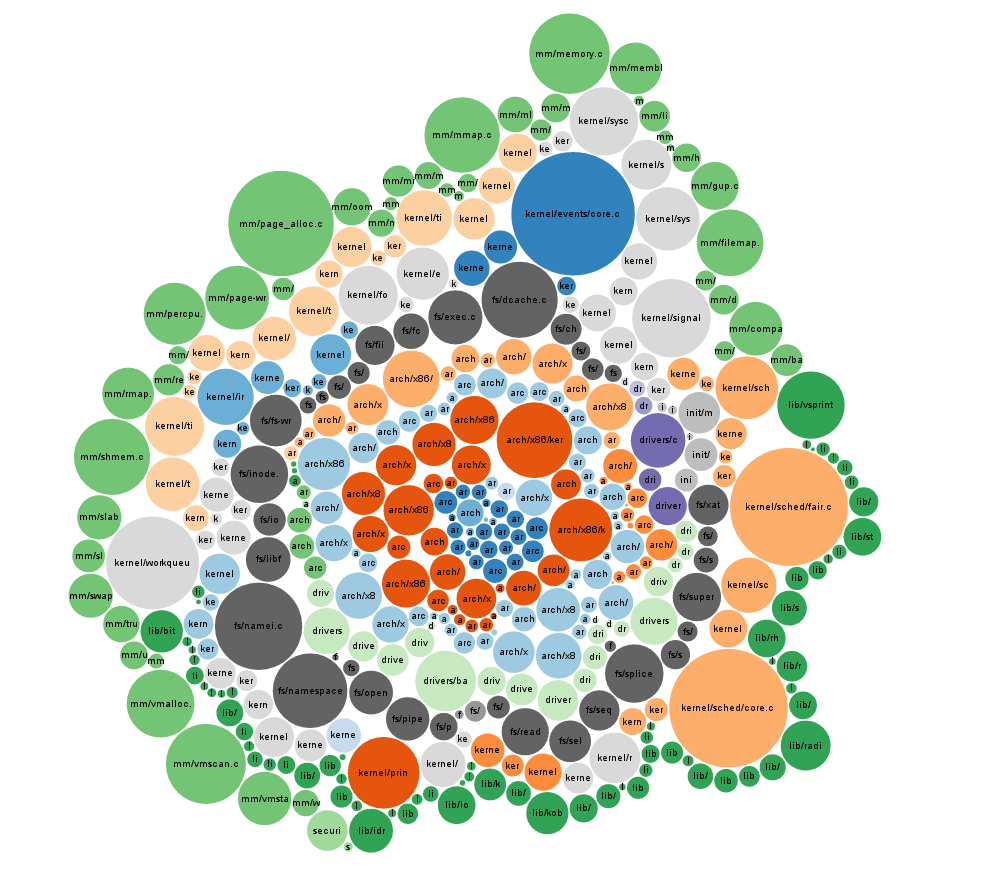
Virtual memory systems are usually pretty complex. Take a look at the list of issues for the design of L3 <https://pdos.csail.mit.edu/6.828/2007/lec/l3.html>. The largest section there is for creating address spaces. For the Linux kernel, in this diagram a lot of the MM code is colored green <https://i.stack.imgur.com/1dyzH.png>, it is a significant portion. More code means more bugs and much harder to formally verify.
I am not convinced by the argument that it is possible to take a fine grained system and trivially expand it to a coarse grained system. How is shared memory handled, mmap'ed dylibs, page level copy-on-write?
The problem with that is that a single error in the fine grained mechanism anywhere in the entire system can quite easily cause complete system compromise. To achieve any safety guarantees requires achieving perfect safety guarantees across all arbitrary code in your entire deployed system. This is astronomically harder than ensuring safety guarantees using virtual memory protection where you only need to analyze the small trusted code base establishing the linear address space and do not need to be able to analyze or even understand arbitrary code to enforce safety and separation.
For that matter, fine grained permissions are a strict superset of the prevailing virtual memory paradigm as you can trivially model the existing coarse grained protection by just making the fine grained protection more coarse. So, if you can make a safe system using fine grained permissions then you can trivially create a safe system using coarse grained virtual memory protection. And, if you can do that then you can create a unhackable operating system right now using those techniques. So where is it?
Anybody who claims to be able to solve this problem should first start by demonstrating a mathematically proven unhackable operating system as that is strictly easier than what is being proposed. Until they do that, the entire idea is a total pipedream with respect to multi-tenant systems.