The future has no place for biofuel in any substantial amount.
Firewood and derivatives have always had an important place in heating and cooking, and are likely to continue in that role for a while. Other types of biomass based hard fuels (from recycled garbage/waste, algae, etc) will most likely also play a role in electricity production and heating, but perhaps a small one (unless algae based biomass takes off).
And for liquid fuels for transportation use, algae may also end up being a competitor to hydrogen when oil runs out. I remember there were a lot of companies working in that space 10 years ago, but then there was the oil price crash in 2015, and it seems many switched away.
For instance algenol was positioning itself as a fuel company, but appear to have diversified:
https://www.algenol.com/sustainable-products/?category=ndust...
If oil prices remain at current levels, though, algae may be only a few years away from scaling up to take a significant part of the market.
Growing algae occupies >10x the area of floating solar panels producing the same usable energy. Harvesting and processing algae costs >>1 orders of magnitude more than delivering electrical power via wire.
The reasonable expectation is that transitions will be toward cheaper alternatives, with societal inertia acting to delay transition well beyond the point of obvious benefit. Thus, existing nukes will continue operating well after building solar + storage and then switching to that would be cheaper.
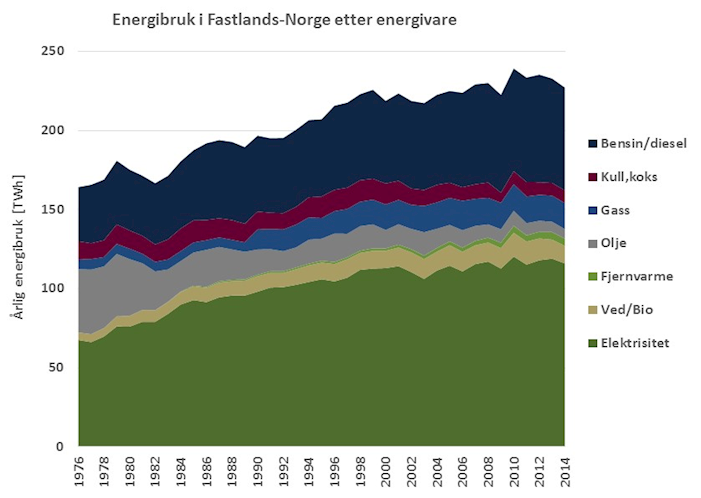
https://www.nve.no/Media/7326/energibruk_energivar_2014-kopi...
Here is similar data from Sweden:
https://www.researchgate.net/profile/Egnell-Gustaf/publicati...

Here is for the world, my understanding is that "Traditional Biomass" is mostly firewood there too:
https://ourworldindata.org/exports/global-energy-substitutio...

Does the lady of the house want to collect scraps of firewood and then cook in a hot already smokey kitchen or on a only heats the pan induction cooktop? Yeah.
Getting together $10 for a stove that needs 5x less firewood is a challenge. They need a new one every year because making one that lasts costs more.
> A problem with biofuel is scaling it up, see: https://ieeexplore.ieee.org/document/7498153. According to that article the U.S. would need to devote "an area bigger than Texas and California and Pennsylvania combined" to crops specifically for its own jet biofuel needs. That's just for flying, not for food or fuel for ground transportation or anything else.
Also that article says that from 2009-2013 a $100 million effort was made to figure out how to get sufficient synthetic fuel from algae but they eventually gave up and went back to the drawing board.