I wonder if the reason why it takes longer as you approach 0 diopters is because at that point the signal received by the brain is enough such that the brain can learn to "deconvolve" the image (blur adaption), removing any incentive for further axial shrinking.
Edit: actually going further I wonder if the stressor you mentioned is indeed actually ciliary accommodation. This is known to be very taxing (hence why people get eye strain from looking at computers for a long time), so it makes sense that the body would adapt to relieve this stressor by elongating the eyeball itself so that the screen can now sit at optical infinity.
It is also a relatively well-known result from large correlative studies that time spent outdoors decreases the chance for myopia. I read something about how it was total luminous flux of the bright outdoors that helped to prevent progression of myopia – just something to think about, especially given the recent trend of blue light blocking glasses. Who knows if those wavelengths might actually be needed in some subtle manner for optical development.
But note that because convergence and accommodation are linked, without any accommodation there might be a greater tendency for the eye to develop exophorias. I wonder if you look at the data you might see a high correlation between exophoria and myopia?
I've had tremendous frustration from optometrists insisting that I have a fixed prescription, but invariably whatever they prescribe me ends up wrong. In the end I ignored my optometrist, found a way to order online and ordered every single prescription for contacts from -5.5 to -6.5 with a couple of options for other parameters and literally just tried them all.
What I found was that my "correct" prescription really, truly varies, ... even over a period of just days. So I ended up just switching between different contacts as needed. But one effect I observed is that a great sequence was to wear slightly under-strength lenses for a week or so and then switch up a level. This seems to do what you suggest ... my eyes then slot into the correct strength with improved comfort and vision and often stabilise there.
Every now and then, everything tips over (often if I get a really bad sleep for some reason) and then I go back to the "slightly under strength" option to try and reset.
All of this I've figured out purely empiracally because I've been so unhappy with the options that multiple optometrists provided me .... so its nice to hear someone say something vaguely similar to what I experience!
Take a look at this chart:
https://static2.feelgoodcontacts.net/images/astigmatism-degr...
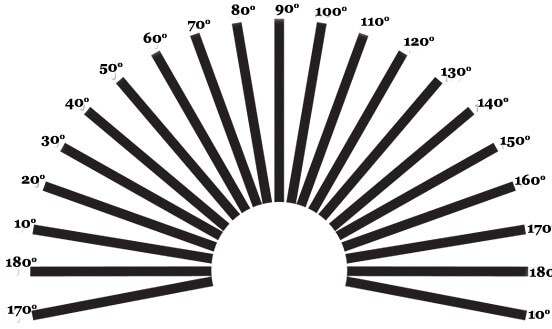
Basically all the lines should look equally sharp when your vision is corrected. In my case - if I don't wear glasses and move close enough to see it clearly - the horizontal lines have a shadow going upwards, where as the vertical lines are sharp. The shadow is strongest on the 0 degree and 180 degree lines, meaning I have an astigmatism at one of those.
This doesn't tell you what the correction should be, but it tells you if you have it.
I ordered slightly undercorrected glasses (-2/-2.5 instead of -2.25/-2.75) exactly a year ago to try the same, and it did nothing for my myopia. I use the undercorrected glasses all the time, except when driving at night and when playing sports, and nothing has changed. I still use them all the time because the cheap frame I chose turned out to be very comfortable, more than the expensive one from my regular glasses.
At first I had some hope because for the first days using the undercorrected glasses I would end up with a strong headache in the evening; when this passed I figured that maybe my eyes had begun adjusting. But every time I try the regular and undercorrected glasses side-by-side, I see noticeably better with the regular ones (I sometimes test this just by eyeballing something afar, or by reading a home-printed Snellen chart 3 meters away).
I figured some people have glass-induced myopia, and some people just have myopia.
For liability reasons (e.g. driving) optometrists tend to err on the side of stronger rather than weaker, so most prescriptions are for distance activity. If you're spending many hours with screens that are at arms length or closer, then reducing a distance-driving prescription by 0.25 may not be enough to reach the "edge of blur" for closeup vision.
The https://endmyopia.org community has more info. If you don't have the time to learn about measurements and feedback testing, look for a local optometrist who endorses vision therapy and can work iteratively with you.
This comment may be relevant: https://news.ycombinator.com/item?id=30112144
Now I couldn't find support for it anywhere so I was thinking this might be a case of a very reasonable explanation that turns out to be wrong. Is there some literature on this?
I'd like to know more. Why do you think they were set up wrong? (Not trying to get into an argument, I honestly don't know)
[1] https://www.theguardian.com/news/2018/may/10/the-invisible-p...
[2] https://www.ucsusa.org/resources/disinformation-playbook
Would you say that glasses cure hyperopia in most people?
It's said that -0.25 diopters is not noticeable by 50% of population, and especially for base prescriptions <= -2 ish the scale of distance quickly becomes negligible (e.g. a +1.25 add would give 31 inches and a +1.5 add is 26 inches, so only a 5" difference which is basically negligible. Also note that as one commenter noted, I've found my focusing ability changes throughout the day and also based on stress, sleep level etc., so that on a good day I might not need the glasses at all to see up to 32".
A final point is that if you end up going too weak you might find your posture being affected as you inch your neck forward to try to adjust. You could consciously try to prevent this, but I'm sure involuntary habits will kick in, so I think it's better to just choose a prescription precisely calculated for the focal length you want.
In principle the stressor explanation would hold for astigmatism as well, and you could try the same of reducing the cylindrical power as well. N=1 but I've found astigmatism is more easily corrected by the brain, such that you might not even need correction for a -1 cyl power whereas you'd definitely see blurriness at -1 sph.
It induces a hormetic effect on the eyeballs, causing them to grow longer over time, inducing blurriness. As you increase the strength of the prescription glasses, the hormetic effect will continue in a feedback loop, worsening your vision as your eyeball elongates.
It's the same adaptation that causes muscles to weaken, strengthen, bones to harden, calluses to form.
"Well then, if that's true, why was my vision blurry as a child when I wasn't wearing glasses?"
The initial blurriness one experiences as a child isn't caused by glasses and is likely a consequence of the ciliary muscle becoming "exhausted" from prolonged staring up close. Your eye muscles are actually most relaxed when staring at objects in the far distance. It evolved that way. We didn't "evolve" for close up work.
We know glasses induce myopia because we can reliably cause myopia in all sorts of animals by making them wear contact lenses. There's no controversy about this. Feel free to look up the studies yourself.
What's less plausible is whether the axial elongation can be reversed in humans. And it does seem (with some effort and time) it can be, although there's considerably pushback from poorly designed scientific studies suggesting otherwise but lots of Internet communities of people who have improved their vision significantly.
You can induce a reverse hormetic effect by wearing glasses that are on the "border" of blurriness and staring at objects in the distance for long periods of time. In other words, wear slightly weaker prescription glasses than what you're currently wearing; one for close-up work and one for far distance so you're always just on the "edge" of blurriness.
You can usually improve your vision at a rate of 0.75 diopters per year if you do this consistently.
At this point, I usually get a lot of disbelief and criticisms, links to randomized controlled studies suggesting the opposite. I get into arguments trying to explain how those studies were set up wrong, people call me crazy, etc. It's pretty annoying.
So I simply offer this: If you wear glasses, try ordering a slightly weaker version from Zenni Optical (or any store of your choosing). Try it for a year. See what happens.
It's cheap. And low risk.
"Don't I need a prescription?"
You do, in the sense that you need your prescription strength number, but the word "prescription" here is a misnomer. Anybody can order prescription glasses online legally. It's like ordering socks. It is not like ordering prescription drugs. Completely different legal classifications.
But if you're still skeptical, I ask you to think about this problem from first principles for a moment.
If Homo Sapiens started naturally going blind from the age of 9, our ancestors would not have survived long. Most animals that have poor vision usually compensate with some other sense. And while it may be possible humans just naturally evolved to have terrible vision, studies of other populations (like the Moken population that can see underwater and have near-perfect vision) suggest it's likely a modern problem.
There is a stressor. What is the stressor? It's multi-variate, but the most influential in modernity is wearing glasses.
I wear two pairs. One for close-up work (so it's slightly blurry when I'm programming). And another that's much stronger (and safer) for driving. So I can see all the stop signs clearly, but the mountains in the distance are just blurry. In this way, I'm always at the "edge" of blurriness.
There's a few other techniques you can do, but that one is the easiest to maintain. (Interestingly enough, people who hike outdoors a lot seem to do the best).
As you improve you'll find yourself ordering weaker and weaker prescriptions (although the closer you get to 0 diopters, the longer it seems to take).